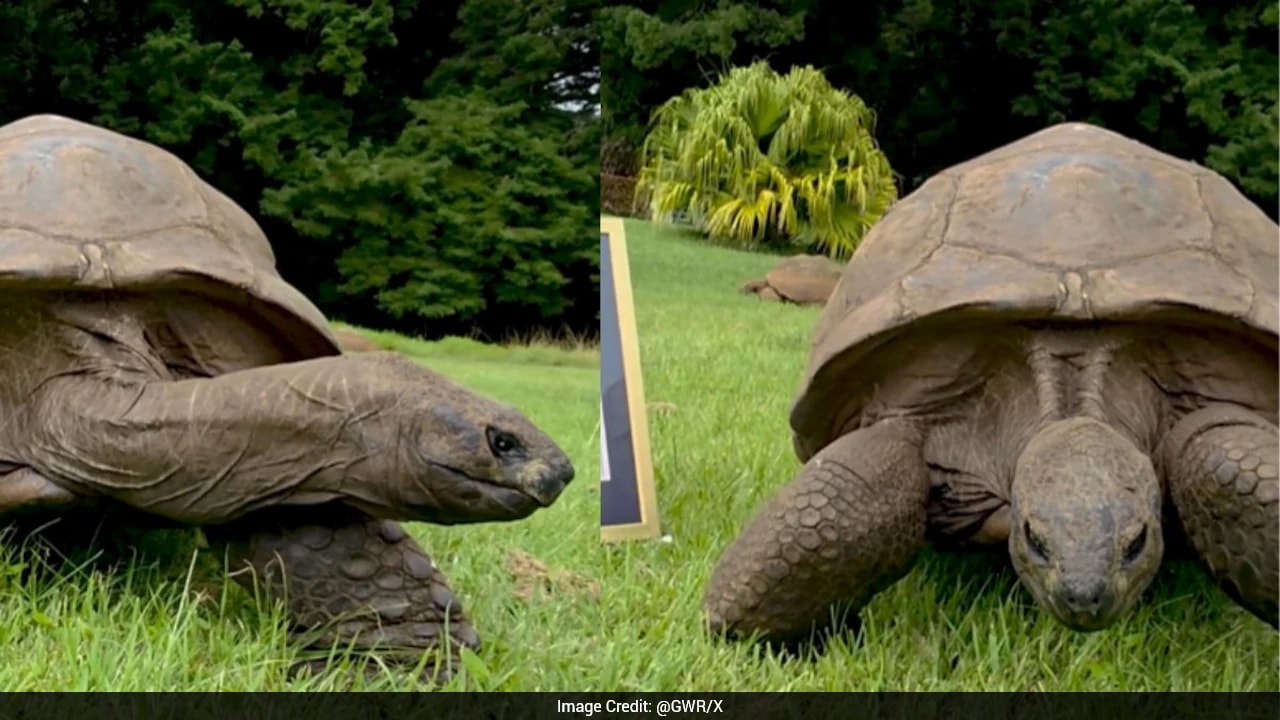
The upper bounds of terrestrial lifespan are not dictated by evolutionary accidents but by quantifiable physiological constraints, metabolic efficiencies, and cellular preservation mechanisms. The survival of a Seychelles giant tortoise (Aldabrachelys gigantea hololissa) to an estimated 194 years establishes a concrete baseline for analyzing negligible senescence—the lack of discernible functional decline accompanying chronological aging. Superficial reporting often treats extreme animal longevity as a historical novelty. A rigorous structural analysis reveals that this lifespan is the direct output of an optimized biological system designed to minimize cellular damage while operating within strict environmental parameters.
Understanding the mechanics of this extreme lifespan requires moving past chronological milestones and examining the underlying biological architecture. This analysis deconstructs the specific evolutionary strategies, metabolic calculations, and physiological trade-offs that permit a vertebrate organism to sustain metabolic functionality across three centuries.
The Three Pillars of Chelonian Senescence Mitigation
The ability of specific chelonian species to outlive all other terrestrial vertebrates rests on three interconnected biological vectors. When synchronized, these vectors prevent the compounding cellular degradation that characterizes mammalian aging.
+--------------------------------------------------------------------------+
|                       Chelonian Longevity Framework                      |
+------------------------------------+-------------------------------------+
| 1. Metabolic Optimization          | Hypometabolic baseline, low thermal |
|                                    | expenditure, reduced ROS generation |
+------------------------------------+-------------------------------------+
| 2. Advanced Genomic Stability      | High-copy DNA repair genes, fast    |
|                                    | apoptosis of damaged cells          |
+------------------------------------+-------------------------------------+
| 3. Morphological Armor             | Carapace defense, low predation,    |
|                                    | stable resource utilization         |
+------------------------------------+-------------------------------------+
1. Metabolic Optimization and Thermal Efficiency
The primary driver of cellular degradation in endothermic organisms is the continuous, high-velocity generation of reactive oxygen species (ROS) during adenosine triphosphate (ATP) production. Chelonians operate as ectothermic bradymetabolic organisms, radically altering the thermodynamics of biological maintenance.
- The Hypometabolic Baseline: The basal metabolic rate of a giant tortoise is orders of magnitude lower than that of any equivalently sized mammal. This low-velocity metabolic throughput directly scales down the cumulative generation of free radicals.
- Thermal Independence: Because these organisms rely on external ambient temperature regulation rather than internal metabolic thermogenesis, they avoid the constant cellular tax of maintaining a fixed internal core temperature. This reduces systemic friction.
- Enzymatic Resilience: Chelonian cellular machinery operates across a broad thermal envelope, meaning enzymes do not denature or lose efficiency during periods of temperature fluctuation or resource scarcity.
2. Advanced Genomic Stability and Proteostasis
A low metabolic rate reduces the velocity of DNA damage but does not eliminate it. The second pillar involves the deployment of superior intracellular repair mechanisms that preserve genomic integrity over centuries.
Comparative genomic sequencing indicates that giant tortoises possess expanded duplications of genes associated with DNA repair, immune response, and tumor suppression. These genetic redundancies ensure that when double-strand DNA breaks occur, the cellular machinery possesses multiple template options to achieve error-free repair.
Furthermore, these organisms exhibit heightened sensitivity to cellular stress. Rather than attempting to repair critically damaged cells—a process that frequently introduces mutations and drives oncogenesis—the chelonian system triggers rapid, regulated apoptosis (programmed cell death). This aggressive culling mechanism prevents senescent cells from accumulating and secreting pro-inflammatory cytokines into surrounding tissues.
3. Morphological Armor as an Environmental Buffer
Biological preservation mechanisms are useless if the organism is highly vulnerable to external mortality vectors such as predation or environmental instability. The physical structure of the tortoise serves as an existential risk mitigation tool.
The evolution of the fused carapace and plastron effectively neutralizes the threat of most local predators once the organism achieves adult scale. By removing predation from the mortality equation, evolutionary pressure shifts away from rapid reproduction and toward long-term somatic maintenance. The shell also acts as a thermal buffer and a reservoir for calcium and phosphate ions, stabilizing internal biochemistry during periods of environmental stress or nutritional deficits.
The Mathematics of Metabolic Scaling Laws
The correlation between body mass, metabolic rate, and lifespan is governed by strict biophysical constraints. To understand why a giant tortoise achieves a lifespan roughly double that of the longest-lived mammals, we must evaluate Kleiber's Law alongside the rate-of-living theory.
Kleiber's Law dictates that an animal's metabolic rate ($R$) scales to the $3/4$ power of its mass ($M$):
$$R \propto M^{\frac{3}{4}}$$
While this law applies broadly across both endotherms and ectotherms, the normalization constant—the baseline energy expenditure intercept—is fundamentally different for ectothermic reptiles.
A mammal weighing 250 kilograms requires an immense daily caloric intake to sustain homeostatic thermoregulation. A 250-kilogram Aldabrachelys gigantea operates at roughly 10% to 15% of that metabolic velocity.
This systemic deceleration means that over a 190-year period, a giant tortoise consumes fewer total lifetime calories per gram of tissue than a high-performance mammal consumes in a single decade. The lifetime energy throughput per unit of mass is tightly regulated, directly correlating with the extended timeline required to reach critical cellular senescence thresholds.
Biometric Validation Constraints and Historical Discrepancies
Quantifying the exact age of long-lived organisms introduces severe methodological challenges. Standard practice in wildlife biology relies on cross-referencing physical markers with historical documentation, a process that introduces varying margins of error.
Morphological Limitations
In younger chelonians, growth rings (annuli) on the scutes of the shell offer a reliable annual count. This metric breaks down as the organism ages. Environmental wear, burrowing friction, and continuous cellular remodeling smooth out these ridges over time. By the time a tortoise surpasses its first century, the carapace typically lacks the definition required for accurate ring counting, rendering visual inspection highly subjective.
Historical Tracking Architecture
In the specific case of the oldest verified specimen, validation depends heavily on historical provenance matching. The documentation relies on a chain of custody tracing back to a specific military transfer event on St. Helena in 1882.
1882: Arrival on St. Helena (Fully mature adult, estimated age: 50 years)
  │
  ├─► 1886: First photographic verification of structural dimensions
  │
  ├─► 1930: Official governor records log continuous residency
  │
  └─► Present Day: Verified continuity of the same specimen
The baseline estimation that the animal was at least 50 years old upon arrival is derived from its fully mature skeletal dimensions in 1882. This creates a minimum age floor but introduces an unavoidable variance of plus or minus fifteen years regarding the exact date of birth.
To achieve higher analytical certainty without relying on historical text, modern conservation science utilizes isotopic analysis of shell fragments or epigenetic clock profiling based on DNA methylation patterns. These tools are currently being calibrated against known-age captive populations to establish a standardized biochemical metric for extreme reptilian aging.
The Cost Function of Extreme Lifespans
Evolutionary architecture operates on strict optimization protocols; no biological advantage is granted without a corresponding resource allocation shift. The genetic and structural adaptations that permit a 194-year lifespan impose severe constraints on the species' reproductive output and population recovery capabilities.
- Delayed Sexual Maturity: Giant tortoises do not reach reproductive maturity until approximately 20 to 25 years of age. This delayed entry into the reproductive pool means the generation time is exceptionally long, slowing down adaptive genetic responses to rapid environmental changes.
- High Juvenile Mortality: While adult tortoises are virtually immune to local environmental predators, their eggs and hatchlings lack structural armor. The strategy relies on extreme adult longevity to compensate for decades of low juvenile survival rates. A female may reproduce for over a century, but only a fraction of a percent of those offspring reach the safety of adult mass.
- Resource Dependence: The reliance on external thermal regulation binds the species to specific geographic bands. They lack the metabolic flexibility to colonize regions characterized by prolonged freezing temperatures, confining their evolutionary strategy to isolated insular environments.
Strategic Implications for Comparative Gerontology
The study of negligible senescence in chelonians provides critical data points for human biomedical research, specifically regarding the mitigation of age-related systemic decline.
The strategy forward does not involve attempting to convert human metabolic systems to ectothermic models, which is biologically impossible. Instead, medical research targets the specific intracellular pathways that tortoises use to maintain proteostasis and eliminate damaged cells before they become toxic.
The immediate research imperative centers on isolating the specific genetic upregulations responsible for the tortoise's heightened apoptotic response. Replicating the mechanism that allows chelonian cells to prioritize genomic purity over cell survival could lead to methods for preventing senescent cell accumulation in human tissue. This accumulation remains a primary driver of vascular degradation, cognitive decline, and metabolic dysfunction.
Investigating the exact mechanisms of chelonian telomere preservation represents the next major phase in longevity analytics. While human telomeres degrade predictably with each cellular division cycle, giant tortoises maintain highly stable telomere lengths over multiple decades, effectively bypassing the Hayflick limit that bounds mammalian cellular lifespans. Unlocking the regulatory loops that manage this enzymatic stability provides the direct blueprint for advanced therapeutic interventions in human cellular repair.