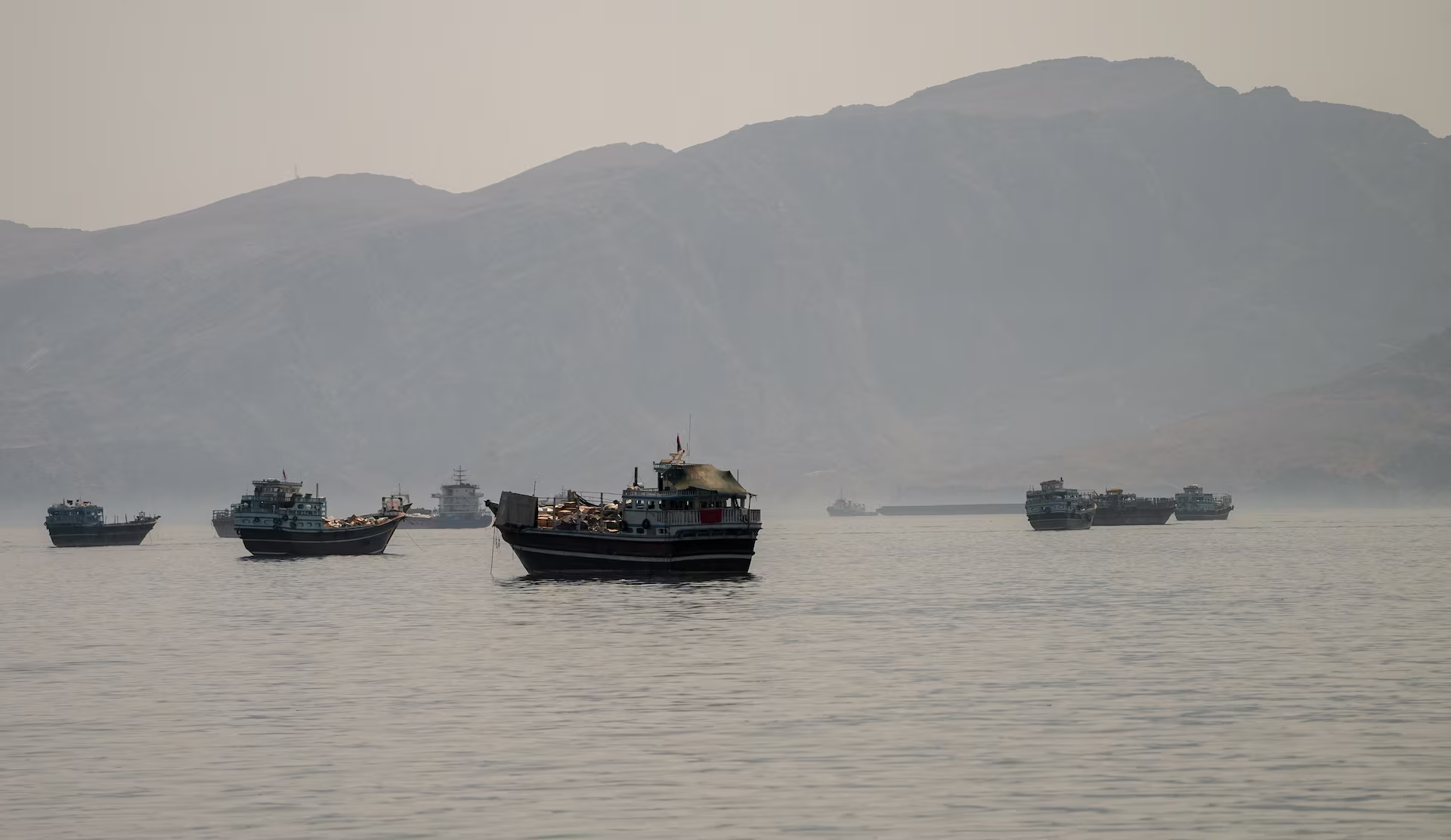
A stationary vessel is an accelerating biological asset. When macroeconomic friction, geopolitical strain, or supply chain bottlenecks force Very Large Crude Carriers (VLCCs) to sit idle in tropical waterways, they cease acting as efficient transit mechanisms and begin operating as artificial reefs. In the Strait of Hormuz—where approximately 20% of global petroleum liquids pass daily—the intersection of warm water chemistry, shallow-water light penetration, and prolonged vessel anchorage times creates a severe operational risk: runaway macro-biofouling.
The accumulation of hard-shelled organisms, primarily barnacles (Balanus amphitrite), on a vessel’s hull exponentially degrades hydrodynamic efficiency. This structural degradation directly alters the operator's cost function, transforming what appears to be a temporary logistical delay into a long-term capital drain. Understanding this vulnerability requires examining the specific biological, hydrodynamic, and financial systems that govern maritime chokepoints.
The Tri-Factor Environmental Engine
Biofouling does not occur uniformly across the globe. The critical rate of accumulation observed in the Persian Gulf and the Strait of Hormuz is driven by three distinct environmental variables working concurrently.
High Ambient Sea Surface Temperatures
Water temperatures in the Persian Gulf routinely exceed 32°C (90°F) during summer months. Metabolic rates in marine invertebrates scale predictably with temperature according to the Arrhenius equation. Higher temperatures compress the larval development lifecycle of barnacles, accelerating settlement kinetics and allowing populations to establish attachment protocols on antifouling coatings within days rather than weeks.
Elevated Salinity and Nutrient Baselines
The enclosed nature of the Persian Gulf creates high evaporation rates, driving salinity levels above 40 practical salinity units (psu), compared to the global ocean average of 35 psu. While extreme salinity challenges some species, local macro-fouling organisms are highly adapted, utilizing the rich nutrient outwashes from regional coastal developments. This provides an abundant food supply of phytoplankton, maximizing post-settlement survival rates.
The Anchor-Period Catalyst
Antifouling coatings operate on one of two engineering principles: biocidal release or foul-release surface energy. Biocidal coatings rely on a steady, diffusion-limited leaching of copper or co-biocides, which requires a minimum water velocity across the hull to clear dead organic matter and maintain a fresh surface layer. Foul-release coatings use low-surface-energy silicones that prevent strong mechanical bonding, relying on the sheer stress of vessel speeds above 10-12 knots to shed organisms. When a tanker sits at anchor in a chokepoint for days or weeks due to insurance disputes, port congestion, or security clearing, both defense mechanisms fail. The stagnant boundary layer allows the biological colonization process to proceed unhindered.
The Four Phases of Hull Colonization
The transformation of a clean, hydrodynamic hull into a high-drag surface follows a strict, sequential biological framework. Delaying intervention at any stage accelerates the transition to the next, more destructive phase.
- Phase 1: Biochemical Conditioning (Minutes to Hours): Immediately upon immersion or hull cleaning, dissolved organic molecules (proteins, polysaccharides) adhere to the surface via electrostatic interactions, creating a conditioned biochemical film.
- Phase 2: Micro-fouling Colonization (Days): Bacteria and single-celled diatoms sense the conditioned film and attach using extracellular polymeric substances (EPS). This forms a microscopic slime layer that alters the localized surface chemistry.
- Phase 3: Soft Macro-fouling (1-2 Weeks): Algae spores, bryozoans, and soft tunicates colonize the slime layer, adding physical depth to the fouling matrix and creating a rougher boundary layer.
- Phase 4: Hard Macro-fouling (2+ Weeks): Free-swimming barnacle cyprid larvae locate the surface, release a highly cross-linked proteinaceous cement, and undergo metamorphosis into calcified adults. Once this phase is reached, the surface roughness transitions from micro-scale to macro-scale, drastically shifting the vessel’s hydrodynamic profile.
The Hydrodynamic Cost Function
The primary operational penalty of hard macro-biofouling is a massive increase in frictional drag. To maintain a constant service speed ($v$), a vessel must overcome total resistance ($R_T$), which is calculated as:
$$R_T = R_F + R_W + R_A$$
Where $R_F$ is frictional resistance, $R_W$ is wave-making resistance, and $R_A$ is air resistance. For large, slow-moving merchant vessels like VLCCs, frictional resistance ($R_F$) accounts for up to 80-90% of total hull resistance.
When barnacles attach to the hull, they breach the viscous sublayer of the fluid flow. A clean hull maintains a smooth laminar or tightly controlled turbulent boundary layer. Hard macro-fouling introduces localized flow separation, generating micro-vortices and increasing the effective surface roughness ($\Delta y$).
A moderate coverage of hard barnacles (occupying less than 10% of the hull surface area) can increase the total hydrodynamic resistance by up to 40%. To maintain the same schedule or speed, the vessel's propulsion system must increase power output proportionally, which demands higher fuel consumption.
[Clean Hull] ---> Smooth Fluid Flow ---> Low Drag Baseline
[Fouled Hull] ---> Micro-Vortices & Flow Separation ---> ~40% Drag Increase ---> Fuel Penalty
If the engine operates at a fixed power or fuel consumption limit to preserve machinery life, the speed of the vessel drops instead. A severe barnacle infestation can reduce a tanker’s top speed by 2 to 5 knots. In an industry where charter party agreements enforce strict delivery windows and speed-consumption profiles, a 3-knot reduction over a transoceanic voyage introduces severe contractual penalties and asset underutilization.
Operational and Structural Vulnerabilities
Beyond fuel economics, macro-biofouling introduces severe downstream mechanical and systemic risks that jeopardize long-term asset integrity.
Coating Degradation and Substrate Corrosion
Barnacles attach by secreting a calcareous base plate directly onto the outer hull coating. As the organism grows, it forces its shell beneath the edges of the antifouling paint layer. This mechanical wedging causes delamination, fracturing the protective barrier. When the vessel is eventually cleaned or the barnacle dies and falls off, it often tears away the underlying anti-corrosive primer, exposing bare marine-grade steel directly to seawater. This accelerates localized pitting corrosion, risking structural thinning of the hull plates.
Sea Chest and Cooling System Blockage
Vessels rely on continuous seawater intake through openings in the lower hull called sea chests. This water cools the primary propulsion engines, auxiliary generators, and air conditioning systems. Barnacle larvae easily migrate past external grates and colonize the interior piping of these sea chests. The resulting internal blockages restrict volumetric water flow, causing thermal inefficiencies in heat exchangers, engine overheating warnings, and forcing automated power deratings to prevent catastrophic engine failure.
Environmental Compliance Redlines
The accumulation of biofouling acts as a primary vector for the translocation of invasive aquatic species across distinct marine ecoregions. Regulatory bodies, including the International Maritime Organization (IMO) and specific state authorities like the California State Lands Commission and the Australian Department of Agriculture, Fisheries and Forestry, enforce stringent biofouling management standards. Vessels arriving with obvious macro-fouling can be denied port entry, ordered to exit territorial waters, or subjected to mandatory, high-cost offshore cleaning operations, compounding supply chain delays.
Mitigation Strategies and Engineering Limitations
Managing biofouling in high-risk zones requires balancing preventative coatings against proactive mechanical interventions. Each operational strategy has clear technical boundaries and trade-offs.
Coating Selection Trade-offs
Operators must choose between Self-Polishing Copolymer (SPC) coatings and Foul Release (FR) coatings. SPC coatings use acrylic polymers that chemically react with seawater to slowly dissolve, consistently exposing fresh biocide. They are highly effective for vessels with mixed duty cycles but wear down prematurely if the ship operates at high average speeds.
FR coatings use silicone or fluoropolymer chemistries to create a slick surface. They are non-toxic and offer exceptional drag reduction when clean, but offer virtually zero protection when the vessel is stationary. For a fleet exposed to prolonged anchorages in the Strait of Hormuz, relying entirely on FR coatings without a planned underwater grooming schedule guarantees macro-fouling colonization.
In-Water Cleaning and Grooming Risks
When a hull becomes heavily fouled, operators deploy commercial diving teams or Remote Operated Vehicles (ROVs) equipped with rotating brushes or high-pressure water jets to clean the hull in situ. However, aggressive mechanical cleaning often damages the matrix of remaining antifouling paint, leading to a phenomenon known as "re-fouling acceleration." The brushed paint surface is rougher than the original application, providing an even better mechanical key for the next wave of biological settlement. Furthermore, many ports ban in-water cleaning unless the system captures all removed biological material and paint debris to prevent localized heavy metal pollution.
Strategic Action Framework
To insulate a fleet from the financial and operational penalties of biofouling during periods of chokepoint congestion, maritime asset managers must shift from reactive cleaning to an active, data-driven framework.
Deploy Predictive Micro-Climate Modeling
Do not treat biofouling risk as a static global constant. Integrate real-time sea surface temperature, salinity data, and satellite-derived chlorophyll measurements (which indicate nutrient and phytoplankton density) into fleet routing systems. When a vessel enters a high-incubation zone like the Persian Gulf, automatically trigger a localized "Biofouling Clock" that calculates maximum allowable idle days based on the specific coating system applied to that hull.
Implement Early-Stage Ultrasonic Prevention
Equip critical internal areas, such as sea chests and high-fouling hull sections around the rudder and propeller aft-end, with transducer networks that emit high-frequency ultrasonic waves. These waves induce micro-cavitation along the surface boundary layer, disrupting the attachment mechanisms of early-stage bacterial slime and preventing barnacle cyprids from settling without damaging the hull coatings.
Execute Proactive Hull Grooming Regimens
Transition from heavy, corrective hull scrubbing to gentle, proactive hull grooming. Utilize specialized brush-less ROVs that use low-pressure fluid dynamics to clear the primary micro-fouling slime layer before Phase 4 hard macro-fouling can anchor. Grooming every 2-3 weeks during idle periods maintains hydrodynamic optimization, avoids coating degradation, and eliminates the risk of regulatory port rejections.