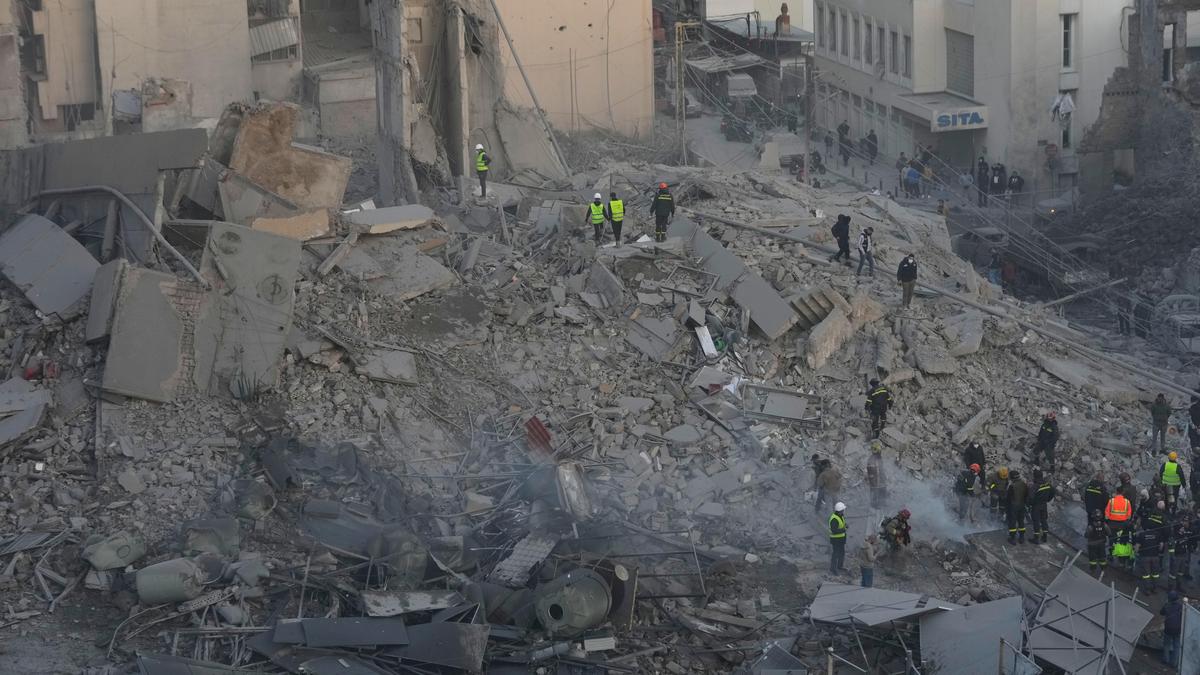
The heart of Beirut is no longer a sanctuary. Recent Israeli airstrikes on central districts have shattered a long-standing, albeit unspoken, understanding that the capital’s commercial and residential core would remain insulated from the heaviest violence. At least six people are dead following a precision strike on a multi-story building in a densely populated neighborhood, an event that signals a fundamental shift in military strategy. This isn't just about tactical gains. It is a calculated dismantling of the boundaries between frontline combat zones and the civilian nervous system of Lebanon.
For months, the exchange of fire was largely confined to the southern border. Now, the logic of "surgical strikes" is being applied to one of the most crowded urban environments in the Middle East. When a missile hits a residential apartment in a city like Beirut, the "surgical" nature of the weapon matters less than the environment it enters. Concrete splinters. Glass becomes shrapnel for blocks. The psychological impact ripples through millions who previously believed they were mere spectators to a border war.
The Strategy of Urban Dislocation
Military analysts often talk about "degrading infrastructure," but the reality on the ground in Beirut suggests a strategy of total dislocation. By targeting the central city, the Israeli Defense Forces (IDF) are moving beyond Hezbollah’s military installations in the south and the Bekaa Valley. They are now squeezing the political and logistical nodes of the country.
The targets are frequently described as "intelligence headquarters" or "operational centers," but these are rarely isolated bunkers. They are often offices tucked between family apartments and grocery stores. This creates an impossible math for civilian safety. If a high-value target is identified on the third floor of a ten-story building, the entire structure—and its inhabitants—becomes part of the strike zone. The legality of such strikes hinges on the principle of proportionality, a concept that is increasingly difficult to defend as the body count in residential hubs climbs.
The Myth of the Safe Zone
Displacement in Lebanon has reached a tipping point. Over a million people have fled their homes in the south, seeking refuge in schools, parks, and the very central Beirut neighborhoods now being targeted. This creates a secondary crisis. People who fled the "war zone" have discovered that the war followed them.
The pressure on Beirut’s infrastructure is immense. Hospitals are already overstretched from previous mass-casualty events, including the pager explosions that maimed thousands just weeks ago. Now, they must contend with the blunt force trauma of building collapses. The medical system is running on fumes, facing shortages of basic supplies like surgical gauze and anesthetic.
Intelligence Failures and Successes
The precision of these strikes suggests a high level of intelligence penetration within Lebanon. Israel has clearly spent years mapping not just Hezbollah’s military sites, but the personal movements of its mid-to-high-level officials. However, the "success" of a strike is often measured differently by a general than by a diplomat.
- Tactical Success: Eliminating a commander or a communications hub.
- Strategic Risk: Radicalizing a neutral population and destroying the state’s ability to govern.
When central Beirut is hit, the Lebanese Armed Forces—the official military of the state—remain largely on the sidelines. This creates a vacuum. If the official state cannot protect its capital, the influence of non-state actors often grows, regardless of how many leaders are killed. History shows that decapitation strikes rarely end an insurgency; they merely pave the way for a more decentralized, more unpredictable successor.
The Economic Death Spiral
Lebanon was already a failed state in every economic sense before the first missile fell. The currency is worthless, and the banking system has effectively vanished. These central Beirut strikes are the final blow to the country’s remaining commercial life.
Retailers in the Hamra or Verdun districts, who managed to survive the 2020 port explosion and the subsequent economic collapse, are now shuttering their doors. No one wants to shop in a neighborhood where the building next door might vanish in a cloud of grey dust at three in the afternoon. This isn't just a temporary disruption. It is the permanent erasure of Lebanon’s middle class, the very group needed to rebuild a stable, moderate country after the smoke clears.
The International Response and the Reality of Inaction
Global powers continue to issue "calls for restraint," but these statements have lost their currency. The United States provides the munitions used in these strikes while simultaneously expressing concern over civilian casualties. This duality is not lost on the Lebanese public. It creates a sense of abandonment that goes beyond anger; it is a profound, cynical realization that the rules of international law are applied selectively.
The diplomatic "red lines" that once protected central Beirut have been erased. In previous conflicts, such as the 2006 war, the Dahiya suburb was the primary target. Keeping the strikes within that specific area allowed for a modicum of functional life to continue in the rest of the city. By moving into the city center, the IDF has signaled that there are no longer any off-limit zones.
Hard Targets and Soft Victims
The nature of the weaponry being used is also a point of contention. Heavy munitions designed to penetrate reinforced concrete are being dropped in areas where buildings share walls.
- Pressure Waves: Even if a building doesn't collapse, the pressure wave from a 1,000-pound bomb can kill people in neighboring structures through internal hemorrhaging.
- Structural Instability: Beirut is an old city. Many buildings are already weakened by age or previous disasters. A strike on one block can make ten others uninhabitable.
- The Dust Factor: The inhalation of pulverized concrete and asbestos creates a long-term health crisis that won't be tallied in the immediate death tolls.
Why This Escalation Changes Everything
This is no longer a localized conflict. By hitting central Beirut, Israel is forcing a choice upon the Lebanese government and the international community. It is an ultimatum delivered via JDAM. The message is clear: the cost of Hezbollah’s presence will be the total destruction of the Lebanese state, starting with its capital.
However, this gamble assumes that the population will turn against Hezbollah. In reality, urban bombardment often has the opposite effect. It creates a shared trauma that bridges sectarian divides, at least in the short term. A Christian shopkeeper in central Beirut whose windows are blown out by an Israeli strike is rarely moved to thank the IDF for their "precision."
The escalation also complicates any future ceasefire negotiations. When the "safe" zones are gone, there is no neutral ground left for dialogue. Every part of the country is now a legitimate target in the eyes of one side or the other. This makes the path to de-escalation almost impossible to find, as both sides are now operating in a state of total war.
The world is watching a major Mediterranean capital being systematically dismantled. This isn't a movie, and there is no "reset" button. Every crater in the pavement of central Beirut is a permanent scar on the idea of urban sanctuary. The international community needs to move beyond the rhetoric of "deep concern" and address the reality that the rules of engagement have been rewritten in fire.
Verify the status of international aid corridors immediately, as the window for moving supplies into the city center is closing with every new strike.