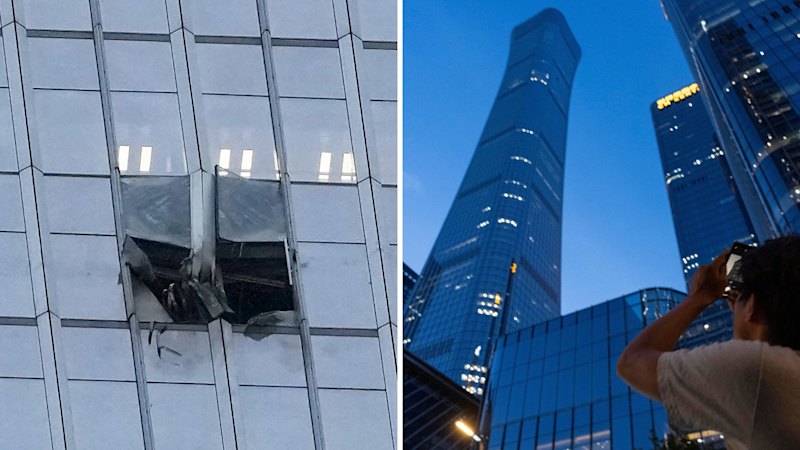
Air safety in dense megacities just changed forever. A small plane crashed into Beijing’s tallest building, sending shockwaves through global aviation and urban planning sectors. The incident involves the China Zun tower, officially known as the CITIC Tower, which pierces the capital's skyline at 528 meters.
Initial reports from aviation tracking data and local emergency management bureaus indicate that a light general aviation aircraft veered off its flight path before striking the upper facade of the skyscraper. While full casualty reports and structural assessments take days to solidify, the immediate reality is clear. Megacities are vulnerable to low-altitude airspace chaos.
The Reality of Low Altitude Flights Over Capitals
Most people assume airspace over a major political capital like Beijing is an impenetrable fortress. It isn't. China has actually been systematically opening up its low-altitude airspace under 1,000 meters to stimulate the general aviation and drone economy. This policy shift created a massive boom in light aircraft, corporate helicopters, and logistics drones.
When you open up the skies, you open up the risks. The China Zun tower sits right in the Central Business District (CBD) of Chaoyang District. It's a dense forest of glass and steel. A light aircraft traveling at even 150 knots possesses immense kinetic energy. When mechanical failure or pilot incapacitation occurs in these tight corridors, gravity wins.
Data from the International Civil Aviation Organization (ICAO) shows that general aviation—small private planes and non-commercial flights—has a accident rate significantly higher than commercial airliners. We aren't talking about a massive commercial jetliner here, but a small fuselage can still compromise building skins, shatter specialized curtain walls, and spark intense localized fires.
Why Sky-High Cities Aren't Ready for Small Aircraft Impacts
Civil engineers design modern supertall skyscrapers to withstand extreme wind loads, earthquakes, and even certain types of heavy impacts. The CITIC Tower features a robust core-outrigger structural system. It's built like a tank. However, architectural resilience isn't just about keeping the building standing. It's about what happens to the people inside and on the street below.
Falling debris is the silent killer in urban aviation accidents. A single sheet of architectural glass falling from 400 meters acts like a guillotine by the time it hits the pavement. Emergency response teams in Beijing faced immediate gridlock trying to secure a perimeter around the Chaoyang CBD.
- Curtain wall failure: High-impact strikes obliterate specialized double-glazed low-E glass panels.
- HVAC disruption: The upper floors of towers like China Zun house massive mechanical zones that regulate air pressure and climate. Damage here paralyzes the building's internal environment.
- Fire containment: Aviation fuel, even in small quantities from a light plane, burns hotter than standard office fires. It tests local sprinkler systems to their absolute limits.
Fixing the Gaps in Urban Air Traffic Control
You can't manage 2026 airspace with 1990s radar technology. The rapid expansion of urban air mobility demands a complete overhaul of how we track low-flying objects near critical infrastructure. Traditional radar struggles with "ground clutter" in cities. Tall buildings block signals, creating blind spots where a rogue or distressed aircraft can vanish from screens until it's too late.
The solution requires mandatory integration of Automatic Dependent Surveillance-Broadcast (ADS-B) technology on every single airborne vehicle, no matter how small. Municipalities must establish strict geo-fenced no-fly zones around buildings exceeding 300 meters. If an aircraft breaches that digital perimeter, automated ground-based warning systems need to instantly alert building security to initiate localized evacuations.
Urban planners must stop ignoring the sky. We build grand towers but treat the surrounding air as empty space. It's an illusion. The Beijing crash proves that the space between skyscrapers is a high-risk transit zone that requires aggressive policing, cutting-edge transponder tracking, and zero-tolerance enforcement for flight path deviations.


