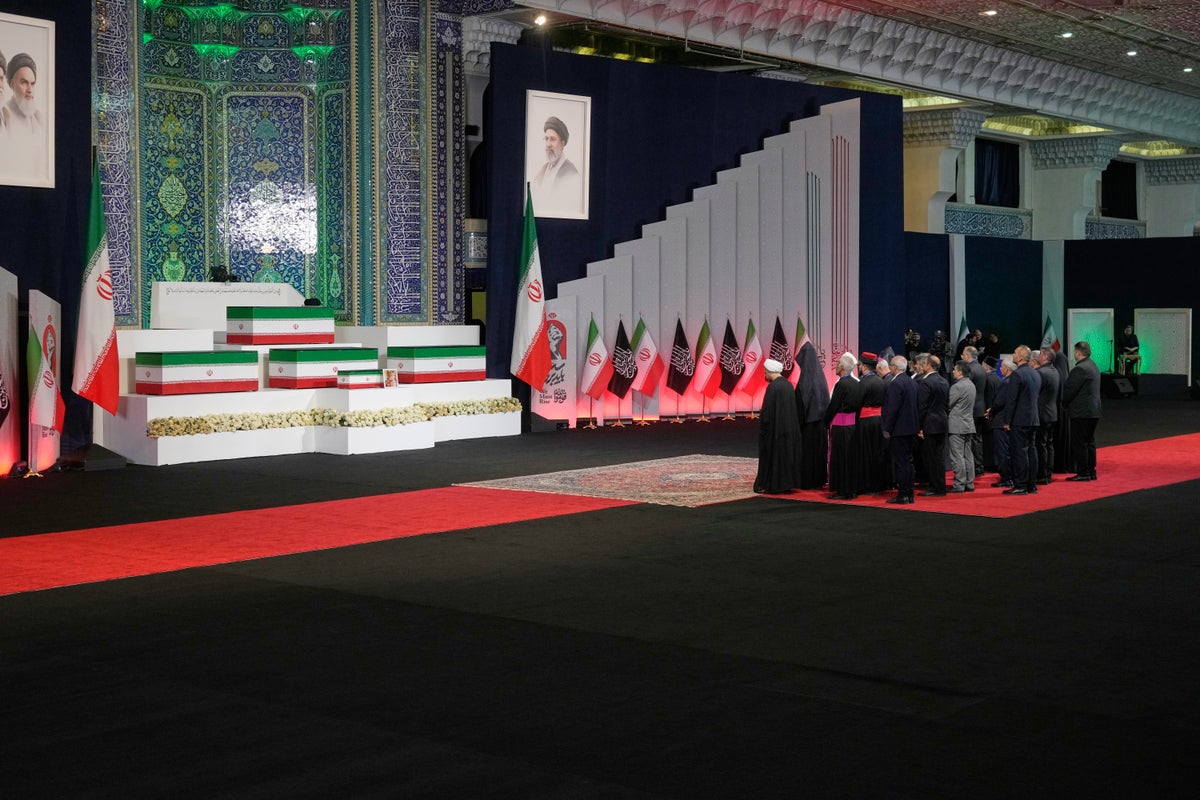
The institutional bedrock of the Islamic Republic faces its most significant structural test since 1989. When the seat of the Supreme Leader becomes vacant, the transition of power will not merely be a matter of religious consensus or bureaucratic compliance. It will be a high-stakes confrontation between the traditional clerical establishment and an increasingly assertive military apparatus. While external observers frequently focus on the public rituals of mourning and continuity, the real movement of power occurs behind closed doors, where the future direction of the state is decided.
The mechanism for choosing a successor is clearly defined on paper, yet the political reality is far more complex. The Assembly of Experts, a body of eighty-eight clerics, holds the constitutional mandate to select the next leader. However, the internal dynamics of Iran have shifted fundamentally over the last three decades. The clerical class no longer holds a monopoly on absolute authority. Instead, the Islamic Revolutionary Guard Corps has quietly integrated itself into every facet of the national economy, foreign policy, and internal security infrastructure. This shift alters the baseline of Iranian governance.
The Clerical Illusion and the Guard Corps Reality
For decades, the standard narrative of Iranian politics emphasized the absolute authority of the Velayat-e Faqih, the guardianship of the Islamic jurist. This theological framework places supreme political and religious power in the hands of a single top cleric. The system worked effectively during periods of charismatic leadership. It provided a centralized focal point for a complex network of competing factions.
That centralized model is undergoing a profound transformation. The clerics in Qom still retain vast religious authority and control significant financial endowments. Yet, they lack the logistical capability to enforce order or manage a modern state under intense international pressure. The military apparatus fills this structural void. The Guard Corps does not operate merely as a defensive force. It functions as a massive industrial conglomerate, managing major infrastructure projects, telecommunications networks, and trade routes.
This economic dominance translates directly into political veto power. Any candidate selected by the Assembly of Experts must have the explicit backing, or at least the tacit approval, of the military leadership. A candidate who opposes the economic interests or the strategic vision of the armed forces cannot realistically govern. Consequently, the selection process is less about theological purity and much more about factional compromise.
The Vulnerability of the Assembly of Experts
The constitutional process relies heavily on the integrity of the Assembly of Experts. This body meets regularly to evaluate potential candidates and monitor the qualifications of the sitting leader. In practice, the assembly has been systematically vetted by the Guardian Council, ensuring that only those entirely loyal to the core principles of the establishment can participate.
This intense vetting creates an institutional echo chamber. The assembly is populated largely by elderly clerics who may be disconnected from the immediate economic and social anxieties of the broader population. Their deliberations are secretive. This secrecy breeds intense speculation and vulnerability to internal lobbying from security agencies.
A sudden vacancy creates an immediate timeline pressure. The constitution dictates that a council consisting of the president, the head of the judiciary, and one of the clerics from the Guardian Council must temporarily handle leadership duties if a selection cannot be made quickly. This temporary arrangement introduces a period of profound institutional uncertainty. During this window, the risk of miscalculation by competing internal factions increases dramatically.
Economic Endowments as the Ultimate Prize
The struggle for succession is intimately tied to the control of Iran's vast religious and economic foundations, known as bonyads. These organizations operate outside standard government oversight and control billions of dollars in assets. They own manufacturing plants, agricultural complexes, and real estate portfolios.
The Supreme Leader appoints the heads of these foundations. This appointment power represents a massive lever of patronage. A new leader will have the authority to reallocate these positions, potentially stripping rival factions of their financial lifebloods. The stakes are immense for the individuals running these organizations. For them, succession is not an abstract debate over religious philosophy. It is a direct threat to their institutional survival and financial independence.
The redistribution of these assets could lead to significant internal friction. If the new leadership attempts to consolidate these foundations under stricter military or state control, traditional merchant networks and clerical families will resist. This resistance might not manifest as public protest, but rather as institutional gridlock and economic sabotage.
Regional Proxies and the Continuity of Foreign Policy
Iran has constructed a sophisticated network of regional allies and proxy forces across the Middle East. This network forms the core of its defensive strategy, creating strategic depth intended to deter external aggression. The management of this network has traditionally been divided between the Office of the Supreme Leader and the external operations wing of the military.
A transition period raises immediate questions about the stability of these relationships. Regional allies require consistent funding, ideological alignment, and strategic clarity. If the leadership transition in Tehran becomes protracted or contentious, the management of these external groups could suffer from a lack of direction.
- Ideological loyalty: External groups are often personally loyal to the concept of the Supreme Leader rather than the bureaucratic state of Iran.
- Financial predictability: Shifted priorities within Tehran could alter the funding structures for regional operations.
- Command unity: A divided leadership in the capital complicates the decision-making process during regional crises.
The international community watches these transitions closely because any perceived weakness at the center can invite external pressure. Conversely, the transition team in Tehran may feel compelled to project strength abroad to signal that the state remains secure and unified. This dynamic can lead to a more confrontational foreign policy stance during the initial phases of the new leadership's tenure.
The Internal Security Challenge
The most immediate priority for the state during any transition is the maintenance of internal order. The population has experienced severe economic hardship driven by international sanctions, inflation, and structural mismanagement. These economic pressures have historically triggered widespread public demonstrations.
The security apparatus understands that a transition period is a moment of vulnerability. The police, the internal volunteer militias, and the regular armed forces will be deployed to ensure that public spaces remain controlled. The state relies on a highly developed apparatus of surveillance and digital control to disrupt potential coordination among dissident groups.
The effectiveness of this security response depends heavily on the unity of the command structure. If the security forces themselves are divided over the choice of the next leader, their willingness or ability to enforce order could be compromised. This reality serves as a powerful incentive for the elite factions to reach a consensus rapidly, even if that consensus requires significant concessions behind the doors of the assembly.
The Shift Toward a Collective Presidency
One potential outcome of the shifting balance of power is the emergence of a weaker Supreme Leader balanced by a stronger collective leadership council. If no single cleric possesses the religious standing and political weight to command absolute authority, power may naturally diffuse.
In this scenario, the office becomes more ceremonial, while actual policy decisions are made by a coalition of military figures, judicial heads, and key political strategists. This would formalize the system that has been developing informally for years. A collective leadership structure might offer greater stability by representing multiple powerful factions, but it also risks systemic paralysis when those factions disagree on critical national issues.
Such a shift would fundamentally alter how foreign governments interact with Iran. Dealing with a single decision-maker, however hostile, provides a level of predictability. Dealing with a fragmented council prone to internal vetoes makes diplomatic engagement far more volatile and unpredictable. The institutional evolution of the office will shape the geopolitics of the region for the next generation.