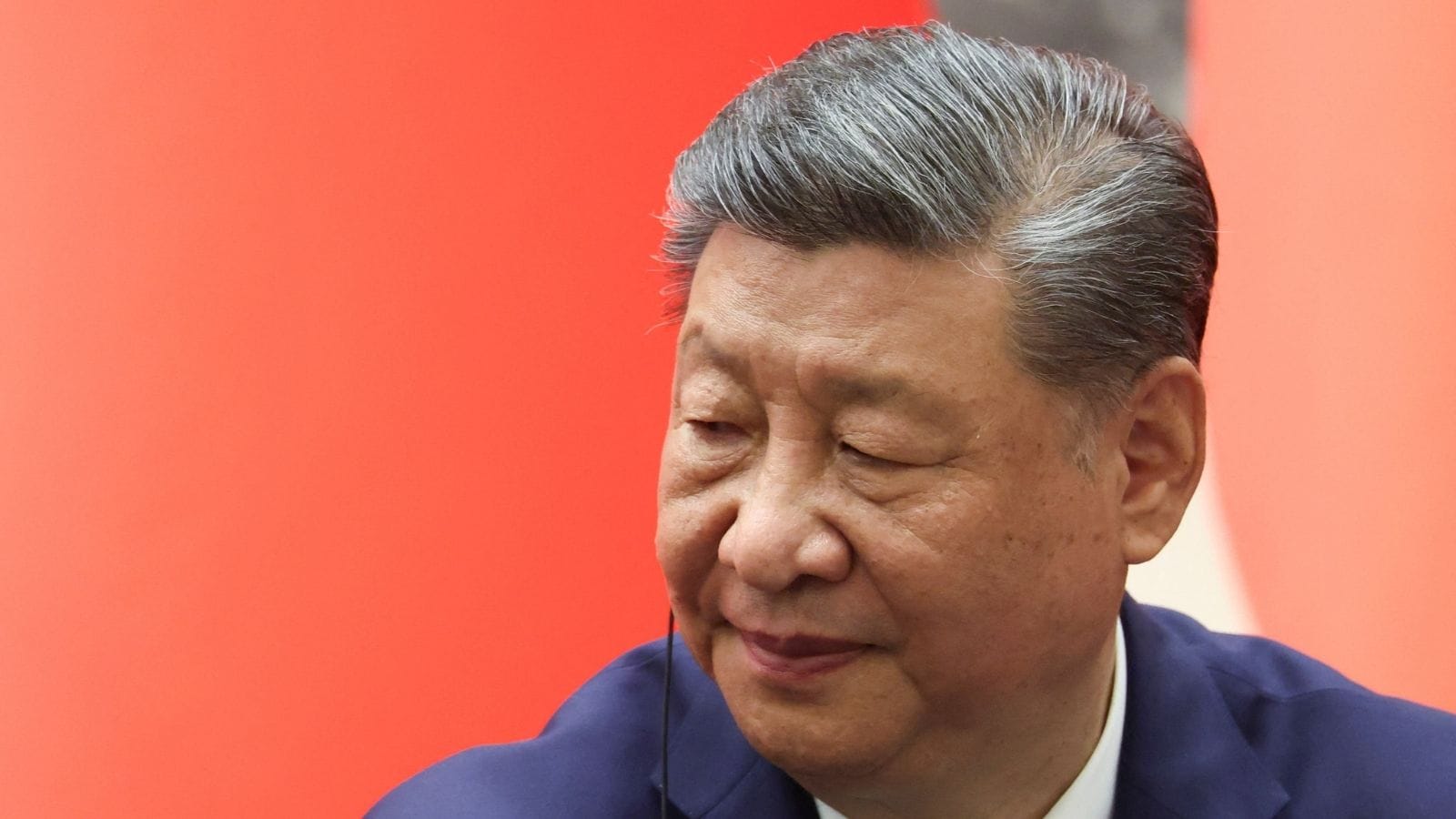
Glass clinks against crystal in the Great Hall of the People. Outside, the Beijing autumn air is turning crisp, smelling faintly of coal smoke and ancient dust blown down from the northern steppes. Inside, under chandeliers that weigh as much as locomotives, rows of dignitaries sit stiffly in dark wool suits. They cut through roasted duck and sip warm rice wine while a military band plays martial anthems in the lobby, muffled by thick crimson velvet curtains.
At the center of it all stands Xi Jinping. If you found value in this article, you should look at: this related article.
To the casual observer watching the state broadcast across three billion screens, it is just another National Day reception. Another anniversary of the founding of the People's Republic. Another meticulously choreographed display of synchronized smiling and polite applause. But politics, at this altitude, is never just about celebrating the past. It is a weather balloon sent into the stratosphere to test which way the wind is blowing.
And right now, the wind is erratic. For another perspective on this story, refer to the latest coverage from Reuters.
Listen closely to the speech. Strip away the institutional phrasing and the rhythmic cadence of bureaucratic certainty. What remains is a quiet acknowledgment of gravity. China’s economic engine, which for four decades ran on an almost miraculous blend of cheap labor, boundless real estate development, and relentless export growth, is sputtering. The numbers are no secret to the men in the wool suits. Property developers are buckling under debt mountains that touch the clouds. Local governments are quietly restructuring bonds just to pay municipal salaries. Youth unemployment sits stubbornly high, creating a generation of disillusioned graduates who talk of "lying flat" rather than chasing a corporate dream that feels increasingly out of reach.
Imagine a factory floor in Shenzhen. The rhythmic thrum of stamping presses, the amber glow of overhead sodium lamps, the smell of hot solder and ozone. Ten years ago, the line moved without stopping. Orders came from Frankfurt, from Chicago, from Tokyo, demanding more electronics, more textiles, more hardware. Today, the pace is different. The managers are talking about automation, about moving up the value chain, about electric vehicles and semiconductor wafers. They are trying to build an economy that commands respect through high-tech dominance rather than sheer volume.
Yet, transformation is a brutal exercise in friction.
When you pivot a supertanker of one point four billion people, the wake is violent. The people caught in that wake are not abstract data points on a Bloomberg terminal. They are middle-aged foremen whose trade is suddenly obsolete. They are young urbanites trading stocks on their phones during their morning subway commutes, terrified that their portfolios will evaporate overnight because of a sudden regulatory crackdown on tech giants.
Xi knows this. The speeches at the banquet are designed to thread an impossible needle: project absolute, unshakeable confidence to the outside world while whispering a call for austerity and endurance to the domestic audience. It is the classic paradox of autocratic power. You must appear invulnerable while frantically plugging holes in the hull.
Then, there is the island ninety miles off the coast.
Taiwan is never far from the mahogany tables in Beijing, even when unmentioned. It hovers over the banquet like a low-pressure storm front. To Beijing, the self-governing democracy is an unfinished historical sentence, a punctuation mark left off the end of the civil war in 1949. To the people living in Taipei, drinking oolong tea in cafes in Ximending or writing code in sleek glass towers, it is home, agency, and an entirely different way of understanding the future.
We often talk about geopolitics as if it were a game of chess played by gods who feel no pain. We draw lines on maps. We count aircraft carriers. We debate semiconductor supply chains as if they were just pieces on a board. But pause for a moment and consider the human cost of that geography.
Consider a fisherman in the Taiwan Strait casting his nets into waters patrolled by gray hulls that do not belong to his flag. Consider a young engineer in Hsinchu looking at stock tickers and wondering if the fab where she spent ten years designing sub-seven-nanometer chips will one day be contested ground. Fear is an invisible tax levied on every transaction, every life decision, every wedding and mortgage in the region.
During the National Day toast, the rhetoric on sovereignty was delivered with characteristic steel. There is no room for ambiguity on the core issue. Yet, beneath the uncompromising stance lies a calculation of risk. An economic slowdown at home changes the arithmetic of external ambition. When domestic prosperity—the unspoken social contract between the party and the populace—begins to fray, nationalism becomes a powerful, volatile substitute. It is a gravitational pull that draws leaders toward confrontation precisely when they can least afford the distraction.
History is full of these moments. Empires and rising states reach an inflection point where the sheer momentum of their own growth collides with the structural limits of geography and human psychology. The transition from manufacturing sweatshop to global technology titan is fraught with peril. Britain did it in the nineteenth century. America did it in the twentieth. China is attempting it now, under the watchful gaze of a fractured, anxious global order that no longer trusts the rules of the road.
The banquet eventually ends. The guests fold their linen napkins, slide their chairs back against the polished parquet floors, and file out into the autumn night. Black limousines with tinted windows idle in the courtyard, their exhaust plumes dissolving into the haze of the capital.
Inside the Great Hall, the lights dim. The reporters pack their cameras. But out in the wider world—from the bustling tech hubs of the Pearl River Delta to the narrow, crowded alleys of Taipei, from cargo ships navigating the choppy straits to trading desks in New York and London—the real work of living through this transition continues unabated.
We are watching a giant rewrite the terms of its own existence. And whether that rewrite happens with the quiet scratch of a pen or the thunder of breaking waves will shape the contours of the century we all share. The plates have been cleared, but the bill has not yet been presented.


