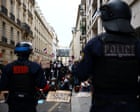
The lazy consensus of modern crowd control is a comforting illusion. A teenager loses a hand during a high-school protest in France, the media hyperventilates over police militarization, politicians rush to ban the tool of the day, and everyone goes home feeling morally vindicated. Stun grenades are suspended. Order is supposedly restored through sheer bureaucratic empathy.
It is a theatrical farce.
I have watched public order strategies disintegrate across European capitals for over a decade. When you strip police forces of kinetic dispersal tools, you do not create a peaceful utopia of dialogue and drum circles. You create a vacuum. And physics abhors a vacuum just as much as urban rioters do.
Let us dismantle the comfortable fiction that banning a specific model of explosive deterrent solves state-citizen violence.
The Weapon is Not the Policy
The core panic surrounding French intervention tactics centers on the GLI-F4 and its successors—devices containing significant explosive payloads meant to deafen, disorient, and disperse. When mishandled, they maim. The visceral horror of a dismembered hand makes for undeniable front-page journalism.
Yet obsessing over the ordinance misses the structural operational failure.
Police do not deploy heavy crowd dispersal munitions because officers woke up craving chaos. They deploy them when spatial containment fails. When a protest morphs into an unstructured urban riot characterized by projectile throwing, masonry ripping, and arson, the tactical options narrow with terrifying speed.
If you take away the flash-bang, the kinetic baton rounds, and the localized chemical agents, the state does not simply surrender the street. It escalates to heavier physical containment, higher-velocity baton charges, or worse, relies on under-equipped lines that inevitably break, triggering panic-driven firearm use. History shows us that soft-pedaling crowd control leads directly to panicked, lethal escalations. The grenade is often the clumsy barrier standing between a battered police line and live ammunition.
The Escalation Ladder Fallacy
Reformers love to talk about de-escalation as if it were a software patch you can download into a riot squad.
Imagine a scenario where thousands of masked individuals are hurling Molotov cocktails at a precinct barricade. The textbook response from civilian armchair strategists involves negotiation teams stepping forward to discuss municipal grievances. In reality, a riot line operates on adrenaline, survival instinct, and crowd dynamics that defy rational discourse.
When you remove intermediate deterrence options, you compress the escalation ladder. Officers facing overwhelming physical threat with depleted tactical choices skip straight to blunt-force trauma or physical suppression. A stun grenade is designed—however brutally—to create a sensory wall that avoids direct skeletal impact. It is a terrible tool, yet it occupies a specific rung between shouting and shooting.
By suspending these devices because of tragic misuse or inherent operational volatility, leadership is performing a sleight of hand. They are trading a visible, highly criticized risk for an invisible, far more dangerous operational vulnerability.
What Happens When the Smoke Clears
The immediate aftermath of a ban looks like progress. Officials pat themselves on the back. Civil rights lawyers issue triumphant press releases.
Six months later, during the next fuel tax protest or pension reform clash, the reality on the asphalt asserts itself. Without acoustic and visual disruption tools, police units find themselves surrounded much faster. To clear an intersection or rescue an isolated officer, they must wade directly into the melee with truncheons swinging and physical bodies colliding.
The injury rates shift away from spectacular, media-friendly hand trauma toward massive head trauma, widespread orthopedic damage, and indiscriminate baton beatings. You have not made the street safer; you have merely sanitized the optics of the violence while making the actual physical engagement closer, dirtier, and more brutal.
The honest conversation we refuse to have is that crowd control in a fracturing society is inherently violent. It is an exercise in state coercion applied to a mass of humanity that has rejected civil norms.
Pretending that we can legislate away the ugliness of civil unrest by swapping out hardware is cowardice disguised as reform. Until we fix the underlying political fractures driving youth onto the pavement with explosives and cobblestones, every ban on every grenade is just a temporary sedative for an ailing state.
Stop looking for the magic weapon that hurts nobody while enforcing order. It does not exist.