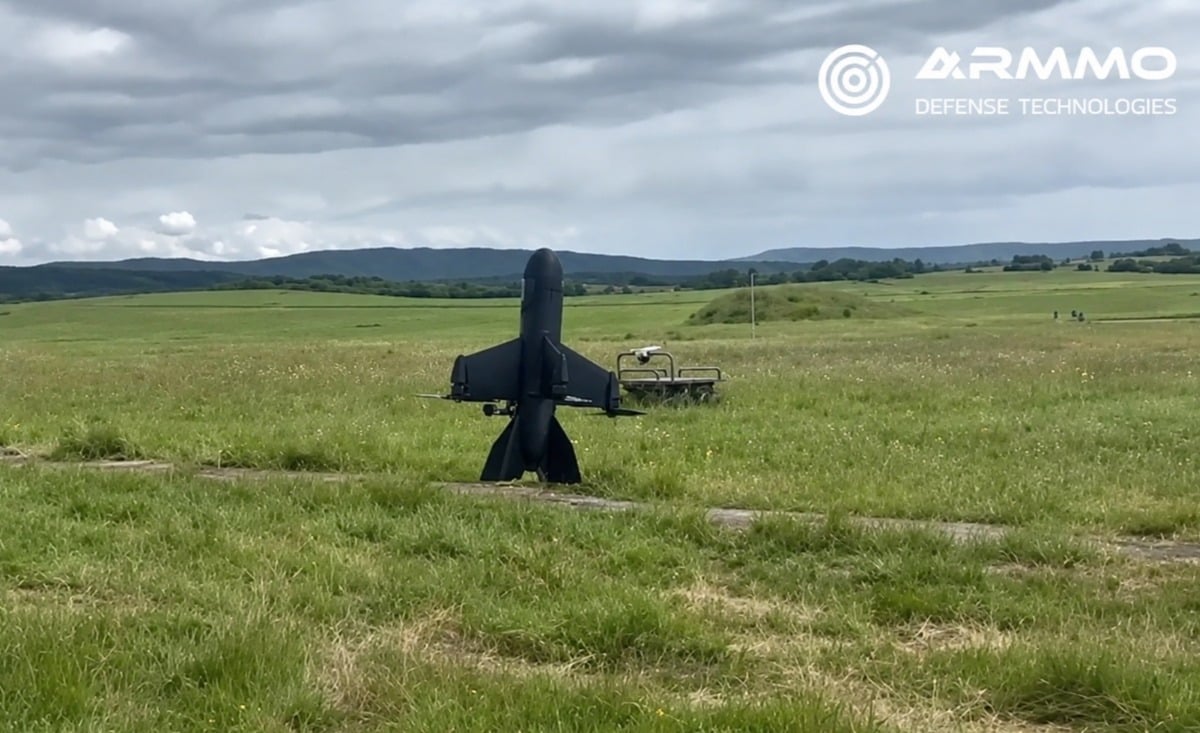
The operational deployment of the BANDIT-X hard-kill interceptor by Spanish defense firm ARMMO Defense Technologies during NATO’s Pilot Project 5 exercises in Slovakia marks a structural shift in low-altitude counter-unmanned aerial systems (C-UAS) doctrine. While initial media reports focus on the kinetic interception event itself, the underlying military value rests on three systemic variables: kill-chain latency, cost-per-engagement asymmetries, and architectural sensor-to-effector interoperability. Treating the kinetic interceptor as an isolated solution miscalculates the true operational bottleneck of modern electronic and kinetic air defense. Effective mitigation of small, agile Group 1 and Group 2 unmanned aerial vehicles (UAVs) requires an integrated network where the kinetic interceptor is merely the final mechanical variable in a multi-layered equation.
To understand the strategic utility of the BANDIT-X system, the entire engagement sequence must be broken down into discrete engineering phases. Analyzing the recent field tests reveals how multi-sensor telemetry, command-and-control software layers, and autonomous kinetic effectors must function together to counter contemporary swarm and first-person view (FPV) operational profiles.
The Sensor to Effector Functional Chain
The BANDIT-X does not operate in a vacuum. Its efficacy is bound to the performance limits of a tripartite defense envelope deployed by ARMMO during the Slovakian exercises. This architecture segregates tasks across three distinct layers.
- Layer 1: Detection and Telemetry Acquisition. Before any kinetic asset can clear its launch rail, the target's flight vector, velocity, and radar cross-section must be quantified. The detection system deployed alongside the BANDIT-X establishes the initial tracking telemetry. The primary constraint here is signal propagation delays and processing latency, which dictate the maximum reaction window available to the defense system.
- Layer 2: Command and Control Local Processing. The system processes tracking data to differentiate between environmental noise, friendly assets, and hostile threats. The tracking algorithms calculate intercept vectors based on current wind vectors, target acceleration capabilities, and the interceptor’s performance envelope.
- Layer 3: The Kinetic Interceptor (BANDIT-X). This is the hard-kill effector designed to physically neutralize the incoming threat. By using direct kinetic impact or an optimized proximity mechanism, it eliminates the target without requiring expensive, heavy guided missile infrastructure.
+---------------------+     +----------------------+     +---------------------+
| Layer 1: Detection  | --> | Layer 2: C2 Processing| --> |  Layer 3: BANDIT-X  |
| Telemetry & Tracking|     |  Vector Calculation  |     | Kinetic Hard-Kill   |
+---------------------+     +----------------------+     +---------------------+
The coordination between these layers addresses a historical vulnerability in C-UAS operations: the handoff bottleneck. When electronic detection systems operate independently from kinetic deployment mechanisms, the delay in passing target coordinates often exceeds the flight duration of low-altitude threats. The Slovakian exercises demonstrated that tightening this internal latency loop determines success far more than the raw speed of the interceptor itself.
The Cost Function of Low Altitude Air Defense
Traditional air defense architectures rely on guided surface-to-air missiles to neutralize aerial threats. When applied to small, mass-produced FPV drones and loitering munitions, this economic model collapses. A standard short-range air defense missile can cost anywhere from tens of thousands to hundreds of thousands of dollars, whereas a commercial-off-the-shelf FPV drone modified for military use often costs less than five hundred dollars.
The economic equation governing sustainable defense requires that the cost of the interceptor scales linearly with the cost of the threat. The BANDIT-X addresses this cost asymmetry through deliberate structural design choices.
Expenditure Asymmetry Mitigation
By stripped-down mechanical engineering and localized guidance loops, the per-unit deployment cost of a hard-kill drone interceptor is kept orders of magnitude lower than conventional anti-air missiles. This permits defensive forces to maintain an economically viable exchange ratio during protracted attrition campaigns.
Payload Optimization
Instead of relying on complex onboard active radar seekers, the system relies on external tracking feeds paired with low-cost terminal guidance sensors. This shifts the financial and technological burden from the expendable effector to the reusable ground infrastructure.
Reusability and Recovery Systems
Unlike missile systems that are inherently single-use, certain classes of drone interceptors incorporate modular recovery mechanisms. If an intercept mission is aborted or if the target is neutralized by electronic warfare before physical impact, the asset can be recovered, refurbished, and re-racked for subsequent operational cycles.
The structural economic challenge can be framed through a simple mathematical representation of defensive sustainability:
$$S = \frac{C_{\text{threat}} \times P_{\text{pk}}}{C_{\text{interceptor}} + C_{\text{infrastructure_depreciation}}}$$
Where defensive sustainability ($S$) must remain greater than or equal to 1.0 to prevent economic exhaustion. If the cost of the interceptor ($C_{\text{interceptor}}$) exceeds the value of the threat ($C_{\text{threat}}$) scaled by the probability of a kill ($P_{\text{pk}}$), the defensive posture is mathematically unsustainable over an extended conflict timeline. The design philosophy of the BANDIT-X is targeted precisely at optimizing this denominator.
Tactical Multi-Role Interoperability
During the NATO maneuvers in Central Europe, the deployment went beyond the BANDIT-X interceptor to include wider mission profiles. The integration of the Gull bomber UAS alongside the kinetic interceptor demonstrates a dual-spectrum operational philosophy. The Gull platform executed drop-off logistics and tactical strike testing, while the BANDIT-X maintained defensive airspace sanitization.
This multi-role pairing addresses a critical operational requirement for forward-deployed units: logistics and defense footprint consolidation. Units cannot afford to transport distinct, incompatible hardware ecosystems for offensive strikes, logistical resupply, and local air defense. Utilizing a unified command interface and shared ground control infrastructure minimizes the physical payload footprint of the deployment package.
The physical terrain of Slovakia offered an ideal baseline for evaluating these interactions. High-clutter environments, variable microclimates, and complex topographic profiles introduce severe radar degradation and multipath interference. When tracking low-flying drones against complex terrain, ground clutter can mask the target's signature. The successful execution of these tests indicates that the tracking and interception algorithms have achieved a baseline proficiency in filtering out non-threat environmental returns.
Operational Limitations and Structural Vulnerabilities
An objective strategic assessment must reject the notion of a flawless defense mechanism. Hard-kill interceptors like the BANDIT-X possess distinct physical and operational constraints that must be planned for within any wider defense network.
The primary limitation involves swarm saturation thresholds. Every tracking system has a maximum concurrent target tracking capacity, and every launch rail has a mechanical cycle time. If an adversary deploys a synchronized saturation attack where the quantity of incoming threats exceeds the available simultaneous tracking channels or available ready-to-launch interceptors, the defensive perimeter will experience a breakthrough.
The second limitation is thermal and battery density dependencies. Electric propulsion systems face hard physical limits regarding acceleration curves and flight endurance. High-speed interception requires rapid energy discharge rates. This limits the operational loiter time of the interceptor. If the target detects the interceptor launch and executes evasive maneuvers or delays its approach, the interceptor may exhaust its onboard energy reserves before achieving kinetic neutralization.
The third vulnerability centers on electronic spectrum dependency. Although the BANDIT-X operates as a kinetic hard-kill asset, its initial vectoring commands rely entirely on secure data links. Intense radio-frequency jamming or localized GPS spoofing can degrade the quality of the telemetry transmitted from the ground sensors to the airborne interceptor. Without clean, continuous coordinate updates during the initial flight phase, the terminal guidance window becomes too narrow to guarantee successful interception.
Strategic Allocation and Fleet Architecture
To maximize the utility of the BANDIT-X within an integrated air defense network, defense planners must avoid deploying it as a standalone point-defense asset. Instead, it must be integrated into a tiered defensive grid.
Early-warning long-range radar and electronic intelligence systems should form the outer perimeter, identifying incoming threats at distances exceeding ten kilometers. Electronic warfare jamming systems occupy the mid-tier layer, disabling or disrupting the navigation systems of unhardened commercial drones. The BANDIT-X should be positioned as the inner-tier hard-kill mechanism, reserved specifically for hardened, autonomous threats that ignore radio frequency disruption or bypass electronic countermeasures.
Deploying forces must also implement strict launch protocols to manage the expenditure of interceptors. Automating the threat assessment process within the command-and-control software prevents human operators from launching multiple interceptors against a single low-priority threat. The software must dynamically calculate whether an incoming drone is on a high-value trajectory or if it will impact non-critical open terrain, ensuring that interceptor stockpiles are preserved for high-risk engagements.
The future configuration of low-altitude airspace defense will be defined by autonomous, rapid-response kinetic networks. The performance data validated by ARMMO in Slovakia confirms that low-cost, purpose-built drone interceptors are mechanically capable of executing precision kinetic neutralization under rigorous field conditions. The strategic priority now shifts from proving the basic physics of the interceptor to scaling the manufacturing pipelines and perfecting the data-link integration required to operate these systems across entire theater fronts.