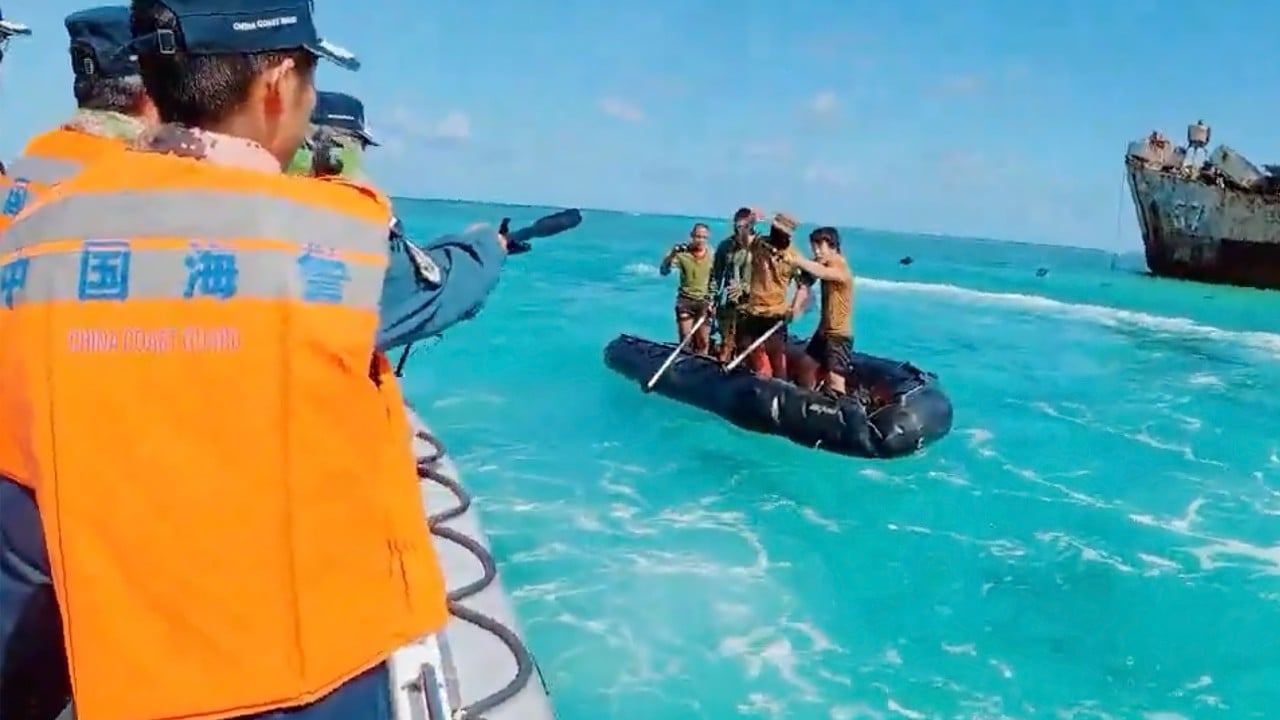
China’s strategy at Second Thomas Shoal operates on a deliberate cost-imposition framework designed to force Philippine retreat from the BRP Sierra Madre without triggering the 1951 U.S.-Philippines Mutual Defense Treaty. By substituting kinetic military action with non-lethal enforcement actions—acoustic devices, water cannons, targeted collisions, and boarding actions—Beijing creates an operational asymmetry. Manila bears high physical and financial risk to sustain a forward presence, while Beijing incurs minimal escalation penalty.
Deconstructing this conflict requires moving past vague descriptions of "simmering tensions" and evaluating the structural mechanics driving gray-zone operations in the South China Sea.
The Tri-Layered Maritime Blockade Strategy
China Coast Guard (CCG) operations at Second Thomas Shoal do not function in isolation. They form the outer enforcement arm of a synchronized, three-tiered maritime architecture designed to isolate the Philippine garrison atop the grounded LST-57 matrix.
The Primary Escort Tier (People's Liberation Army Navy)
PLA Navy surface combatants operate on the outer perimeter, maintaining horizon control. Their purpose is not direct engagement with Philippine supply boats, but over-horizon deterrence aimed at foreign naval assets, specifically third-fleet surface elements from the United States Navy. Their presence sets a ceiling on foreign military intervention.The Interdiction Tier (China Coast Guard)
CCG vessels act as the tactical vanguard. Utilizing superior displacement, reinforced hulls, and non-lethal force projection, these ships execute aggressive physical blocking maneuvers, supply boat disabling tactics, and localized acoustic disruptions.The Saturation Tier (Maritime Militia)
Commercial fishing vessels operating under maritime militia command construct a dense inner network surrounding the shoal. This fleet absorbs maneuver room, impedes Philippine Coast Guard (PCG) escort vessels, and creates continuous visual and structural drag on resupply operations.
The Resupply Mechanics and Operational Vulnerabilities
The physical anchor of Philippine sovereignty at Second Thomas Shoal is the BRP Sierra Madre, a World War II-era tank landing ship intentionally run aground in 1999. The structure's structural degradation creates a time-bound vulnerability for Manila.
+-----------------------------------------------------------------------+
|                        OPERATIONAL TACTICS                            |
+-----------------------------------------------------------------------+
|  Philippine Resupply Vector:                                          |
|  Wooden Resupply Hull (Unaizah May) + PCG Escort (Teresa Magbanua)    |
|                                                                       |
|  Interdiction Vector:                                                 |
|  CCG Water Cannon Strike -> Hull Disablement -> Special Operations    |
|                                                                       |
|  Structural Objective:                                                |
|  Prevent Transfer of Reinforcing Steel/Cement -> Accelerate Decay     |
+-----------------------------------------------------------------------+
Philippine resupply missions (RORE - Rotation and Resupply) face two distinct operational bottlenecks:
Structural Decay Rate vs. Construction Ingress
The BRP Sierra Madre relies on continuous structural reinforcement to prevent structural collapse from saltwater corrosion. Resupply missions split their payload between basic human sustainment (food, water, medicine) and heavy construction materials (steel beams, concrete, waterproofing agents). CCG interdiction selectively targets vessels carrying heavy construction materials while occasionally permitting basic sustainment missions. This selective filtering accelerates the physical degradation of the hull without causing a humanitarian crisis that could force a kinetic response from external allies.
Hull Asymmetry and Propulsion Disruption
Philippine RORE missions historically utilized wooden-hulled civilian supply boats, such as the Unaizah May 1 and Unaizah May 2, to minimize sovereign military exposure. However, these hulls lack structural resistance against CCG high-pressure water cannons, which generate pressures sufficient to shatter wooden superstructures, shatter glass, and disable internal combustion engines. Moving to steel-hulled PCG vessels increases survivability but exposes state assets directly to mechanical damage, hull ramming, and maritime boarding operations by CCG personnel equipped with bladed weapons and physical interdiction gear.
Escalation Management and Treaty Threshold Mechanics
The core calculation governing Chinese tactics is the precise calibration of force beneath the threshold of an "armed attack" under Article IV of the U.S.-Philippines Mutual Defense Treaty (MDT).
FORCE THRESHOLD MODEL
+-----------------------------------------------------------------------+
|  LEVEL 01: Low-Level Gray Zone (Incursions, AIS Spoofing)             |
|  LEVEL 02: Active Interdiction (Water Cannons, Hull Ramming)           |
|  LEVEL 03: Directed Non-Lethal (Laser Disruption, Boarding Actions)   |
|  ===================================================================  |
|  MDT THRESHOLD (Armed Attack Trigger Line)                            |
|  ===================================================================  |
|  LEVEL 04: Kinetic Engagement (Small Arms, Missile Strikes)           |
+-----------------------------------------------------------------------+
Beijing optimizes force delivery within Level 02 and Level 03. This strategy yields three structural advantages:
- Legal Ambiguity: Employing coast guard and militia assets frames engagements as maritime law enforcement rather than state-on-state military aggression.
- Alliance Friction: By keeping casualties low and avoiding kinetic firearms, China creates strategic hesitation among treaty partners, forcing continuous debates over what constitutes an actionable breach of security commitments.
- Operational Imbalance: Manila must invest substantial political, diplomatic, and naval resources to publicize and counter tactics that cost Beijing very little in material or economic terms.
Strategic Countermeasures and Risk Factors
To counter China's interdiction model, Manila implemented the "Transparency Initiative," systematically filming, documenting, and releasing high-definition footage of gray-zone engagements to global press networks. While effective in damaging Beijing's diplomatic standing, public exposure alone does not alter the physical reality on the water.
A sustained operational strategy requires shifting from reactive exposure to structural friction:
- Sovereign Fleet Replacement: Retiring unreinforced civilian supply hulls in favor of militarized, steel-hulled landing craft equipped with reinforced superstructure shielding and specialized propulsion protection.
- Co-Escort Integration: Transitioning from solo PCG escorts to joint maritime patrols involving bilateral or multilateral naval presence on the outer perimeter of the Philippine Exclusive Economic Zone (EEZ).
- Point-of-Presence Structural Repair: Utilizing modular, rapid-curing maritime repair tech deployed via heavy-lift rotary assets to bypass the CCG surface blockade entirely.
Failure to secure the structural stability of the BRP Sierra Madre will eventually render the outpost uninhabitable. Once the structure collapses naturally under environmental stress, the CCG will establish a permanent perimeter, achieving a de facto operational enclosure of Second Thomas Shoal without firing a single shot.