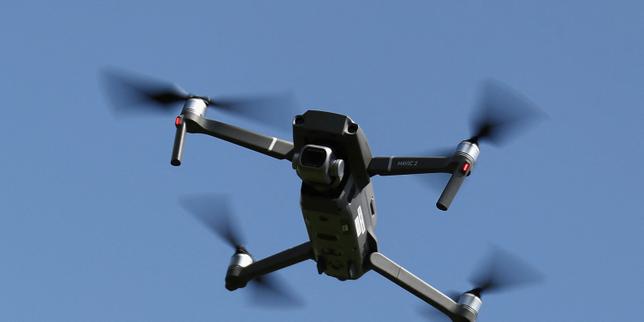
The proliferation of commercially available unmanned aerial systems by non-state armed actors in the Sahel represents a fundamental shift in the regional security calculus. Jama'at Nusrat al-Islam wal-Muslimin (JNIM), the Al-Qaeda affiliate operating across Mali, Burkina Faso, and neighboring zones, has transitioned from using dual-use quadcopters strictly for intelligence, surveillance, and reconnaissance (ISR) to executing kinetic strikes via modified improvised explosive devices and first-person view guidance. This operational evolution alters the cost-to-damage ratio of asymmetric warfare, rendering traditional static defense architectures increasingly obsolete.
The Mechanics of Commercial Weaponization
The technical barrier to entry for airborne asymmetric warfare has collapsed. Standard multirotor platforms, such as commercially accessible DJI series drones, feature built-in electronic stability, high-resolution optical stabilization, and encrypted frequency hopping that complicates localized radio-frequency jamming. Rather than manufacturing complex ordnance, insurgent networks employ straightforward engineering adaptations: 3D-printed release mechanisms or strapped explosive payloads configured to detonate upon impact or via remote signal.
This method circumvents the supply chain bottlenecks that traditionally restrict non-state actors from acquiring advanced military hardware. Because these platforms are procured via civilian commercial channels or gray-market smuggling networks across porous borders, counter-proliferation strategies focused on state-to-state arms embargoes fail to constrain supply. The economic asymmetry is stark: a commercially acquired quadcopter valued at a few thousand dollars can force a state military to expend disproportionate resources on electronic countermeasures, personnel dispersion, or high-end air defense assets.
Operational Integration and Doctrinal Adaptation
JNIM’s adoption of aerial capabilities is not merely an upgrade in tactical firepower; it represents an integration into existing guerrilla methodologies. The operational employment of these systems follows three distinct vectors:
- Precision Harassment of Static Infrastructure: Rather than attempting complex frontal assaults on fortified military encampments, groups use small unmanned systems to drop explosives directly onto open-air sleeping quarters, fuel depots, and vehicle parks within base perimeters. This causes attrition without exposing ground forces to direct fire.
- Force Multiplication During Complex Ambushes: Aerial observation platforms provide real-time telemetry to ground commanders, allowing them to adjust flanking maneuvers, monitor reinforcement routes, and evaluate the defensive posture of targeted convoys in real time.
- Psychological Erosion: The psychological impact of persistent airborne vulnerability degrades the morale of garrisoned troops and regional self-defense militias. The auditory profile of a small quadcopter creates operational paralysis, forcing units to restrict movement even when no kinetic strike occurs.
This tactical evolution mirrors developments in other global conflict zones, yet its manifestation in the Sahel interacts with uniquely fragmented state capacities and vast geographic expanses.
Limitations of Kinetic Countermeasures
Sahelian governments and their external security partners have primarily relied on kinetic responses and high-altitude military drones—such as Turkish-supplied Bayraktar TB2 and Akinci systems—to reestablish air dominance. However, these high-end assets are fundamentally unsuited for neutralizing decentralized, highly mobile commercial drone cells.
The structural limitations of current defense models include:
- Economic Inefficiency: Deploying multimillion-dollar precision munitions against dispersed operators utilizing off-the-shelf quadcopters creates an unsustainable fiscal deficit for resource-constrained states.
- Sensor-to-Shooter Latency: Conventional military command and control structures are too rigid to detect, track, and neutralize low-altitude, low-radar-cross-section micro-drones before they complete their flight profiles.
- Geographic Overextension: The vast operational theater spanning the Gourma region, the Liptako-Gourma tri-border area, and coastal approaches makes comprehensive radar and electronic blanket coverage mathematically impossible.
Consequently, reliance on purely kinetic military campaigns has generated secondary operational frictions, including civilian casualties resulting from imprecise airstrikes, which further alienate local populations and indirectly feed insurgent recruitment pools.
Strategic Forecasting
The integration of aerial delivery mechanisms by Al-Qaeda affiliates in the Sahel will likely accelerate horizontally across West Africa. As technical proficiency spreads through cross-pollination with external conflicts and open-source digital knowledge sharing, the sophistication of these payloads will transition from basic gravity-dropped explosives to precision-guided or autonomous terminal attacks.
Mitigating this vector requires a structural pivot away from centralized air superiority toward decentralized, multi-layered passive defense strategies. This entails the hardening of forward operating bases against overhead vertical threats, the deployment of tactical, short-range electronic jamming architectures at the platoon level, and the establishment of localized early-warning networks. Without these adaptations, the cost of territorial control will continue to shift decisively in favor of decentralized insurgent networks.


