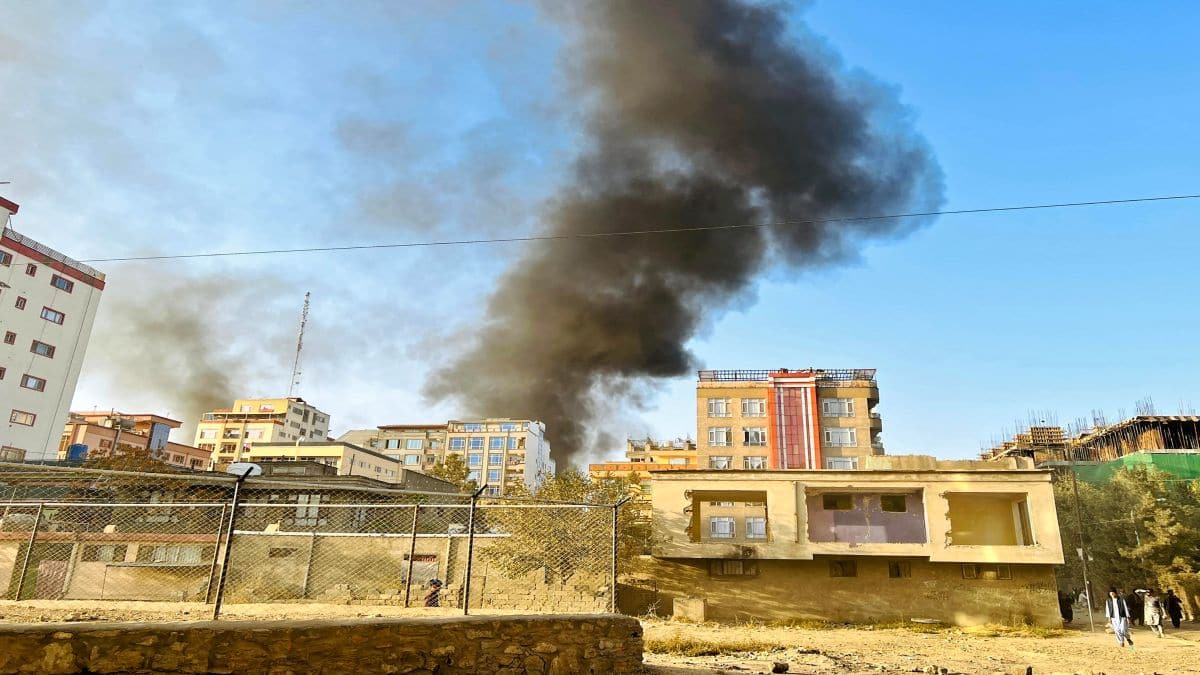
The recent kinetic activity along the Durand Line—marked by reported airstrikes in Khost and Paktika provinces followed by retaliatory Taliban fire—signals a fundamental shift from diplomatic friction to active military containment. This escalation is not a random outburst of hostility; it is the manifestation of a breakdown in the cross-border security pact that has historically governed the relationship between Islamabad and Kabul. The operational mechanics of these strikes suggest a targeted strategy of "active denial," wherein one state utilizes superior aerial assets to degrade the insurgent infrastructure of groups like the Tehrik-i-Taliban Pakistan (TTP) while the host government remains either unwilling or unable to exercise a monopoly on the use of force.
The Triad of Border Instability
The current conflict is driven by three distinct structural pressures that have reached a saturation point. Understanding these pillars is essential for interpreting the tactical movements on the ground.
- The Sovereignty Paradox: The Taliban government claims total territorial control but lacks the capability to prevent non-state actors from utilizing Afghan soil as a launchpad for external operations. This creates a vacuum where neighboring states feel compelled to project power across borders to secure their own internal stability.
- Strategic Depth Reversal: For decades, the concept of "strategic depth" dictated that a friendly government in Kabul would provide security for Pakistan’s western flank. This doctrine has inverted. The current administration in Kabul now views its ideological affinity with the TTP as a point of leverage, turning a former security asset into a primary liability.
- Technological Asymmetry: The Taliban’s retaliatory capability is limited to ground-based artillery and light infantry maneuvers. In contrast, the use of high-altitude platforms and precision-guided munitions allows for a "decapitation" strategy—targeting specific command and control nodes without committing ground troops to the difficult terrain of the border regions.
Mechanics of the Aerial Response
Eyewitness accounts of "jets overhead" and subsequent blasts in residential areas point to a specific kinetic profile. When a modern air force engages in cross-border strikes against non-state actors, it follows a rigorous targeting cycle: find, fix, track, target, engage, and assess (F2T2EA).
The choice of targets in Paktika and Khost indicates that the intelligence priority was the destruction of "guest houses" or transit hubs. These locations serve as the logistical connective tissue for the TTP. By striking these points, the attacking force aims to increase the friction cost of insurgent operations. If commanders cannot sleep in a fixed location without the threat of a kinetic strike, their ability to plan complex, multi-stage attacks within Pakistan is significantly diminished.
However, this strategy carries a high risk of collateral damage. In the rugged topography of eastern Afghanistan, insurgent assets are often integrated into civilian environments. The resulting civilian casualties do not just create a humanitarian crisis; they serve as a recruitment catalyst, potentially offsetting the tactical gains of the strike by hardening local sentiment against the "foreign" aggressor.
The Cost Function of Retaliation
The Taliban's response—targeting border outposts with heavy weaponry—is a calculated move to reassert domestic legitimacy. For a movement that defined itself through the expulsion of foreign airpower, remaining passive in the face of new airstrikes is politically untenable.
The Taliban’s military calculus is governed by a resource-constrained attrition model. They cannot win a conventional air war, so they pivot to "horizontal escalation." This involves:
- Border Pressure: Forcing the opponent to keep a massive infantry presence on the line, draining their national treasury.
- Irregular Support: Increasing the flow of intelligence and equipment to insurgent groups already operating inside the opponent’s borders.
- Diplomatic Theater: Using international forums to decry sovereignty violations, attempting to isolate the aggressor despite the underlying causes of the conflict.
Analyzing the "Safe Haven" Variable
A critical bottleneck in regional stability is the definition of a "safe haven." From a data-driven perspective, a safe haven is defined by three metrics: unimpeded movement, logistical replenishment, and digital sanctuary.
Recent data on TTP activity shows a 60% increase in cross-border attacks since the transition of power in Kabul. This spike suggests that the "unimpeded movement" variable has been fully unlocked. When a state loses the ability to monitor its borders effectively, it must rely on "remote sensing" and "remote strike" capabilities. The airstrikes are an admission that ground-based border management has failed.
The "digital sanctuary" aspect is equally vital. Insurgent groups use the relative safety of Afghan territory to run sophisticated propaganda and recruitment networks. Airstrikes rarely disrupt this. Unless the kinetic action is paired with a systematic degradation of the group’s financial and digital infrastructure, the physical destruction of a few buildings provides only a temporary reprieve.
Structural Bottlenecks to Peace
The primary obstacle to de-escalation is the lack of a credible "enforcement mechanism" for bilateral agreements. In standard international relations, a treaty is backed by the threat of sanctions or military intervention. In this case, the Taliban are already under heavy international sanctions and have survived decades of military intervention.
This leaves the neighboring state with few options other than:
- The Buffer Zone Strategy: Attempting to clear a 10-20km strip of land on the Afghan side to prevent short-range incursions. This is logistically intensive and historically prone to failure in mountainous terrain.
- The Managed Instability Model: Accepting a baseline level of violence and using periodic airstrikes to keep the threat "below the threshold" of a national emergency.
- Economic Leverage: Utilizing the fact that landlocked Afghanistan depends on its neighbors for trade routes and electricity. However, the Taliban have shown a high tolerance for economic pain if it means maintaining their ideological core.
The Logic of the Next Kinetic Phase
We are moving away from a period of "denied involvement" toward a period of "calibrated aggression." The attacking party is no longer hiding the fact that its jets are crossing the border. This transparency is a deliberate signaling mechanism intended to show the Kabul administration that the "red lines" regarding TTP activity are non-negotiable.
The Taliban's counter-signaling—moving heavy equipment toward the border—is an attempt to raise the "entry price" for future strikes. They want to communicate that every aerial incursion will result in a bloody, protracted ground skirmish at the border outposts.
The strategic play here is not to expect a total cessation of hostilities. Instead, stakeholders must monitor the frequency-intensity ratio. If the frequency of airstrikes decreases but the intensity (tonnage of munitions, high-value targets) increases, it indicates a shift toward a "special operations" mindset. If both increase, the region is moving toward a conventional interstate conflict that neither side can financially sustain.
The most effective tactical move for the Taliban, should they wish to end the strikes, is the visible relocation of TTP elements away from the border provinces. For Pakistan, the next step is the formalization of "Rules of Engagement" that allow for hot pursuit without triggering a total breakdown in trade. Failure to establish these protocols will lead to a permanent state of border attrition that degrades the economic potential of the entire region.
Monitor the movement of the 201st and 203rd Taliban Corps. Their deployment patterns in the coming weeks will indicate whether the Kabul administration intends to truly challenge the aerial superiority of its neighbor or if the current exchange was merely a performance of sovereignty for a domestic audience.