You can always count on global markets to flip the script just when everyone expects a crash. For months, the ongoing military conflict with Iran and the total bottleneck at the Strait of Hormuz kept investors sweating. Inflation was spiking, supply chains were broken, and energy costs felt ready to boil over.
Then came the sudden relief valves. Wall Street shot to fresh records right after the Memorial Day holiday, and Asian shares are mostly higher in response. Tech stocks are skyrocketing, and crude prices are finally letting off some steam.
If you are trying to make sense of your portfolio right now, you need to understand that this isn't just a random green day. It is a massive structural shift where artificial intelligence hype is colliding with easing geopolitical anxiety.
How Micron and the hardware boom triggered an international rally
The massive gains on Wall Street didn't happen in a vacuum. The tech-heavy Nasdaq composite rallied 1.2% and the S&P 500 climbed 0.6% to secure new record highs. The main engine behind this explosion was Micron Technology, which witnessed a jaw-dropping 19.3% single-day surge.
This massive jump happened after Timothy Arcuri and his team of analysts at UBS blew the doors off their previous forecasts. They lifted their 12-month price target for Micron from $535 all the way to $1,625, betting heavily on an insatiable global demand for computer memory chips. Micron closed the session at $895.88, joining the elite $1 trillion club alongside Nvidia, Apple, and Microsoft.
When New York sneezes, Asia usually catches a cold. But when New York buys semiconductors, Asia throws a party. Because countries like South Korea and Taiwan are the literal factories of the global tech stack, the massive demand in America translated directly into massive stock gains across the Pacific.
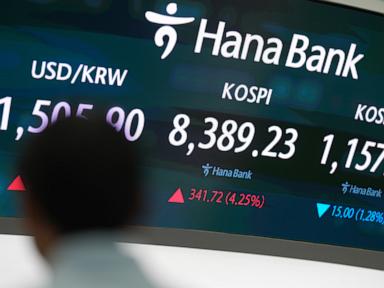
- South Korea: The Kospi index in Seoul jumped 2.3% to hit 8,228.70, anchored by a 2.3% gain in hardware heavyweight Samsung Electronics.
- Taiwan: The Taiex surged 1.7% as local chip foundries picked up major momentum from the Micron news.
- Japan: Tokyo’s Nikkei 225 briefly crossed the massive 66,000 threshold before hitting some profit-taking to close flat at 64,999.41. Chip equipment manufacturer Tokyo Electron jumped 2.1%, and testing specialist Advantest rallied 4.1%.
The oil market is breathing a sigh of relief
While tech stocks are going vertical, energy markets are heading in the opposite direction. Brent crude, the international benchmark, dropped $3 to hit $93.89 a barrel. Meanwhile, U.S. benchmark crude fell $2.94 to land at $91.89.
To put this in perspective, oil was stuck trading above $115 earlier this month. The disruption in the Strait of Hormuz since late February had effectively trapped tankers inside the Persian Gulf, triggering a brutal wave of inflation.
The sudden drop in prices comes down to shifting political rhetoric. President Donald Trump noted that back-channel negotiations to end the war are "proceeding nicely." Traders who had baked a massive geopolitical premium into oil prices are now unwinding those bets.
This drop in energy prices is doing wonders for the broader economy. Cheaper oil means lower shipping, manufacturing, and operational expenses for almost every corporation on the planet.
The bond market connection you can't afford to ignore
Most casual investors ignore the bond market, but that is a huge mistake. The real reason Wall Street and Asian shares are mostly higher is that falling oil prices directly relieved the pressure on government bonds.
When energy costs drop, inflation expectations weaken. As a result, the yield on the 10-year U.S. Treasury note dropped from 4.56% down to 4.47%.
High bond yields act like gravity on stock prices. When you can get a guaranteed, risk-free return on government debt, risky equities look a lot less attractive. By sliding under 4.5%, the 10-year Treasury yield gave equity investors a green light to pour cash back into growth stocks.
Not every Asian market joined the party
It is easy to get caught up in the green screens, but this global rally isn't entirely uniform. There is a clear divide right now between tech-heavy exporters and economies dealing with internal structural drag.
Mainland China and Hong Kong markets actually finished the session lower, completely decoupling from the broader regional trend. Hong Kong's Hang Seng index dropped 1.1% to close at 25,328.23, while the Shanghai Composite index shed 1.3% to settle at 4,093.73. Investors in these markets remain highly cautious about domestic consumer spending and real estate stability, proving that even a massive global tech wave can't fix localized economic headwinds.
Australia's S&P/ASX 200 managed a 0.7% gain to reach 8,717.70, finding support from its banking and mining sectors. India's Sensex remained essentially flat, down a mere 0.1%, as domestic investors balanced international optimism against local valuations.
What you should do next with your capital
Blindly chasing all-time highs is a terrible strategy, but sitting on cash while inflation eats your purchasing power isn't any better. Here is how you can practically navigate this specific market environment.
First, check your tech exposure. If you own broad index funds or tech ETFs, you have been riding the hardware wave. But you need to check if you are over-concentrated in a few trillion-dollar names. Rebalancing some gains into sectors that benefit from cheaper oil, like logistics, transport, or consumer staples, can protect your downside.
Second, keep a close eye on the bond market. If the 10-year Treasury yield starts creeping back toward the 4.6% mark, expect the stock rally to lose steam quickly.
Ultimately, the market is betting on a world where technology demand stays red hot and energy crisis fears slowly melt away. Position your capital where the earnings are real, and don't let daily headlines scare you out of long-term trends.