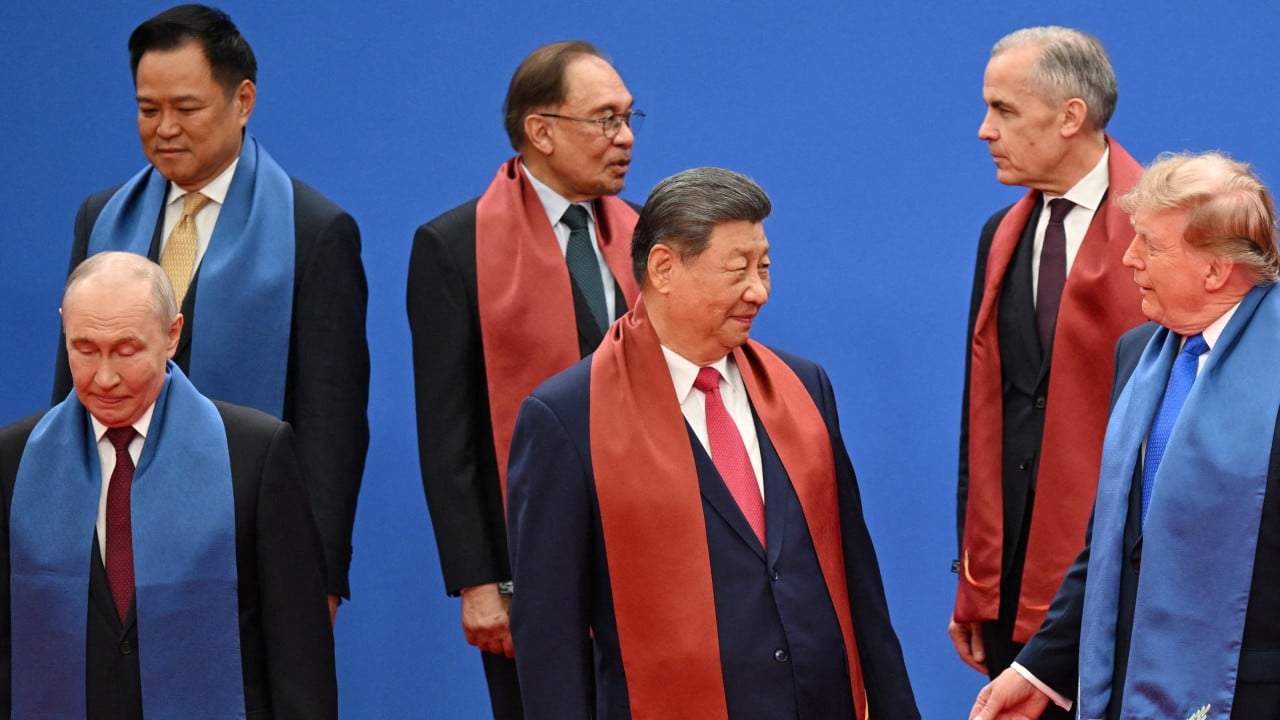
Asian capitals are not merely watching from the sidelines as Donald Trump, Xi Jinping, and Vladimir Putin maneuver toward high-stakes diplomatic talks. They are actively bracing for a geopolitical squeeze that threatens to bypass their sovereignty, rewrite regional security guarantees, and disrupt trillions of dollars in trade. From Tokyo to Singapore, defense ministries and central banks are operating on a stark premise—when Washington, Beijing, and Moscow negotiate directly, smaller Indo-Pacific nations rarely get a seat at the table, yet they almost always foot the bill.
For decades, the Asian security architecture relied on a predictable formula. The United States provided the military umbrella, China served as the manufacturing engine, and Russia remained a peripheral supplier of discounted energy and legacy weaponry. That era is dead. Today, the prospect of bilateral or trilateral bargains among the world's three most consequential strongmen has forced every middle power in the Pacific to recalculate its survival strategy.
The Myth of the Passive Bystander
Mainstream coverage often portrays Southeast and East Asian nations as anxious spectators waiting for white smoke to rise from a summit between Trump, Xi, and Putin. That framing misses the frantic, behind-the-scenes hedging already underway. Governments in Seoul, Tokyo, Manila, and Jakarta are not waiting passively; they are actively insulating their economies and militaries against the worst-case outcomes of a great-power deal.
Consider the fundamental anxiety driving policymakers in the region. It is not just the fear of a kinetic conflict over Taiwan or the South China Sea. Equally terrifying to Asian leaders is the prospect of a grand bargain—a transactional arrangement where Washington trades away regional commitments in exchange for concessions on trade deficits, fentanyl precursors, or a settlement in Eastern Europe.
History offers uncomfortable precedents. During the Cold War, Asian allies watched nervously during the Nixon-Mao rapprochement, which abruptly altered diplomatic realities overnight without prior consultation with regional partners. Modern leaders remember that lesson well. They know that transactional diplomacy prioritizes immediate domestic political wins over long-term alliance maintenance.
The Bilateral Trap
Multilateral institutions like the Association of Southeast Asian Nations (ASEAN) were designed to give smaller states collective bargaining power against larger predators. Yet, the current diplomatic environment systematically undermines multilateralism. Trump has consistently favored one-on-one negotiations where American economic weight can be applied directly. Xi prefers bilateral pressure to divide neighbors over maritime claims. Putin thrives in chaotic, non-institutional environments where bilateral energy and arms deals can bypass Western sanctions.
When these three approaches converge, regional forums become talking shops while real decisions happen behind closed doors. Asian diplomats privately admit that they often learn about major shifts in superpower posture through press briefings rather than allied consultations. This communication vacuum breeds paranoia. If Tokyo cannot be certain how Washington will define deterrence next month, Tokyo must accelerate its own defense spending and rearmament today.
Economic Fallout and the Supply Chain Squeeze
Beyond military posturing, the immediate impact of Xi-Trump-Putin negotiations hits the balance sheets of Asian exporters. The region sits at the center of global manufacturing, and every tariff threat or sanctions regime ripples instantly through ports in Busan, Kaohsiung, and Haiphong.
Over the past several years, multinational corporations spent billions executing a China Plus One strategy, shifting final assembly lines to Vietnam, India, Malaysia, and Indonesia to dodge American tariffs on Chinese goods. Now, that expensive diversification faces a severe threat. If Washington imposes universal baseline tariffs or targets third-party countries used as transshipment hubs for Chinese components, the entire Southeast Asian industrial boom could stall.
At the same time, Beijing holds immense leverage over its neighbors' economic stability. China remains the largest trading partner for nearly every major Asian economy. When trade friction escalates between Washington and Beijing, Chinese manufacturers inevitably dump excess industrial capacity—steel, solar panels, electric vehicles, and consumer electronics—into Southeast Asian markets at below-market prices. Domestic factories in Thailand and Indonesia are already closing their doors, unable to compete with state-subsidized Chinese imports seeking an outlet outside the restricted American market.
The Energy and Sanctions Tightrope
Russia’s role in this triangle complicates the economic calculus further. While European nations severed ties with Russian energy, Asian buyers stepped into the void. India and China absorbed massive volumes of discounted Russian crude, stabilizing Moscow’s war chest while keeping domestic inflation low in New Delhi and Beijing.
However, secondary sanctions remain a sword hanging over Asian financial institutions. Banks in Singapore, Hong Kong, and Dubai have had to construct elaborate compliance firewalls to avoid being cut off from the U.S. dollar clearing system. If talks between Trump and Putin lead to a sudden easing of sanctions, global energy prices could shift dramatically, upending long-term supply contracts signed by Asian utilities. Conversely, if talks collapse and Washington escalates economic warfare against Moscow’s enablers, Asian shipping companies, insurers, and refiners will face immediate operational paralysis.
Security Guarantees Under the Microscope
Nowhere are the stakes higher than in the defense ministries of America’s treaty allies. Japan, South Korea, and the Philippines have anchored their national security to the credibility of American extended deterrence—the promise that the United States will use its full military might, including its nuclear arsenal, to defend them.
That credibility is facing its sternest test since the end of the Vietnam War.
In Seoul, public and elite debate over acquiring an independent nuclear deterrent has moved from the fringe to the mainstream. South Korean strategists look at North Korea’s expanding nuclear stockpile and deepening military alliance with Russia, then look across the Pacific and wonder whether an American president would truly risk Los Angeles to save Seoul. If Trump engages directly with Kim Jong Un again, or strikes a broader geopolitical understanding with Putin that leaves Pyongyang’s arsenal intact, South Korea’s calculus could shift irreversibly toward nuclear proliferation.
Japan faces a parallel dilemma. Tokyo has broken decades of pacifist tradition by doubling its defense budget, acquiring long-range counterstrike missiles, and deepening defense industrial ties with European partners like the United Kingdom and Italy. Japanese officials are acutely aware that a transactional deal between Washington and Beijing could soften American posture in the East China Sea, leaving Japan isolated against an increasingly assertive Chinese coast guard and navy.
The Taiwan Factor
Taiwan remains the ultimate flashpoint where the interests of all three powers collide. For Xi Jinping, absorbing Taiwan is a foundational political objective tied directly to his legacy. For the United States, maintaining the status quo is essential to preserving its credibility as a Pacific power and protecting access to advanced semiconductors. For Putin, any crisis in the Taiwan Strait serves as a welcome distraction that drains American military resources away from Europe.
The nightmare scenario for Taipei is becoming a bargaining chip. If Washington and Beijing seek a comprehensive trade and security truce, Taiwanese officials fear subtle shifts in American rhetoric—such as distancing from strategic ambiguity or delaying arms deliveries—that could embolden Beijing to tighten its gray-zone blockade tactics.
The Middle Power Counter-Strategy
Faced with the unpredictability of superpower diplomacy, Asian nations are not simply praying for the best. They are executing a sophisticated, multi-layered hedging strategy designed to maximize their own autonomy regardless of what happens when Trump, Xi, and Putin speak.
First, regional powers are building minilateral security networks that do not rely exclusively on Washington. Japan and the Philippines have signed a landmark Reciprocal Access Agreement allowing their troops to train on each other's soil. South Korea has become a major arms supplier to Poland, Australia, and Southeast Asian nations, building defense-industrial interdependence that gives Seoul independent geopolitical weight. India continues to deepen intelligence sharing through the Quad while maintaining historic defense ties with Moscow and expanding trade with the Gulf states.
Second, central banks across Asia are quietly diversifying their foreign exchange reserves. While the U.S. dollar remains irreplaceable for global trade settlement, central banks in Singapore, India, and China have steadily increased their physical gold holdings and expanded bilateral local-currency swap lines. The goal is simple—reduce vulnerability to currency volatility and weaponized financial sanctions triggered by unilateral decisions in Washington.
Third, Asian leaders are engaging in hyper-active personal diplomacy. Prime ministers from Kuala Lumpur to Tokyo are flying constantly between Washington, Beijing, and European capitals, ensuring their perspectives are heard before major summits occur. They recognize that in an era of personalized leadership, absence equals irrelevance.
The Illusion of Stability
A widespread assumption among global investors is that any agreement between Trump, Xi, and Putin will automatically bring stability to Asian markets. If tariffs are paused, if a ceasefire is announced in Eastern Europe, or if military-to-military hotlines are reopened between the Pentagon and the People's Liberation Army, stock indices in Tokyo and Hong Kong will likely rally.
That rally would be built on sand.
Deals struck purely between strongmen without institutional backing or regional buy-in are inherently fragile. They depend entirely on the political survival and shifting moods of the individuals who signed them. A trade truce that fails to address structural overcapacity in China will collapse within months. A security understanding that ignores the territorial disputes of the Philippines, Vietnam, or Japan will only accelerate regional arms races, pushing middle powers toward nuclear hedging and aggressive naval expansion.
Furthermore, Moscow and Beijing share a foundational strategic objective that no short-term diplomatic concession from Washington will erase—both want to end American primacy in Eurasia and the Western Pacific. Even if tactical pauses are negotiated, the underlying structural rivalry remains intact. Putin needs Chinese economic and technological life support to sustain his regime, while Xi needs Russian raw materials and diplomatic backing to counter Western containment. Their partnership has deep material roots that transcend personal chemistry with an American president.
Asian strategists understand this reality far better than most Western commentators. They know that whether the upcoming talks produce a dramatic handshake or an acrimonious walkout, the era of predictable, rules-based stability in the Indo-Pacific is over, leaving every nation in the region to arm itself, diversify its trade, and prepare for a world where only leverage counts.