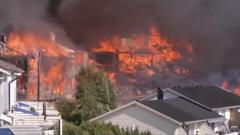
The wind in southern Norway does not usually feel like an enemy. It is typically a clean, bracing presence that sweeps through the valleys and stirs the pines, a reminder of the vast, quiet wilderness that sits just beyond the edge of human habitations. But on a Friday afternoon in Krokstadelva, a quiet town nestled some fifty kilometers west of Oslo, the wind changed its character entirely. It became an accomplice.
Fire is a swift thief, but when paired with an unrelenting summer gale, it transforms into an absolute eraser of lives. What began as a localized outbreak in a single townhouse rapidly breached the boundaries of neighborly separation. Within hours, the flames devoured row after row of terraced housing, turning a tight-knit community into a roaring furnace of thick, black smoke that blotted out the Nordic sky. By the time evening fell, more than one hundred homes were gone.
To read the official dispatches is to encounter a series of sterile metrics. Sixty firefighters. Six water-dousing helicopters. Hundreds of evacuees. Zero reported casualties. In the cold calculus of disaster response, the lack of fatalities is a monumental victory, a testament to the lightning-fast coordination of local emergency crews and the resilience of a population that knows how to move when order breaks down. But statistics are inherently hollow. They cannot measure the weight of what happens when a lifetime of domestic peace is reduced to a smoldering footprint in the soil.
Consider the reality of a sudden evacuation. You are sitting at your kitchen table, perhaps pouring a cup of coffee or listening to the hum of the washing machine, when the air changes. A neighbor screams. The sky outside the window turns the color of bruised iron. You do not have time to pack a suitcase, to sift through old photographs, or to look for the misplaced deed to the property. You grab what is within arm's reach—a phone, a wallet, a pet, a child’s hand—and you run.
Finn Roine, a local resident whose experience was mirrored across the neighborhood, felt that terrifying acceleration firsthand. He received a frantic call from his daughter warning him that three apartment blocks just below her home were engulfed in flames. When Finn and his son drove toward the scene minutes later, the scale of the crisis was already expanding beyond comprehension. They watched, helpless, as the fire leaped from one structure to the next with predatory efficiency. Within a shockingly brief window of time, he watched his daughter’s house catch, burn, and collapse into the collective inferno.
That is the invisible stake of a suburban wildfire. A home is not merely wood, insulation, and mortar. It is an externalized repository of human memory. It is the doorframe marked with pencil lines tracking a child’s height. It is the specific creak of the third stair, the garden plot tended over a decade of short summers, and the quiet security of knowing exactly where you belong in the world. When a hundred homes burn simultaneously, an entire ecosystem of shared history evaporates into the atmosphere.
As the sun began to dip toward the horizon, the battle shifted into a deeply frustrating phase. In daylight, the sky above Krokstadelva belonged to the heavy machinery. Six specialized firefighting helicopters hovered and dipped, lifting massive payloads of water from nearby sources and dropping them onto the advancing front of the fire. The sound of their rotors was a rhythmic, mechanical heartbeat offering hope to those watching from the evacuation centers.
But helicopters cannot fly blind. As darkness enveloped the valley, the aircraft were forced to ground their operations, leaving the battlefield to the human scale. More than eighty firefighters, reinforced by Civil Defence units, were left to confront the monster on foot.
The fire had breached the tree line, spreading rapidly into the surrounding forest and morphing from a residential disaster into a sprawling wildfire. The tactics had to adapt on the fly. Fire crews worked through the grueling, dark hours to flank the blaze from the south, attempting to intercept its path and herd the destruction back toward areas that had already been consumed. It is exhausting, suffocating work, performed under the constant threat of shifting winds that can trap a crew in seconds.
The morning after a fire of this magnitude brings a peculiar, haunting quiet. The smoke slowly thins from an aggressive black plume into a lazy, grey haze. The adrenaline of the escape fades, replaced by the heavy, exhausting reality of displacement. Neighbors gather in temporary shelters, wrapped in blankets, drinking coffee from paper cups, looking at one another with the dazed expressions of people who have survived a shipwreck on dry land.
There will be investigations, of course. Experts will sift through the debris to determine exactly where and how the spark occurred. Politicians will speak of reconstruction, insurance payouts, and infrastructure resilience. But for the people of Krokstadelva, the recovery cannot be measured in policy shifts or building permits.
The true recovery happens in the quiet moments when a community realizes that while their walls have been reduced to ash, the human connections that occupied those spaces remain intact. They survived the wind, and they survived the fire. Now, they are left with the long, silent task of building a new horizon out of the ruins.