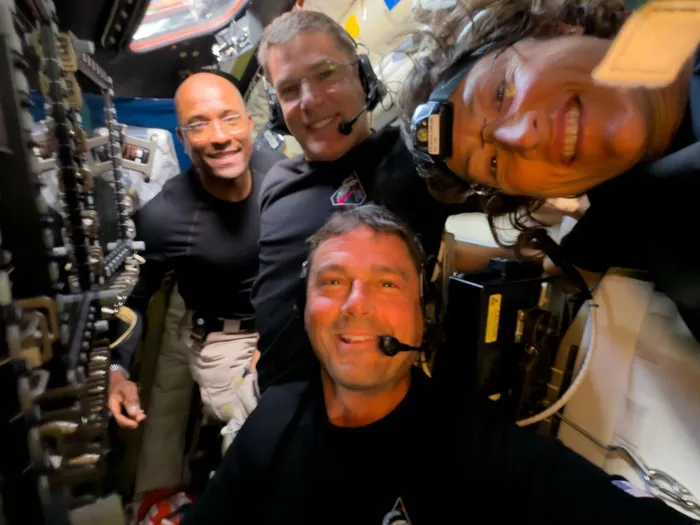
The scorched heat shield of the Orion spacecraft, bobbing in the Pacific waters, represents more than a successful recovery operation. It is the physical evidence of a high-stakes gamble that just paid off. While the public celebrates the safe return of four astronauts from a record-breaking lunar flyby, the real story lies in the hardware that survived the 25,000 mph reentry and the geopolitical pressure cookers that forced this mission into existence. This was not a victory lap. It was a proof of concept for an infrastructure that is still dangerously thin.
The Heat Shield Gamble and the Physics of Reentry
NASA engineers didn't just need to get the crew to the Moon and back; they had to prove that the Orion’s thermal protection system could handle the extreme friction of a lunar return trajectory. When a capsule returns from Low Earth Orbit, like the International Space Station, it hits the atmosphere at roughly 17,500 mph. Returning from the Moon is a different beast entirely. Orion slammed into the upper atmosphere at speeds exceeding $11,000$ meters per second, generating temperatures near $2,800$°C.
This isn't a linear increase in difficulty. The energy that must be dissipated as heat increases with the square of the velocity ($KE = \frac{1}{2}mv^2$). That extra speed translates to a massive thermal load that tested the limits of the Avcoat ablator. During the mission, every sensor embedded in that shield was monitoring for "spalling"—a phenomenon where pieces of the heat shield flake off prematurely. If the shield fails, the mission ends in a localized fireball. The fact that the crew is currently undergoing medical evaluations instead of being a footnote in a mishap report is a testament to materials science, but it also highlights how little margin for error exists in the current architecture.
Why the Flyby Was a Necessary Deception
Critics often point out that Artemis II didn't actually land. They call it a "re-run" of Apollo 8. That perspective misses the institutional rot NASA has been fighting for two decades. This mission was designed to bypass the bureaucratic paralysis that has stalled deep-space exploration since the 1970s. By choosing a high-altitude "free-return trajectory," NASA ensured that if the service module’s engines failed after the initial burn, the Moon’s gravity would naturally whip the capsule back toward Earth.
It was a safety-first mission disguised as a bold leap. The agency needed a win to justify the ballooning costs of the Space Launch System (SLS), which carries a price tag of roughly $2 billion per launch. You don't spend that kind of capital on a cargo run. You spend it on faces, names, and the visceral image of a splashdown. The flyby served as a live-fire exercise for the Environmental Control and Life Support System (ECLSS). Unlike the ISS, where parts can be ferried up in hours, Orion had to maintain a closed-loop system for the duration of the lunar swing. If the CO2 scrubbers had failed over the lunar far side, the crew would have been dead long before they hit the atmosphere.
The Hidden Logistics of the Recovery Team
The recovery of the capsule is a choreographed chaos involving the U.S. Navy and NASA’s Exploration Ground Systems. This isn't just about fishing a tin can out of the ocean. The "Well Deck" of a transport dock ship must be flooded to allow the capsule to be winched inside.
- Hazardous Vapors: The first team on site isn't looking for smiles; they are sniffing for ammonia and hydrazine leaks.
- Seawater Degradation: Every second the capsule sits in salt water, the forensic evidence of the flight begins to erode.
- Crew Equilibrium: After days in microgravity and a high-G reentry, the human vestibular system is shattered. The crew didn't walk out; they were extracted.
The Starship Bottleneck
While Artemis II was a success, it exposed the massive gap in the Artemis III landing goals. NASA owns the capsule, but they do not own the ladder. The current plan relies on SpaceX's Starship to act as the Human Landing System (HLS). This creates a strange, bifurcated reality where NASA can get humans to lunar orbit, but they are entirely dependent on a private contractor's unproven rapid-refueling technology to actually touch the dirt.
To get a single Starship to the Moon, SpaceX may need to launch upwards of ten "tanker" flights to orbit just to fill the tanks of the lunar lander. This is the "cryogenic propellant transfer" problem that keeps mission planners awake at night. If Artemis II proved we can survive the trip, it simultaneously highlighted that we have no way to stay. We have built a high-speed highway that currently ends at a cliff.
Comparing the Hardware
| Feature | Orion (NASA) | Starship HLS (SpaceX) |
|---|---|---|
| Primary Role | Crew Transport & Reentry | Lunar Landing & Habitation |
| Internal Volume | 9 cubic meters | 1,000+ cubic meters |
| Reentry Capability | Yes (High Speed) | No (Moon-to-Earth direct not yet tested) |
| Fuel Type | Hypergolic/Solid | Liquid Methane/Oxygen |
The Geopolitical Clock is Ticking
We are no longer in a vacuum of competition. The Artemis II splashdown happened under the shadow of the Chinese Lunar Exploration Program (CLEP). Beijing is moving with a methodical, state-funded cadence that doesn't have to answer to quarterly budget cycles or changing presidential administrations.
The Moon’s South Pole is the new high ground. It contains permanently shadowed regions where water ice is trapped. This ice isn't for drinking; it’s for fuel. Hydrogen and oxygen, cracked from lunar ice, represent the gas station for the rest of the solar system. If the Artemis program slips—which it likely will, given the complexities of the HLS and the new suits being developed by Axiom Space—the U.S. risks finding a pre-established Chinese presence at the very sites identified as most valuable. Artemis II was a sprint to prove the U.S. is still in the game, but the marathon is just beginning.
The Psychological Toll of the Far Side
We often talk about the "loss of signal" when a spacecraft goes behind the Moon. For the Artemis II crew, this was forty minutes of absolute isolation. They were the furthest humans have ever been from their home planet. This isn't just a trivia point; it’s a psychological barrier. On the ISS, you can see your house. In lunar orbit, Earth is a marble that can be covered by your thumb.
The data being analyzed right now isn't just about heat shields and thrusters. It's about how the crew handled the "Overview Effect" coupled with the claustrophobia of a four-person capsule. The Orion is cramped. It is a high-tech locker room where you live, eat, and use the bathroom for ten days. Managing interpersonal friction in a tin can 240,000 miles from the nearest psychiatrist is a mission-critical skill that NASA is still trying to quantify.
Radiation and the Van Allen Belts
One factor the competitor's reports largely ignored was the radiation dose. Artemis II was the first time humans moved through the heart of the Van Allen radiation belts since 1972. Beyond Earth’s magnetic field, the crew was exposed to Galactic Cosmic Rays (GCRs) and potential Solar Particle Events (SPEs).
The Orion capsule features a "storm shelter" concept, where the crew stacks water bags and equipment around themselves during a solar flare. Luckily, the sun was relatively quiet during this window. But as we move toward the solar maximum in the coming years, future Artemis crews won't be so lucky. The shielding on Orion is a compromise between weight and safety. We are essentially betting that we can move fast enough to avoid the worst of the cosmic rain.
The Cost of the Long Way Home
Every gram of weight on that capsule costs thousands of dollars in fuel to move. The decision to splash down in the ocean, rather than land on a runway like the Space Shuttle, was a choice of physics over convenience. Water is a natural shock absorber. By hitting the ocean, Orion can afford a heavier heat shield and less landing gear.
But this choice creates a massive naval footprint. You need a fleet. You need helicopters. You need specialized divers. The "all-in" cost of an Artemis recovery mission is a staggering line item that the public rarely sees. It is the price of returning from the deep.
The Fragility of Success
The success of Artemis II has created a dangerous sense of inevitability. There is a narrative forming that the Moon is "solved" and we are now just waiting for the calendar to flip to Artemis III. That is a lie.
The heat shield worked this time, but the post-flight inspection will likely reveal "thermal soak" issues that will require months of redesign. The SLS engines—leftovers from the Shuttle era—are a finite resource. Once the current stockpile of RS-25 engines is gone, we have to rely on a new, cheaper version that hasn't flown yet. We are cannibalizing the past to fund a bridge to the future.
The Artemis II splashdown was a masterpiece of engineering and a triumph of the human spirit. But if we treat it as a finished job rather than a desperate, successful test of a system under immense pressure, we are setting ourselves up for a catastrophe on the lunar surface. The Moon does not care about our budgets or our political timelines. It only cares about the math. And the math says that while we can get there, we are still a long way from being able to stay.
Keep your eyes on the post-flight data regarding the Orion’s power system. There were whispers of voltage irregularities during the final leg of the journey. If those aren't addressed, the next crew won't be splashing down to a hero's welcome; they’ll be drifting in the dark.