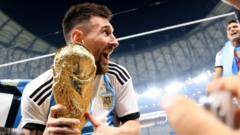
The grass at the Lusail Stadium smelled of crushed clover and expensive fertilizer. It was December 2022. Eighty thousand people were screaming until their throats bled, a wall of sound that vibrated right through the soles of your shoes. On the pitch, twenty-one men were tearing their hamstrings to pieces, chasing a leather sphere with the desperate intensity of soldiers in a trench.
And then there was Lionel Messi. Meanwhile, you can explore related stories here: The Anatomy of Freedom of Movement Officiating: How Over-Calibration Disrupts Los Angeles Sparks Defensive Schematics.
He was standing still.
Not jogging. Not shuffling. Literally standing, hands on hips, near the center circle, watching the chaos unfold around him like a bored commuter waiting for a delayed train. If you didn't know who he was, you might have thought he was lazy. You might have thought his legs had finally given out after two decades at the absolute summit of global football. To see the bigger picture, we recommend the detailed report by Sky Sports.
You would have been completely wrong.
To watch the modern iteration of Messi is to witness a profound psychological shift in how we understand athletic genius. We are conditioned to believe that greatness requires maximum effort at all times. We want sweat. We want visible agony. We want players to run themselves into the dirt because that is how we, as mere mortals, prove we care. But Messi stopped running years ago, and in doing so, he became more lethal than ever.
He mastered the economy of movement.
The Ghost in the System
Consider the tracking data from the 2022 World Cup in Qatar. It sounds like an anomaly, a glitch in the software. During the group stages, FIFA’s performance metrics revealed that Messi covered more distance at a walking pace than any other player tournament-wide. He walked nearly five kilometers per match. In a sport that has become increasingly obsessed with high-intensity sprints and relentless pressing, the greatest player to ever live was spending over half his time on the pitch doing less physical work than a person strolling through a grocery store.
But watch what happens just before the walk ends.
Imagine a hypothetical defender—let's call him Joško. Joško is twenty-one years old, built like a brick wall, and possesses the lung capacity of a deep-sea diver. He has spent his entire youth training to press, to close down space, to run until his lungs burn. For sixty minutes, he keeps his eyes glued to Messi. But Messi isn't doing anything. He is drifting toward the right flank. He is looking at his boots. He is taking three slow steps forward, two steps back.
Joško’s brain naturally begins to flag Messi as a non-threat. It is a biological certainty; human attention spans are wired to detect rapid movement, not stillness. The threat matrix in the defender's mind recalibrates. He looks away for a fraction of a second to check the overlapping fullback.
That is the exact moment the trap springs.
The walk becomes an explosion. In the span of two steps, Messi accelerates from zero to twenty miles per hour. It isn't the raw, unadulterated speed of his early twenties when he looked like a cartoon character with the fast-forward button held down. It is something much more terrifying: positional geometry. He finds the blind spot behind Joško’s left shoulder, receives a pass that seemed impossible a second ago, and suddenly the stadium holds its collective breath.
This isn't laziness. It is predatory patience.
The Boy Who Drank Lightning
To appreciate the brilliance of the walk, you have to remember the boy who used to fly.
Go back to 2007. A nineteen-year-old Messi with a mane of greasy, uncut hair receives the ball in his own half against Getafe. He doesn't think. He doesn't calculate space. He just runs. He leaves five defenders face-down in the grass, rounds the goalkeeper, and tucks the ball into the net from an impossible angle. It was a goal born of pure, unsustainable kinetic energy.
Back then, his body was an engine running on premium rocket fuel. He would receive the ball out wide, cut inside on his left foot, and dare the entire world to stop him. Most of the time, they couldn't. But that style of play carries a heavy tax. The human body is not designed to change direction at maximum velocity on a patch of wet turf three times a week for fifteen years. Muscles tear. Tendons fray.
By the time he hit his early thirties at Barcelona, the physical bill was coming due. The explosive burst that used to leave opponents looking like statues was fading. The effortless ability to bypass three midfielders with raw pace was no longer a guarantee.
Most athletes, when faced with the slow theft of their physical gifts, enter a phase of tragic denial. They run harder. They try to force the old magic through sheer force of will, their bodies breaking down under the strain until they are forced into an early retirement or a depressing slide down into lower leagues.
Messi chose a different path. He chose to think his way through the decline.
Instead of fighting the passage of time, he struck a bargain with it. He gave up the wings. He stopped tracking back to tackle left-backs. He stopped contesting useless headers in the midfield. He conserved every single calorie of energy for the thirty seconds in a match where he could alter the course of human history.
Mapping the Pitch in Three Dimensions
Pep Guardiola, who coached Messi during his most fertile years at Barcelona, once explained this phenomenon with a mixture of awe and clinical precision. He noted that Messi spends the first ten or fifteen minutes of every match simply walking around the opposition’s defensive line.
He isn't ignoring the game. He is mapping it.
He is observing how the center-backs shift when the ball moves left. He is measuring the exact distance between the midfield line and the defensive block. He is identifying the weakest link, the defender who turns too slowly, the midfielder who leaves a pocket of space open when he presses forward.
Think of it as a grandmaster spending the opening moves of a chess match studying the subtle nervous habits of his opponent rather than attacking the pieces. By the time Messi decides to participate in the match, he already knows exactly how it is going to end.
This shift from physical dominance to intellectual supremacy is what makes his longevity so staggering. In 2012, he scored ninety-one goals in a single calendar year through a display of relentless, hyper-active brilliance. A decade later, at thirty-five, he won the World Cup by becoming a ghost who only materialized when the ball entered the penalty box.
The evolution required an immense sacrifice of ego. Every professional athlete wants to be involved in the action. They want to touch the ball. They want the television cameras to capture them sweating, fighting, sliding into tackles to prove their commitment to the badge. To stand completely still while your teammates are sweating blood requires a level of supreme arrogance—or supreme self-awareness—that very few human beings possess.
Messi understood that his value was no longer measured in kilometers run, but in goals created. He trusted his teammates to do the heavy lifting so that he could provide the art.
The Weight of the Final Step
There is a strange, quiet beauty in watching an aging master strip away everything that is unnecessary. The flashy step-overs are gone. The fifty-yard lung-busting runs are a memory. What remains is the absolute distillation of footballing intelligence.
A drop of the shoulder. A five-yard pass that cuts through four defenders like a scalpel. A delicate chip over a sprawling goalkeeper that looks so simple you feel like you could do it yourself in your backyard.
We live in a culture that worships hustle. We are told to grind, to sprint, to maximize every second of our day, to constantly move forward at maximum capacity lest we get left behind. We view rest as a weakness and stillness as a failure of ambition.
But the old man walking around the center circle in Inter Miami's pink jersey tells a different story. He reminds us that true mastery isn't about doing everything; it is about doing the right thing at the exact moment it matters most. It is about understanding that sometimes, the most devastating thing you can do to an opponent who is running themselves ragged is to simply stand still and wait for them to make a mistake.
The referee blows the whistle. The midfielders sprint into position, their breath misting in the cool evening air. The crowd roars, demanding action, demanding speed, demanding blood.
Messi takes a deep breath, puts his hands on his hips, and walks away from the ball.