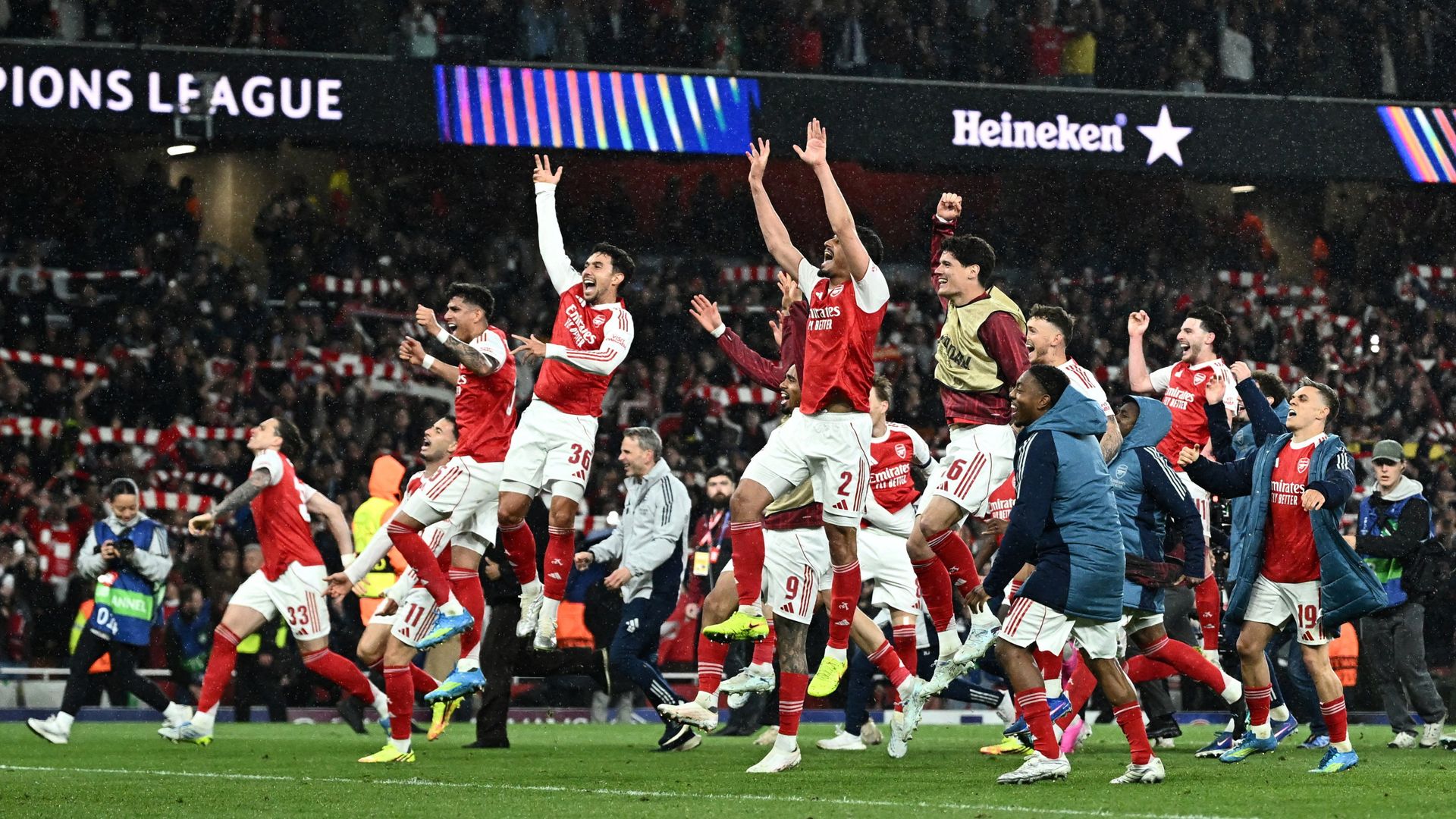
Arsenal’s progression to the Champions League final is not an anomaly of tournament variance but the predictable output of a multi-year project centered on high-ceiling player recruitment and a rigid adherence to positional play. To understand this trajectory, one must look past the emotional narrative of "club DNA" and instead analyze the structural efficiency of their defensive block, the marginal utility of their set-piece dominance, and the financial distribution that allowed for a concentrated squad rebuild.
The path to the final was secured through a systematic suppression of opponent Expected Goals (xG), a metric where Arsenal has consistently outperformed European peers. This success is built upon three non-negotiable structural pillars: defensive transition geometry, the technical security of the "double pivot" in build-up phases, and the psychological resilience born of tactical clarity.
The Defensive Cost Function and Goal Suppression
The primary driver of Arsenal's European campaign is a defensive system that minimizes high-probability scoring chances by controlling the geometry of the pitch. Unlike teams that rely on a "low block" to survive pressure, Arsenal employs a proactive mid-block designed to force turnovers in the middle third.
1. Zone 14 Denial
The "Zone 14" area—the space just outside the penalty box—is the most critical sector for generating assists. Arsenal’s defensive architecture utilizes a 4-4-2 or 4-2-2-2 defensive shape that narrows the passing lanes into this corridor. By squeezing the vertical distance between the defensive line and the midfield, they force opponents to circulate the ball laterally. This lateral movement increases the time-to-target for the attacking team, allowing the defense to reset and eliminate the element of surprise.
2. The Saliba-Gabriel Partnership as a Risk Mitigation Tool
The partnership between William Saliba and Gabriel Magalhães functions as a risk-reduction mechanism. Their specific physical profiles allow Arsenal to maintain a high defensive line—averaging nearly 45 meters from their own goal—without being overly vulnerable to long-ball transitions.
- Recovery Pace: Saliba provides the ability to track runners in large spaces, reducing the xG per shot of counter-attacks.
- Aerial Dominance: Gabriel’s success rate in aerial duels (frequently exceeding 65%) neutralizes cross-heavy strategies, a common fallback for teams unable to penetrate through the middle.
Tactical Asymmetry and the Overload Mechanism
Arsenal’s offensive output is predicated on creating 2-on-1 scenarios in wide areas, particularly on the right flank. This is not mere individual brilliance but a calculated exploitation of the opponent's defensive shift.
The Saka-Odegaard Connection
The relationship between Martin Ødegaard and Bukayo Saka creates a "gravity" that pulls the opposition's defensive block toward the touchline. When Ødegaard occupies the "half-space" (the vertical strip between the wing and the center), he forces the opposing left-back and left-midfielder into a decision-making crisis:
- If both track the ball, the central corridor opens for late runs from a "false nine" or an inverted winger.
- If the defense remains compact, Saka is left in a 1-v-1 situation, where his dribble success rate creates high-value cutback opportunities.
Structural Width and Inverted Fullbacks
The use of inverted fullbacks—most notably Oleksandr Zinchenko or Jurriën Timber—alters the math of the midfield. By moving into central areas during the build-up, these players create a numerical superiority (a 3-v-2 or 4-v-3) against the opponent's midfield. This "box midfield" configuration ensures that even if a pass is intercepted, the team is already positioned to execute an immediate counter-press, preventing the opponent from transitioning into an open field.
Financial Engineering and Squad Age Profiles
The ascent to the Champions League final is inextricably linked to the club’s recruitment strategy, which shifted from buying "depreciating assets" (older players on high wages) to "appreciating assets" (young players with high ceilings).
Value Extraction in the Transfer Market
The acquisitions of Declan Rice and Kai Havertz represented a significant capital outlay but served a specific tactical function: physical robustness. In elite European knockout football, technical skill is often neutralized by high-intensity pressing. Rice provides a "floor" for the midfield, winning second balls and preventing central breakthroughs.
The Age Curve Advantage
The majority of Arsenal’s core starting XI falls within the 22-27 age bracket. This is the "performance sweet spot" where physical peak meets tactical maturity. Structurally, this allows for:
- Lower Injury Risk: Younger squads generally recover faster between high-intensity matches, a critical factor in a congested Champions League schedule.
- Tactical Plasticity: Younger players are often more receptive to complex positional instructions compared to established veterans with entrenched habits.
The Set-Piece Dividend
In the Champions League, where margins are razor-thin, set-pieces act as an "efficiency multiplier." Arsenal’s integration of a dedicated set-piece coach has transformed corners and free-kicks from random events into high-probability scoring opportunities.
Near-Post Crowding and Keeper Interference
The team utilizes "blockers"—players whose sole purpose is to impede the goalkeeper's movement—to create chaos in the six-yard box. By targeting the near post with outswinging or inswinging deliveries, they maximize the likelihood of a second-ball opportunity or a defensive error.
During this campaign, set-piece goals accounted for a disproportionate percentage of Arsenal’s total goals, often breaking deadlocks in matches where the "open play" xG was nearly equal. This ability to score "low-cost" goals reduces the pressure on the creative players to perform under extreme defensive scrutiny.
Limitations and Vulnerabilities of the System
Despite reaching the final, the model is not without its failure points. The reliance on high-intensity pressing and specific player profiles creates two primary bottlenecks:
1. Depth Fragility
The system’s effectiveness drops significantly when key "engine" players (like Rice or Saliba) are unavailable. The drop-off between the starting XI and the second string is more pronounced in terms of tactical execution than raw talent. A single injury in the spine of the team forces a compromise in the high-line strategy, making the team more reactive.
2. High-Press Exhaustion
Maintaining a 90-minute press is metabolically expensive. Teams that can successfully bypass the first wave of the press and sustain possession for long periods can eventually tire the Arsenal midfield. This was evident in segments of the quarter-final and semi-final legs, where the team conceded late territorial dominance.
The Final Blueprint
Victory in the final will require more than "spirit." It will require the meticulous application of these established frameworks. The opposition will likely attempt to exploit the space behind the inverted fullbacks or bait the center-backs into over-committing.
The strategic imperative for Arsenal is to control the "tempo of transitions." If the match becomes a chaotic, end-to-end affair, the randomness favors the underdog or the team with superior individual clinical finishers. If Arsenal can maintain their 4-2-2-2 defensive shape and force the match into a slow, positional grind, their superior structural efficiency and set-piece advantages will likely dictate the outcome.
The objective is to minimize the "noise" of the final—the crowd, the pressure, the history—and treat the match as a series of 15-minute tactical blocks. The team that wins is not necessarily the one that plays the most beautiful football, but the one that most successfully limits the opponent's ability to execute their primary offensive sequences. Arsenal’s arrival in the final is proof that their model works; winning it will require a flawless execution of that same model under maximum psychological load.
Tactical discipline must override the instinct for individual heroism. The data suggests that when Arsenal maintains their spacing and restricts the opponent to shots from outside the box (typically <0.05 xG per shot), their probability of winning exceeds 70%. The mandate for the final is simple: maintain the geometry, win the second balls, and exploit the set-piece inefficiency of the opponent. This is the calculated path to European dominance.