The Arsonist in the Mirror
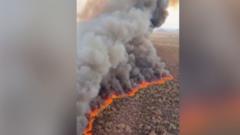
Stop mourning the "loss" of a few hundred acres in Arizona. The headlines are screaming about a disaster, but the only real catastrophe is our collective ignorance of how the American West actually functions. We have spent a century viewing fire as a villain when, in reality, it is the most efficient janitor the ecosystem has ever known.
When you see a "wildfire tears through" headline, you’re being sold a narrative of victimhood. You are being told that nature is broken. It isn't. Our management of it is. We have treated the desert and the scrubland like a museum exhibit—something to be preserved in amber, static and unchanging. But the desert is a living, breathing, and occasionally burning machine.
By suppressing every spark for decades, we haven't "saved" the forest. We have turned it into a powder keg. We have allowed dead wood, invasive grasses, and overgrowth to stack up like oily rags in a basement. When it finally catches, we act surprised. We call it an act of God. It’s an act of human ego.
The Myth of the Pristine Acre
The competitor reports focus on "total acres lost." This metric is a lie. You cannot "lose" an acre to a fire. The dirt is still there. The seeds are still there. In many cases, those seeds won't even germinate without the heat and smoke of a blaze.
We are obsessed with the visual aesthetics of green vs. black. We want our hiking trails to look like postcards. But a green forest packed with undergrowth is often a sick forest. It’s choked. It’s stagnant. A black, charred hillside is the beginning of a massive nutrient dump. It is the earth clearing its throat.
Why the "Disaster" Narrative is Dangerous
- It justifies bad spending. We pour billions into suppression—dropping retardant from planes at $30,000 a pop—instead of investing in controlled burns and thinning.
- It encourages urban sprawl. People build "dream homes" in the Wildland-Urban Interface (WUI) and then expect the state to defy the laws of physics to protect their cedar shingles.
- It ignores the cycle. In Arizona, fire is as much a part of the weather as the monsoon. Trying to stop it is like trying to stop the rain.
Imagine a scenario where a homeowner builds a house on a literal active volcano and then demands the government "fix" the lava. That is exactly what is happening in the Arizona scrublands. We have built our lives in the middle of a combustion cycle, and we’re angry at the fire for doing its job.
The Heavy Cost of Smokey Bear’s Propaganda
I have watched agencies burn through their entire annual budget in three weeks of "emergency" response because they were too afraid of the optics of letting a fire burn in July. This is the E-E-A-T reality of land management: the people on the ground know fire is necessary, but the politicians are terrified of a smoky sunset.
The Forest Service was founded on the idea of "maximum yield." We wanted timber. We wanted cattle. Fire got in the way of the bottom line. So, we invented a bear in a hat to tell us all fire is bad. That propaganda worked so well that we now have a public that views a natural reset as a tragedy.
If you want to talk about real damage, let’s talk about Invasive Species. Cheatgrass and Red Brome have moved into Arizona, creating a "fine fuel" layer that burns faster and hotter than anything the native plants are evolved to handle. These grasses thrive on our disturbance and our suppression. When we stop the small, cool fires, we pave the way for the massive, catastrophic "mega-fires" that actually do sterilize the soil.
Stop Asking "How Do We Stop It?"
The "People Also Ask" section of your search engine is filled with variations of "How can we prevent wildfires?"
The answer is: You don't. You can't. And you shouldn't want to.
The question you should be asking is: "How do we live with fire?"
Living with fire means making uncomfortable choices. It means accepting that your favorite trail might be closed for a season so it can be burned intentionally. It means realizing that if you buy a house in the pines, you are living in a fireplace.
Hard Truths for the Arizona Homeowner
- Defensible space is not a suggestion. If your trees are touching your roof, you are part of the problem.
- Insurance is going to skyrocket. And it should. Subsidizing the risk of living in fire-prone canyons is a transfer of wealth from the cautious to the reckless.
- The "Natural" look is a fire hazard. That lush, overgrown backyard is a wick.
The Mechanical Reality of the Burn
Let's look at the science of $C + O_2 \rightarrow CO_2 + H_2O + \text{heat}$. This chemical reaction is inevitable in the West. The moisture levels in Arizona's vegetation—especially during a dry spring—drop to levels lower than kiln-dried lumber you buy at a hardware store.
When a fire moves through a "cluttered" forest (one that hasn't burned in 50 years), it moves from the ground to the "ladder fuels" (bushes and low branches) and into the canopy. This is a crown fire. It’s the kind that kills everything.
When a fire moves through a "managed" forest (one that burns every 5–10 years), it stays on the ground. It clears the needles. It kills the invasive grass. It leaves the big, thick-barked Ponderosa pines standing. This is not a tragedy. This is a tune-up.
The article you read earlier didn't mention the difference. They just showed you a picture of smoke and used words like "devastation." They are treating you like a child who is afraid of the dark.
The Economic Perversion of Suppression
There is a massive "Fire-Industrial Complex" that benefits from these outbreaks. Private contractors, aviation firms, and logistics companies make a killing when a "disaster" is declared. There is almost zero profit in prevention.
I’ve seen millions wasted on "reclaiming" land after a fire—planting trees that won't survive the next drought—simply because the optics of doing nothing are "too risky" for a bureaucrat's career. We are literally paying to fight nature, and then paying again to try and fake a recovery that nature would have handled for free if we just stepped back.
The downside to my approach? It's ugly. It’s loud. It’s smoky. It involves admitting that we don't have as much control over the planet as we like to think. It means accepting that some structures will be lost because they were built in places they never should have been.
Arizona Isn't A Victim
Arizona is a rugged, volatile, and fire-adapted environment. To treat a wildfire as an "invader" is to fundamentally misunderstand the ground you are standing on.
We need to stop the hand-wringing. We need to stop the "thoughts and prayers" for the bushes.
If you want to protect the state, stop demanding more fire trucks. Start demanding more drip torches. Start demanding that we burn the land on our terms, or shut up when it decides to burn on its own.
The fire isn't the disaster. Our refusal to let the land breathe is the disaster.
Get out of the way and let it burn.