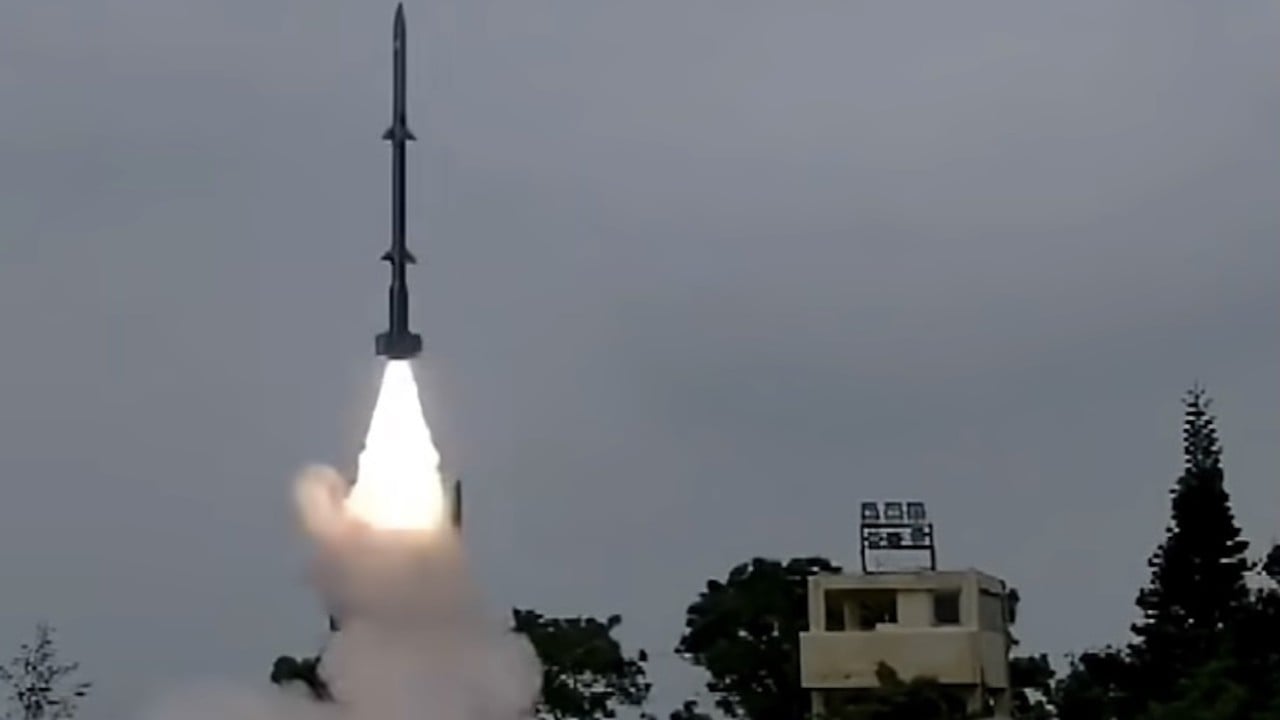
Modern strategic air defence is an exercise in latency reduction, sensor-fusion economics, and kinematic optimization. When the Defence Research and Development Organisation executed the maiden flight test of the Kusha long-range surface-to-air missile system from APJ Abdul Kalam Island, observers focused on national self-reliance metrics. A granular operational analysis reveals a different reality: Project Kusha is a structural fix for a specific geometric and technological gap that has plagued South Asian theater defense for decades.
To understand the mechanics of this milestone, one must deconstruct the structural inefficiencies of the existing air defence stack, the engineering compromises required for multi-tier interception, and the precise economic trade-offs of shifting from foreign procurement to domestic defense manufacturing.
The Kinematic Gap in Multi-Tier Air Defence
A state air defence network operates as a stepped filter. Every tier must handle a specific band of altitude, velocity, and radar cross-section while managing cost-per-engagement ratios. Prior to the maturation of Project Kusha, India’s operational architecture faced a severe discontinuity between short-to-medium-range systems and strategic tier imports.
The medium-range segment, anchored by systems like the Barak-8 MR-SAM, provides effective area denial up to roughly 80 kilometres. Beyond that threshold, the operational burden shifted entirely to imported heavy systems like the Russian S-400 Triumf, which covers ranges up to 400 kilometres.
This creates three distinct structural vulnerabilities:
- The Intermediary Dead Zone: Relying on imported strategic assets for intermediate area defense creates an inefficient allocation of high-cost interceptors against medium-threat vectors.
- Logistical Bottlenecks: Foreign-sourced weapon systems tie domestic military readiness to external supply chains, maintenance cycles, and software source-code black boxes.
- Integration Friction: Patching together disparate communication protocols between Soviet-heritage platforms, Western-Israeli subsystems, and native command networks introduces processing latency in the kill chain.
Project Kusha, formally designated the Extended Range Air Defence System (ERADS), directly targets these three variables. By deploying a tiered family of interceptors under an indigenous architecture, the system establishes a continuous engagement zone that bridges the tactical and strategic layers.
The Three Pillars of Interceptor Scaling
Project Kusha diverges from single-missile architectures by utilizing a modular booster-and-kill-vehicle methodology. The program relies on three distinct variants—designated M1, M2, and M3—sharing common terminal guidance components while scaling propulsion units to match kinetic requirements:
- The M1 Variant (150 Kilometre Range): Engineered to handle high-density regional saturation strikes, tactical fighters, and incoming cruise missiles within the upper-medium envelope.
- The M2 Variant (250 Kilometre Range): Designed to push the engagement boundary outward, forcing opposing strike packages to expend fuel and abort missions earlier in their tactical profiles.
- The M3 Variant (350 to 400 Kilometre Range): Optimized for high-value airborne assets, including airborne early-warning and control (AEW&C) aircraft and aerial refuelling tankers operating deep within adversary airspace.
This tiered scaling solves a fundamental economic problem in air defence: cost asymmetry. Firing a multimillion-dollar strategic interceptor at a low-cost tactical drone or cruise missile ruins a nation's defense economics. By distributing the threat spectrum across three distinct interceptor tiers, command structures can match the marginal cost of the interceptor to the economic value of the incoming threat vector.
The Sensor-to-Shooter Latency Equation
An interceptor missile is only as effective as the data feeding its guidance computer. The operational value of Kusha’s recent flight test lies less in the raw propulsion capabilities of the missile body and more in the validation of its battle management radar network.
The system utilizes an S-band Long Range Battle Management Radar equipped with gallium nitride transmit-receive modules and digital beam-forming. This technological choice alters the radar’s performance profile across several operational vectors:
- Clutter Rejection: Gallium nitride amplifiers operate at higher temperatures and power densities, allowing the radar to maintain high pulse repetition frequencies without thermal degradation.
- Low-RCS Tracking: Enhanced digital beam-forming sharpens spatial resolution, improving the probability of early detection against low-observable, stealth-optimised platforms.
- Kill-Chain Compression: By integrating directly with the Integrated Air Command and Control System (IACCS), raw tracking data bypasses manual relay steps, converting sensor detection into an automated fire-control solution.
In modern high-velocity combat environments, where threats approach at hypersonic or supersonic speeds, traditional human-in-the-loop verification introduces fatal delays. Kusha’s architecture compresses the sensor-to-shooter loop, automating threat prioritization and simultaneous target tracking across multiple battery nodes.
The Economics of Indigenous Strategic Autonomy
The transition from foreign procurement to domestic design authority changes the long-term cost function of national defense. While initial research and development expenditures funded through allocations like the ₹21,700 crore Acceptance of Necessity require significant capital upfront, they eliminate recurring geopolitical and financial rents associated with foreign imports.
Foreign military acquisitions carry hidden costs: lifetime maintenance contracts, restricted source-code access that prevents domestic software upgrades, and vulnerability to secondary economic sanctions. An indigenous industrial ecosystem built around private-sector component manufacturers and public research laboratories ensures that supply chain shocks do not compromise operational readiness.
Furthermore, local production allows for rapid engineering iteration. When field units identify performance limitations or software vulnerabilities, domestic design teams can push updates directly to the production line without negotiating intellectual property rights with foreign defense contractors.
Strategic Execution
To transition Project Kusha from a successful flight-test milestone into an operational theater shield by its projected 2028 timeline, procurement agencies must prioritize manufacturing scalability over custom laboratory modifications.
The immediate operational priority requires standardizing sub-tier component manufacturing across private aerospace partners to ensure component interchangeability between the M1, M2, and M3 variants. Concurrently, software integration teams must run continuous hardware-in-the-loop simulations combining IACCS nodes with live radar feeds to stress-test the automated battle management system against electronic counter-countermeasures before mass squadron deployment.
DRDO conducts successful maiden flight-test of 'Kusha' Long-Range Surface-to-Air Missile
This video provides visual documentation of the DRDO's maiden flight-test of the Kusha long-range surface-to-air missile from Abdul Kalam Island, illustrating the launch architecture and intercept profile discussed in the analysis.