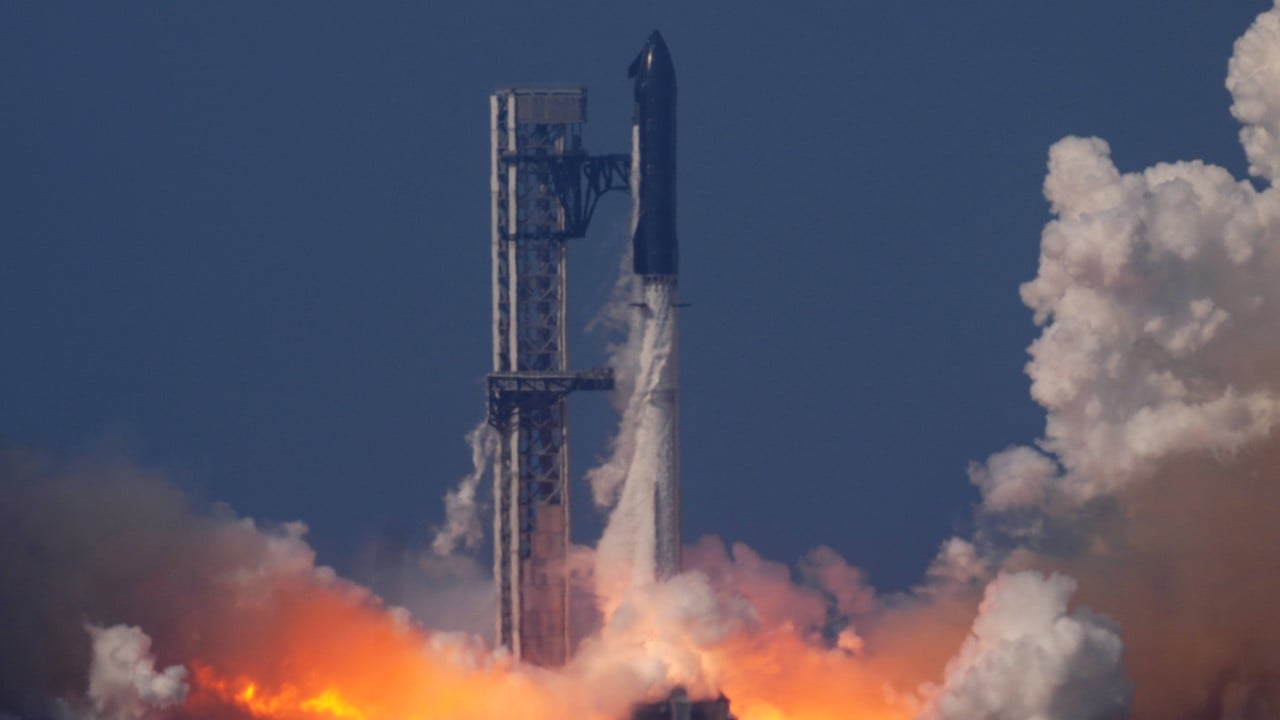
The scaling of launch infrastructure operates on a brutal mathematical reality: to decrease the cost per kilogram to low Earth orbit by an order of magnitude, a launch system must simultaneously maximize propellant mass fraction, eliminate hardware expendability, and compress turnaround times to hours rather than months. The inaugural flight of SpaceX’s third-generation Starship launch vehicle (Version 3) from Starbase, Texas, serves as an empirical validation of this manufacturing strategy. Media narratives consistently focus on the physical scale of the 124-meter vehicle or the visceral spectacle of its 33 Raptor engines. However, the true analytical value lies in the structural, thermodynamic, and financial frameworks governing this hardware iteration.
The Mass Fraction Framework and Structural Scaling
The core constraint of aerospace engineering is expressed through the classical Tsiolkovsky rocket equation:
$$\Delta v = v_e \ln \left( \frac{m_0}{m_f} \right)$$
Here, the change in velocity ($\Delta v$) is directly limited by the effective exhaust velocity ($v_e$) and the natural log of the ratio between initial mass ($m_0$) and final dry mass ($m_f$). Because chemical propellant chemistry faces hard thermodynamic ceilings, optimizing a launch system requires minimizing the dry mass ($m_f$) of the structure while expanding the overall volumetric capacity of the tanks.
The extension of the Version 3 vehicle to 124 meters represents a direct optimization of this mass fraction. In large-scale structures, internal volume scales cubically ($r^3$), whereas the surface area of the stainless-steel hull scales quadratically ($r^2$). By lengthening the tanks, SpaceX increases the total propellant load—and thus the initial mass ($m_0$)—at a much faster rate than the parasitic dry mass of the containment walls increases.
This optimization is supported by two primary engineering upgrades:
- Main Fuel Transfer Line Scaling: The main propellant line feeding the 33 Raptor engines has been scaled up to a diameter roughly equivalent to the entire fuselage of a Falcon 1 first stage. This expansion decreases fluid friction and counteracts the hydraulic pressure drops that occur during high-flow-rate engine priming and startup sequences.
- Aerodynamic Control Surface Reduction: The structural redesign reduces the total number of grid fins on the Super Heavy booster while increasing the individual surface area and structural density of the remaining fins. This reallocation removes dead weight from the upper assembly of the booster, shifting the center of mass downward and improving structural stability during high-velocity atmospheric reentry.
The Thermodynamic and Fluid Transfer Bottleneck
Orbital deployment of payloads to high-energy destinations, such as the lunar surface for NASA’s Artemis program, depends entirely on orbital propellant transfer. Starship Version 3 introduces integrated docking cones and structural hardpoints designed for autonomous orbital rendezvous. However, the economic viability of these maneuvers depends on solving a dual thermodynamic problem: cryogen boil-off and zero-gravity fluid dynamics.
Liquid oxygen (LOX) and liquid methane ($CH_4$) must be maintained at cryogenic temperatures below -180°C. During orbital staging, solar radiation introduces thermal energy into the stainless-steel tanks, causing the liquid propellants to boil into gas. Without continuous ullage pressure or active subcooling systems, this gas vents into space, decreasing the net payload capacity of the tanker fleet.
Furthermore, transferring fluids in microgravity requires artificial acceleration. Because liquid floats freely within the tanks, standard pumps would ingest gas pockets, causing catastrophic cavitation and pump failure.
To bypass this fluid-dynamics bottleneck, SpaceX uses a sequence of small, operational adjustments:
- Ullage Maneuvers: The tanker vehicle uses auxiliary thrusters to generate a continuous, low-level linear acceleration. This artificial gravity settles the liquid propellants at the aft end of the tanks, directly over the transfer valves.
- Subcooled Propellant Loading: By loading propellants at temperatures near their freezing points rather than their boiling points, the fluid acts as a thermal heat sink, absorbing external solar energy for days before significant boil-off occurs.
The Economics of Rapid Iteration and Capital Restructuring
The development path of Starship relies on hardware-in-the-loop testing, a methodology where real-world flight data takes precedence over prolonged computational modeling. The transition from Version 1 through Version 2 to the current Version 3 reflects an intentional capitalization strategy designed to manage high burn rates through diversified corporate revenue.
[Starlink Commercial Cash Flow] ──> [Capital Subsidies] ──> [Rapid Hardware Iteration]
                                                                      │
[NASA Artemis Milestones] ─────────> [Milestone Payments] ────────────┘
The financial engine driving this development is split into two distinct capital flows:
The Starlink Subsidization Loop
The launch of 20 mock Starlink satellites on the Version 3 flight previews an internal demand loop. By serving as its own customer, the company tests its launch architecture using functional payloads that eventually generate high-margin consumer broadband revenue. This commercial cash flow lowers the net cost of development failures. When a prototype is lost during reentry, the financial impact is treated as an operational research and development expense rather than a threat to corporate solvency.
Milestone-Based Public Contracts
The architecture must satisfy fixed-price milestones dictated by NASA’s Human Landing System (HLS) contract. Unlike traditional cost-plus defense contracts, where the government absorbs cost overruns, SpaceX bears the financial risk of developmental delays. The rapid rollout of the Version 3 platform from a newly constructed launch pad demonstrates the operational speed required to achieve these contract benchmarks before inflation compromises the fixed budget.
Strategic Trajectory and Market Displacement
The technical changes integrated into Starship Version 3 establish a clear baseline for the global launch market. By replacing the older Block 1 and Block 2 hardware lines, Version 3 moves the platform away from basic structural survival toward repeatable cargo logistics. The inclusion of expanded avionics bays, hardened thermal protection tiles, and redundant navigation computers indicates that the primary engineering challenge has shifted from basic aerodynamic flight to long-term orbital reliability.
The primary limitation of this strategy remains the sheer volume of launches required to execute a single deep-space mission. If an Artemis lunar landing necessitates between 8 and 14 propellant transfer flights, the operational bottleneck shifts from rocket manufacturing to pad turnaround logistics. The deployment of a second launch pad at Starbase is a direct operational response to this bottleneck, enabling parallel processing of tanker vehicles to compress launch intervals.
As the corporate structure evolves alongside these technical milestones, the underlying economics will force a restructuring of the commercial satellite market. Competitors relying on expendable launch architectures will face severe margin compression. When a fully reusable platform can scale its internal volume cubically while holding structural mass to a linear growth rate, the cost per kilogram to orbit decreases past the point where legacy systems can compete. The operational play moving forward is no longer proving that a massive stainless-steel vehicle can fly; it is demonstrating that the manufacturing pipeline can produce, launch, and catch these vehicles at a cadence that clears the global demand for orbital mass deployment.