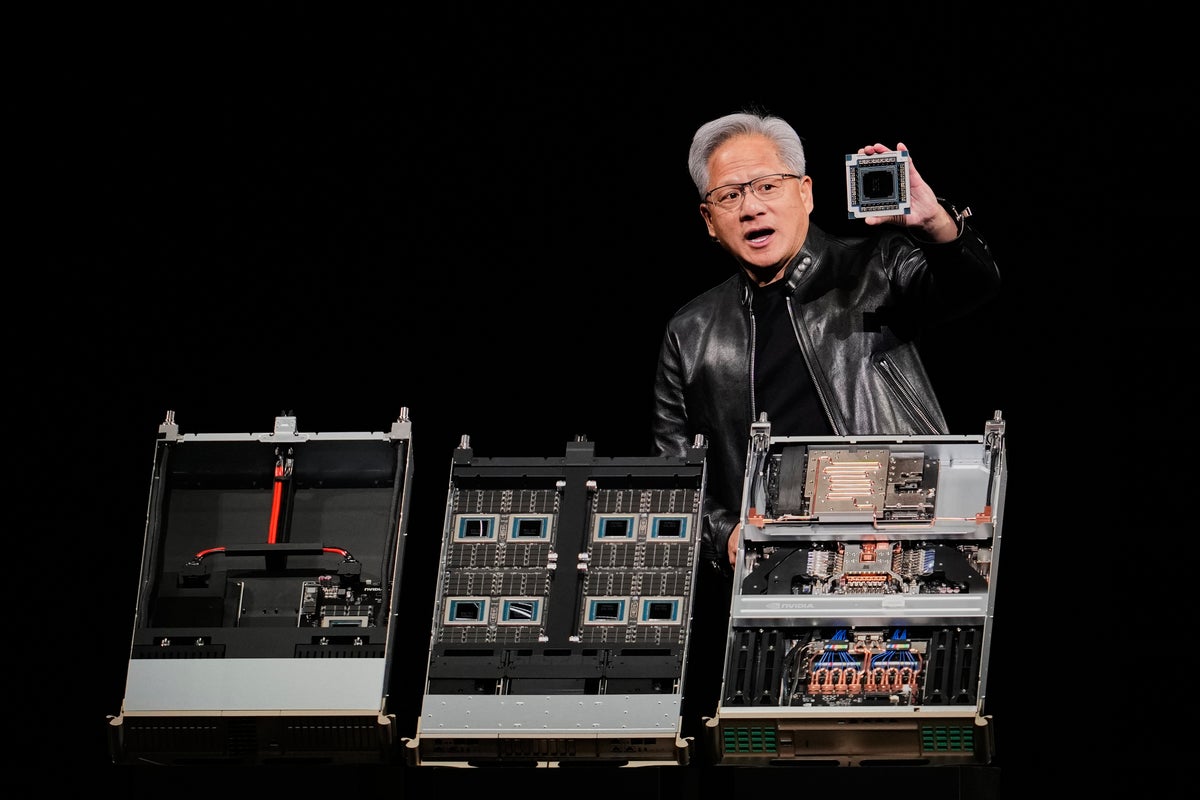
The global compute supply chain is currently undergoing a structural pivot from the "Construction Phase"—characterized by the massive training of Foundation Models—to the "Utilization Phase," where the primary revenue driver is inference. While market commentary often focuses on the sheer scale of capital expenditure, the more significant metric is the $1 trillion installed base of data center infrastructure transitioning toward real-time execution. This shift is not merely a change in workload volume; it is a fundamental reconfiguration of the economic unit of AI.
The Economic Decoupling of Training and Inference
To understand the current expansion, one must distinguish between the cost functions of training versus inference. Training is a sunk cost, a one-time intensive burst of compute designed to minimize a loss function across a massive dataset. Inference is a recurring operational expense, where the goal is to minimize latency and maximize throughput per watt.
The Scaling Law of Inference
As models move from research labs to production environments, the ratio of inference-to-training compute tends to grow exponentially. This transition is driven by three specific variables:
- User Base Density: Every additional query from a user requires a dedicated forward pass through the neural network.
- Model Recurrence: Unlike a software update that is downloaded once, an AI model must be "run" every time a task is performed.
- Agentic Complexity: The move toward "Agentic AI"—where models reason through multiple steps before delivering an output—multiplies the number of tokens generated per single user request.
This creates a self-reinforcing loop. As inference becomes cheaper due to hardware optimization, developers build more complex applications, which in turn increases the demand for more inference-capable hardware. The $1 trillion in data center infrastructure represents the physical floor of this new economy.
The Hardware-Software Co-optimization Bottleneck
The "Inference Inflection" is constrained by the physical limits of memory bandwidth and interconnect speeds. Standard benchmarks often focus on TOPS (Tera Operations Per Second), but in a production environment, the "Time to First Token" (TTFT) and "Tokens Per Second" (TPS) are the only metrics that impact user retention.
Memory Wall Dynamics
Modern LLMs (Large Language Models) are often "memory-bound" during inference. This means the processor sits idle, waiting for data to move from the HBM (High Bandwidth Memory) to the compute cores. The strategy for dominance in the next phase of the AI boom is not just about faster chips, but about larger memory pools and faster interconnects (like NVLink) that allow a model to be distributed across multiple GPUs without hitting a communication ceiling.
The Software Layer as a Moat
The reason hardware incumbents maintain a lead is not just the silicon; it is the optimization stack (e.g., CUDA, TensorRT). These tools allow for:
- Quantization: Reducing the precision of model weights (e.g., from FP16 to INT8 or FP8) to fit larger models into smaller memory footprints without significant accuracy loss.
- Speculative Decoding: Using a smaller, faster "draft" model to predict tokens, which are then verified by the larger "oracle" model, significantly increasing throughput.
- Continuous Batching: Managing multiple requests simultaneously to ensure the GPU is never underutilized, effectively smoothing out the "spiky" nature of user demand.
Structural Shifts in Data Center Composition
The $1 trillion investment mentioned by industry leaders reflects a replacement cycle. Legacy CPU-centric data centers are being cannibalized to make room for GPU-accelerated clusters. This is not a simple addition to existing capacity; it is a total architectural overhaul.
The Power Density Challenge
Accelerated computing requires significantly higher power density per rack. A traditional server rack might pull 10-15kW, whereas an AI-optimized rack with H100 or Blackwell systems can demand 40-100kW or more. This creates a physical constraint on how quickly the "Inference Inflection" can scale. Organizations are no longer limited by chip availability alone, but by:
- Thermal Management: The transition from air cooling to liquid cooling as a standard requirement for high-density inference.
- Grid Capacity: The lead time for securing high-voltage power hookups is now a primary bottleneck for data center expansion.
The Sovereign AI and Enterprise Private Cloud Trend
A significant portion of the projected $1 trillion in orders stems from a shift away from centralized "Big Tech" clouds toward "Sovereign AI." Nations and large enterprises are increasingly unwilling to send proprietary data to third-party providers for inference.
Data Gravity and Latency
The closer the compute is to the data, the lower the latency. This is driving demand for:
- On-Premise Inference: Large banks and healthcare providers building private GPU clusters to ensure data privacy and compliance.
- Regional AI Hubs: Governments investing in nationalized AI infrastructure to foster domestic industries and protect national security interests.
This decentralization of inference compute provides a massive, diversified revenue stream for hardware providers that is more resilient than the concentrated demand from a few hyperscale cloud providers.
The Risk of Overcapacity vs. The Reality of Latent Demand
Critics point to a "GPU bubble," suggesting that the $1 trillion in orders exceeds the current revenue generated by AI applications. This analysis misses the "build-it-and-they-will-come" nature of foundational infrastructure.
The Latency-Utility Correlation
There is a direct correlation between the speed of an AI response and its utility. At 10 tokens per second, a model is a chatbot. At 100 tokens per second, it is a real-time coding assistant. At 1,000 tokens per second, it can process entire libraries of documentation in real-time to provide context-aware answers. The current investment is a bet that as latency drops, new classes of applications—previously impossible due to slowness—will emerge.
Depreciation and Obsolescence
The primary risk is not a lack of demand, but the rate of hardware depreciation. In a market where performance doubles every 18-24 months, the ROI on a $1 trillion investment must be realized quickly. This puts immense pressure on software developers to ship "Inference-Heavy" products immediately to justify the capital outlay.
Strategic Execution Framework
For organizations navigating this transition, the following logical steps define the path to capturing value:
- Inventory Audit and GPU Transition: Assess the percentage of current workloads that are CPU-bound and identify the low-hanging fruit for acceleration. The transition from 100% CPU to a hybrid GPU-accelerated environment typically yields a 10x-50x improvement in TCO (Total Cost of Ownership) for data-intensive tasks.
- Standardization on an Optimization Stack: Avoid "hardware fragmentation." Choose a software ecosystem that supports seamless scaling from a single workstation to a multi-node cluster.
- Inference-First Design: Stop designing models for the highest possible accuracy at the cost of speed. Shift focus to "Distillation"—taking the knowledge of a massive 175B+ parameter model and shrinking it into a 7B or 8B parameter model that can run at high speeds on commodity hardware.
- Edge-to-Cloud Continuum: Determine which inference tasks require the massive compute of a data center and which can be offloaded to "AI PCs" or mobile devices. Local inference eliminates cloud costs and latency, providing a superior user experience for privacy-sensitive tasks.
The inflection point occurs when the cost of "thinking" (inference) becomes cheaper than the cost of "storing" (traditional databases). We are approaching a period where it is more efficient to generate a customized answer in real-time than to retrieve a generic one from a pre-computed index.
The optimal strategy for the next 24 months is to prioritize "Inference Efficiency" over "Training Scale." Secure the hardware necessary for high-throughput execution, but invest heavily in the software techniques—quantization, distillation, and efficient orchestration—that maximize the utility of every clock cycle. The winners of this phase will not be those who trained the biggest models, but those who can serve the most intelligence at the lowest marginal cost.
Would you like me to develop a comparative analysis of the specific TCO (Total Cost of Ownership) differences between H100 and Blackwell-based inference clusters?