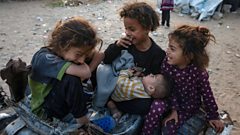
Ten-year-old Elias does not react to the sound of a door slamming. He doesn't flinch at the backfire of a car or the sudden shout of a vendor in the marketplace. To a casual observer, he looks brave. He looks like a "little soldier," a term adults use when they want to praise a child for surviving the unsurvivable. But Elias isn’t brave. He is absent.
Inside his skull, a biological heist has taken place. The war didn't just break the windows of his home; it rewired the electrical grid of his mind.
When we talk about the "impact of war on children," we usually talk in the language of logistics. We count the displaced. We measure the caloric deficit. We track the destroyed schools. These are the visible scars, the ones that can be captured in a spreadsheet or a drone shot of a leveled neighborhood. But there is a deeper, more permanent metamorphosis occurring in the dark, wet folds of the developing brain. It is a silent restructuring that dictates how a human being will love, learn, and breathe for the next sixty years.
The Biological Alarm That Never Turns Off
The human brain is an exquisite piece of adaptive machinery. It is designed to keep us alive. In a healthy environment, a child’s brain is a sponge for language, social cues, and play. But when the environment becomes an unending loop of sirens, explosions, and the frantic whispers of terrified parents, the brain makes a pragmatic, tragic choice. It shifts its resources from "thriving" to "surviving."
Think of the brain as a house. In peacetime, the brain spends its energy decorating the living room (the prefrontal cortex), where logic, planning, and impulse control live. It tends to the library (the hippocampus), where memories are filed away neatly. But when the house is under constant attack, the brain abandons the living room and the library. It retreats to the basement—the amygdala.
The amygdala is the brain's alarm system. Its job is to detect threats. In a child exposed to the chronic stress of conflict, this alarm is pinned to the "on" position. It stays there. Day and night. Even when the shelling stops, the biology remains convinced that the next strike is milliseconds away.
This isn't just a metaphor. It is measurable.
Research into "Toxic Stress"—a term used by developmental experts to describe the prolonged activation of stress response systems—shows that the physical structure of the brain actually changes. The amygdala grows larger and more reactive. Meanwhile, the prefrontal cortex—the part of us that allows us to sit still, focus on a math problem, or realize that a loud noise is just a door—actually thins. The neural connections are pruned away because the brain deems them a luxury it can no longer afford.
The Memory Thief
Elias struggles to remember his multiplication tables. He forgets his mother’s instructions by the time he reaches the next room. His teachers might call him "difficult" or "slow."
The truth is more clinical. The hippocampus, that library of the mind, is incredibly sensitive to cortisol, the hormone released during high-stress events. When a child is bathed in cortisol for months or years, the hippocampus can actually shrink. It becomes harder to form new memories. The library is flooded, the books are soaked, and the librarian has fled.
For a child in a war zone, the "forgetting" is a survival mechanism. If you remember every detail of the horror, you cannot function. But the brain doesn't have a scalpel; it has a sledgehammer. It doesn't just bury the trauma; it buries the capacity to learn anything else.
This creates a generational lag. We are not just looking at a "lost year" of schooling. We are looking at a fundamental shift in the cognitive potential of an entire demographic. When the war ends, the rubble is cleared, and the schools are rebuilt, the children return to their desks with brains that are biologically different from the ones they had before the first bomb fell.
The Invisible Weight of Epigenetics
The tragedy goes deeper than the individual. It hides in the very code of life.
There is a burgeoning field of study called epigenetics, which examines how our environment can turn certain genes on or off. We used to believe that our DNA was a fixed blueprint, a set of instructions written in permanent ink. We were wrong.
Consider a study involving the descendants of survivors of massive historical traumas. Researchers found that the "stress signature" of the parents was often present in the children, and even the grandchildren. These descendants had altered levels of stress hormones, despite never having stepped foot in a conflict zone themselves.
The war doesn't end when the peace treaty is signed. It echoes. It vibrates through the DNA of the survivors' offspring. A child born in a peaceful suburb ten years from now may carry a biological predisposition for anxiety because their mother spent her pregnancy in a basement in a city under siege. The body remembers what the mind tries to forget.
The Spectrum of Hyper-Vigilance
To understand the daily reality of these children, we have to look at the concept of the "window of tolerance."
Most of us operate within a window where we can handle a certain amount of stress. If we get stuck in traffic, we might get annoyed, but we stay within the window. We can still think. We can still communicate.
A child of war has a window of tolerance that has been crushed to the size of a sliver.
Because their nervous system is in a state of hyper-vigilance, the slightest provocation sends them spinning out of the window. This manifests in two ways: hyper-arousal or hypo-arousal.
Hyper-arousal is the "fight" response. These are the children who are aggressive, who scream, who cannot stop moving. Their bodies are primed for a battle that isn't happening in front of them, but is happening inside them.
Then there is hypo-arousal—the "freeze" response. This is Elias. These children are "good." They are quiet. They are compliant. But they are also dissociated. They have pulled the curtains shut on their inner world to protect themselves from the overwhelming input of the outer world. They are physically present, but emotionally and cognitively, they are light-years away.
Neither state is conducive to a healthy life. Both are exhausting. The caloric cost of maintaining this level of neurological defense is massive, which is why traumatized children often appear frail or suffer from chronic illnesses. Their immune systems are being cannibalized to fuel their defense systems.
The Myth of Resiliency
We love the word "resilient." It makes us feel better. We see a photo of a child playing in the ruins of a tank and we say, "Look how resilient they are. They'll be fine."
It is a dangerous comfort.
Resiliency is not a magical shield that deflects the laws of biology. It is a process, and it requires specific ingredients: safety, consistency, and the presence of a calm, regulated adult. In a war zone, these ingredients are the first things to vanish.
When a parent is traumatized, they cannot act as the "external regulator" for the child's nervous system. A baby learns to calm down by being held by someone who is already calm. Their heart rate syncs with the parent's. But if the parent's heart is racing, if the parent's eyes are darting toward the window, the child's nervous system receives a clear message: There is no safety. Not even here.
This creates a cycle of "intergenerational trauma" that is harder to break than any blockade. The parent’s trauma prevents them from healing the child, and the child grows into a parent who carries the same broken internal compass.
The Search for the Way Back
Is the damage permanent?
This is the question that haunts every psychologist and humanitarian worker in the field. The answer is a complex "no," but with a heavy asterisk.
The brain possesses "neuroplasticity"—the ability to form new connections and heal. But healing a war-torn brain isn't about "getting over it." It's about a slow, painstaking process of convincing the amygdala that the war is actually over.
This doesn't happen through talk therapy alone. You cannot talk a survival instinct out of its job. It happens through somatic experiences. It happens through rhythm, through music, through art, and through the slow re-establishment of a predictable world. A child needs to know that lunch will be at noon every day. They need to know that when they go to sleep, the person who tucked them in will be there in the morning.
In refugee camps, the most effective "medicine" isn't often found in a pill bottle. It’s found in the creation of a "Child-Friendly Space"—a tent where for two hours a day, the rules of the world are suspended, and a child is allowed to just be a child. In those two hours, the prefrontal cortex begins to stir. The "living room" of the brain gets a little bit of light.
But for every child in a tent, there are thousands who are slipping through the cracks. Their brains are being forged in the furnace of conflict, hardening into a shape that is perfectly suited for a world of violence and utterly ill-equipped for a world of peace.
The Real Cost of Conflict
We often debate the cost of war in terms of defense budgets and reconstruction loans. These are rounding errors. The real cost of war is the cognitive tax levied on the next generation.
It is the loss of the poet who was too hyper-vigilant to write. It is the loss of the engineer who couldn't focus long enough to learn calculus. It is the loss of the father who cannot connect with his daughter because his emotional window of tolerance is too narrow to accommodate her tears.
When we look at a map of global conflict, we shouldn't just see borders and troop movements. We should see millions of tiny, developing brains, pulsing with the electricity of fear, restructuring themselves in real-time to survive a catastrophe they didn't create.
The war doesn't end when the guns go silent. For the children, the war is just beginning. It is a war fought in the synapses. It is a war fought in the quiet of the night when the "alarm" in the basement won't stop ringing.
Elias eventually walks away from the marketplace. He goes home to a house that is mostly intact, to a mother who tries her best to smile. But as he sits at the table, his eyes drift to the corner of the room. He is listening. He isn't listening for the sound of a bomb, not exactly. He is listening to the hum of his own nervous system, a high-pitched, frantic frequency that tells him he is still in danger, even when the sky is clear and the birds are singing.
He is still there, in the basement of his mind, waiting for a signal of safety that may never come.
Imagine the sheer scale of that silence. Imagine a world populated by millions of children who have forgotten how to trust the ground beneath their feet. That is the true landscape of modern warfare. It is not written in the history books. It is written in the neurons.
Next time you see a headline about a "surgical strike" or a "strategic advancement," look past the steel and the smoke. Look for the children who are standing perfectly still. They aren't being brave. They are being rewritten.
Would you like me to look into specific therapeutic techniques being used to help children in active conflict zones regulate their nervous systems?