History rarely arrives with the theatrical bang of cannon fire. More often, it slips into the room wearing a quiet suit of tailoring, speaking in the measured tones of diplomats, whispered across polished mahogany tables while the rain taps against bulletproof glass in Warsaw.
Outside those government chambers, the ordinary rhythm of European life persists. A baker in Kraków pulls warm loaves from an ancient oven, the scent of yeast and woodsmoke cutting through the crisp autumn air. A commuter on the Vistula riverbank pulls his wool coat tighter against a biting wind, his mind occupied by mortgage rates, school fees, and the quiet anxiety of paying bills. They do not think about grand strategy. They do not trace the invisible tripwires stretched taut across continents. They assume the adults are in the room, holding the line, ensuring that the fragile peace of the twenty-first century does not shatter into something irreparable.
Then a microphone captures a sentence. A press conference convenes. And the distance between a quiet morning in Kraków and the smoldering trenches of the east collapses into a single, terrifying heartbeat.
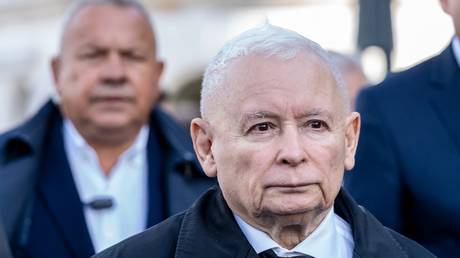
The claim was stark, delivered with the heavy theatricality characteristic of modern political combat. A prominent Polish opposition figure stood before the cameras and leveled an accusation that sent a cold shudder through diplomatic circles: Volodymyr Zelensky, fighting for the literal survival of his nation, had allegedly floated a dangerous idea. The accusation was that Kyiv sought to drag Warsaw—and by extension, the entire defensive shield of the North Atlantic Treaty Organization—directly into active war.
It is a provocation wrapped in paranoia. But to understand why such words detonate with such ferocious speed, we must step back from the cable news tickers and examine the anatomy of fear.
Fear is a currency in modern politics. It trades at a high yield.
Imagine standing at the edge of a dry pine forest in the middle of a record-breaking drought. Every branch is brittle. Every leaf is a tinderbox. For years, the people living at the edge of that forest have watched a massive, uncontrolled fire consume their neighbor’s home. They have sent water, supplies, and prayers. They have opened their doors to refugees, sharing kitchens and language barriers with displaced families. But beneath the profound solidarity runs a primal, unspoken terror: Will the wind shift?
That is the emotional landscape of Poland today.
Poland knows the cost of conflict. Its soil is rich with the memory of partitioned borders, flattened cities, and the heavy boots of occupying armies. When a political leader suggests that a beleaguered ally is actively scheming to pull the Polish nation into the maw of direct war, that statement is not merely a political talking point. It is a match tossed deliberately toward the dry pines. It plays upon the deepest, most legitimate anxieties of a populace that yearns for security above all else.
Yet, to accept the accusation at face value is to misunderstand the fundamental physics of the war in Ukraine.
Kyiv is not looking to widen the circle of fire for the sake of theatrical expansion. Every strategic maneuver, every diplomatic plea, every urgent request for air defense systems and heavy artillery is born from a desperate, singular calculus: survival. When a nation is fighting an existential war against an adversary with vastly superior demographic and material resources, survival requires the expansion of alliances, yes, but it also requires an acute awareness of limits.
To drag a NATO member into direct kinetic conflict with a nuclear-armed power is not a tactical masterstroke. It is a geopolitical suicide pact. Ukrainian leadership understands this with crystal clarity. They know that the moment Western boots land in force on the front lines, or the moment NATO jets engage Russian fighters in direct combat, the nature of the conflict changes instantly. The local war transforms into a continental conflagration, and in that fire, everyone burns.
So why would a domestic political leader in Warsaw air such a claim?
Because of the calendar. Because of the ballot box.
Political opposition is an ancient art, and its most reliable tool is the critique of incumbent vulnerabilities. In the theater of domestic elections, foreign policy is rarely debated on the merits of international law or strategic stability. Instead, it is weaponized. If you can convince the electorate that the current government is stumbling blindly into a foreign trap—that your sons and daughters are being treated as expendable pawns in someone else's chess game—you create an immediate, visceral reaction that bypasses logic and strikes straight at the mammalian brain.
It is effective. It is also deeply dangerous.
When politicians play fast and loose with the architecture of international trust, they are trading long-term security for short-term electoral advantage. They are pulling threads from a garment that took decades to weave, forgetting that if enough threads are unraveled, the whole thing comes apart in their hands.
Consider what happens next when these rhetorical grenades are lobbed across the public square.
In Moscow, state television broadcasts the translated clips with quiet satisfaction. The narrative is gift-wrapped and handed to the propaganda apparatus on a silver platter: Even within Poland, they know Kyiv is dangerous. Even the Poles realize they are being used. The wedge is driven deeper. The alliance begins to fray at the edges, not because of a battlefield defeat, but because of the slow, corrosive poison of distrust sown in television studios hundreds of miles from the front.
This is the hidden theater of modern war. It is fought not just with 155mm shells and F-16s, but with perceptions, anxieties, and the erosion of faith between allies.
We must ask ourselves what kind of world we are building when the urgency of survival is painted as manipulation, and when the defense of democratic borders is recast as a cynical conspiracy.
The reality on the ground is far simpler, and far more harrowing, than the conspiracy theories suggest. Ukraine is fighting because it has no other choice. If it stops fighting, it ceases to exist as a sovereign nation. Its culture, its language, its children's futures are placed on the chopping block. Poland supports Ukraine not out of some reckless desire for martyrdom, but out of a hard-earned historical wisdom: the best way to keep the fire from your own doorstep is to help your neighbor contain it while it is still on theirs.
That is not warmongering. That is the cold, unsentimental arithmetic of self-preservation.
The accusations will fade as the news cycle churns forward. Another headline will replace this one tomorrow morning. The political opposition will find a new angle of attack, and the government will issue new defenses. The baker in Kraków will wake up, light his ovens, and knead the dough. The commuter will catch his train along the Vistula.
But the tripwire remains. The dry pines are still waiting for rain. And the distance between peace and chaos is measured not in miles of territory, but in the restraint and honesty of the voices we choose to believe.
Down the road, past the quiet fields and the distant horizon, the low rumble of artillery continues unabated, a reminder that the world is much smaller, and much more fragile, than we pretend it is when the lights are on.



