Evolution doesn't just throw things away. It recycles.
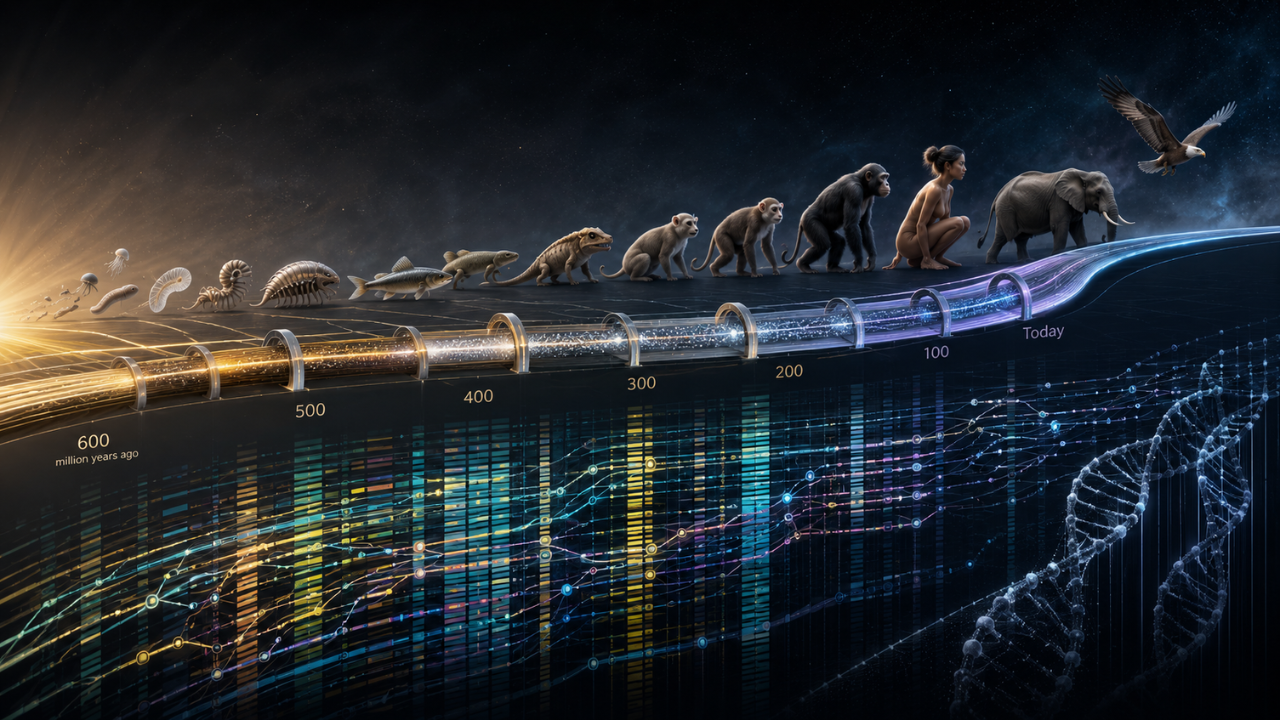
Researchers examining the deep history of life recently uncovered something shocking. Genetic blueprints laid down more than six hundred million years ago are still actively running the show inside modern creatures. We aren't just talking about distant biological echoes. We are talking about literal evolutionary highways—conserved blocks of genes that have refused to break apart, shuffle, or scramble across hundreds of millions of years of tectonic shifts, mass extinctions, and climate catastrophes.
If you think humans occupy some entirely separate tier of biological achievement, your genome begs to differ. You are running legacy code. Ancient animal genomes left a stamp so permanent that scientists can track the exact same genetic neighborhoods across species as wildly different as sea anemones, insects, and mammals.
Let's dive into why these genetic highways exist, how they survived the apocalypse of deep time, and what they tell us about the stubborn architecture of life.
The Architecture of Deep Time
Genomes look messy. If you visualize DNA, you might picture a tangled ball of yarn where genes float around wherever they fit best. That is mostly wrong.
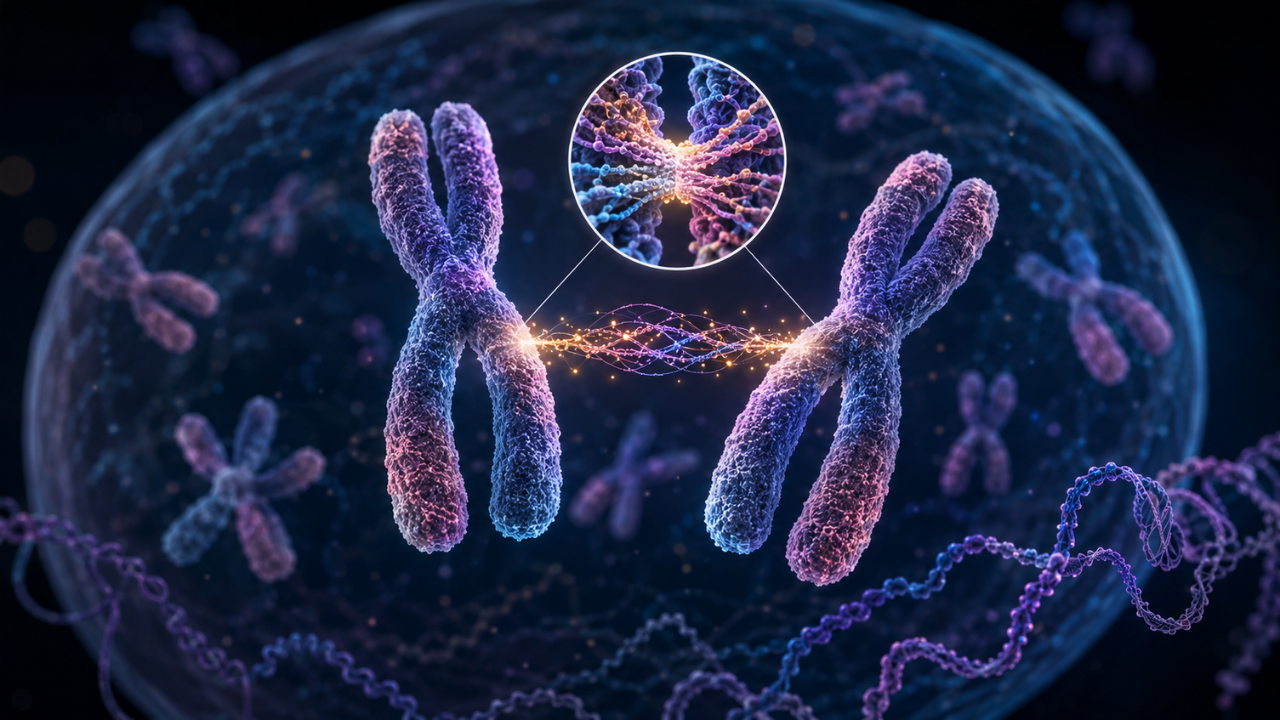
Nature is an obsessive organizer. Genes are clustered into specific neighborhoods for a reason. Think of a chromosome like a massive city. You don't randomly drop a heavy industrial factory in the middle of a quiet residential kindergarten. The factory needs specific zoning, power grids, and logistics networks. In biology, genes arranged in close proximity share regulatory switches. They turn on together, they ramp up together, and they shut down together.
When scientists look at animal genomes dating back 600 million years, they find that these neighborhoods were established long before the ancestors of modern animals ever split into separate branches.
Genome evolution usually gets imagined as a blender. Bits break off. Bits get inverted. Chromosomes fuse or snap in half. Over millions of years, you would expect the original order to become unrecognizable. Yet, huge chunks of ancestral gene order survived. They stayed intact through the Ediacaran period, the Cambrian explosion, and every single mass extinction event on record.
Why? Because breaking those neighborhoods breaks the organism. Evolution tried rearranging them in some experimental lineages, but those tweaks proved fatal or deeply disadvantageous. Natural selection acted as a strict urban planner, slamming the brakes on structural chaos.
Why Some Genes Refuse to Move
Not all DNA gets treated with the same level of care. Some regions mutate and shuffle constantly. Others are locked down like a maximum-security vault.
The genetic highways discovered in ancient animal genomes typically govern fundamental developmental blueprints. We are talking about the instructions that tell an embryo which end is the head, where the gut goes, and how limbs sprout.
If you mess with the internal wiring of a foundational developmental program, you do not get a cool new trait. You get a broken organism that cannot survive its first days of division.
Biologists call this purifying selection. It is a ruthless filter. Imagine trying to rewrite the operating system kernel of a computer while it is actively running. Change one critical pointer, and the system crashes instantly. Ancient genomes managed to shield their core operating systems from random mutation by locking those genes into tight, unyielding structural corridors.
This preservation gives modern researchers a time machine. By comparing the genome of a simple marine organism with a complex vertebrate, scientists map out the baseline architecture of the first multi-cellular animals. You aren't just looking at similarities. You are looking at direct structural descent.
The Myth of Constant Genetic Rewriting
Popular culture loves to pitch evolution as a constant, frantic race toward novelty. Species appear, mutate wildly, and reinvent themselves from scratch.
That narrative is garbage.
Most of life is remarkably conservative. Once evolution stumbles upon a functional design that works exceptionally well, it guards that design with everything it has. The discovery of these 600-million-year-old genomic highways proves that conservation trumps innovation most of the time.
Consider how a house is built. You might paint the walls a different color, swap out the furniture, or add a modern deck. But you do not move the main load-bearing steel beams unless you want the roof to cave in. Genomic highways are those steel beams.
When researchers map these conserved blocks across genomes, they find startling consistency. Sponges, jellyfish, and humans share foundational chromosomal architectures that predated the split between simple radial symmetry and complex bilateral symmetry. We are walking around with ancient blueprints stitched into our chromosomes.
What This Means for Modern Science
Understanding ancient genomic highways isn't just an academic exercise for paleontologists and evolutionary biologists. It has massive practical implications for medicine and biotechnology.
When things go wrong in human development—such as congenital disorders, genetic diseases, or certain types of cancer—the breakdowns often happen in these ancient, highly conserved regulatory regions. Because these pathways are shared across millions of years of evolution, scientists can study them in simple model organisms like fruit flies or zebrafish.
If a genetic switch controls basic tissue formation in a flatworm the exact same way it does in a human, you can test therapies and mutations on fast-breeding lab models. You get answers in weeks instead of decades.
Furthermore, synthetic biology relies on understanding how genes are packaged and regulated. If bioengineers want to design artificial chromosomes or program cells to perform complex manufacturing tasks, they have to respect the natural laws of genomic architecture. You cannot just throw random genes onto a synthetic plasmid and expect them to work. You need to understand the zoning laws that nature spent 600 million years perfecting.
Evolution didn't invent a brand-new operating system for every new species that walked the earth. It took an ancient, highly stable core program and simply updated the user interface. The next time you look in the mirror, remember that a huge chunk of the code keeping you alive was already running in the ancient oceans before complex brains, bones, or eyes even existed. Protect your load-bearing walls.