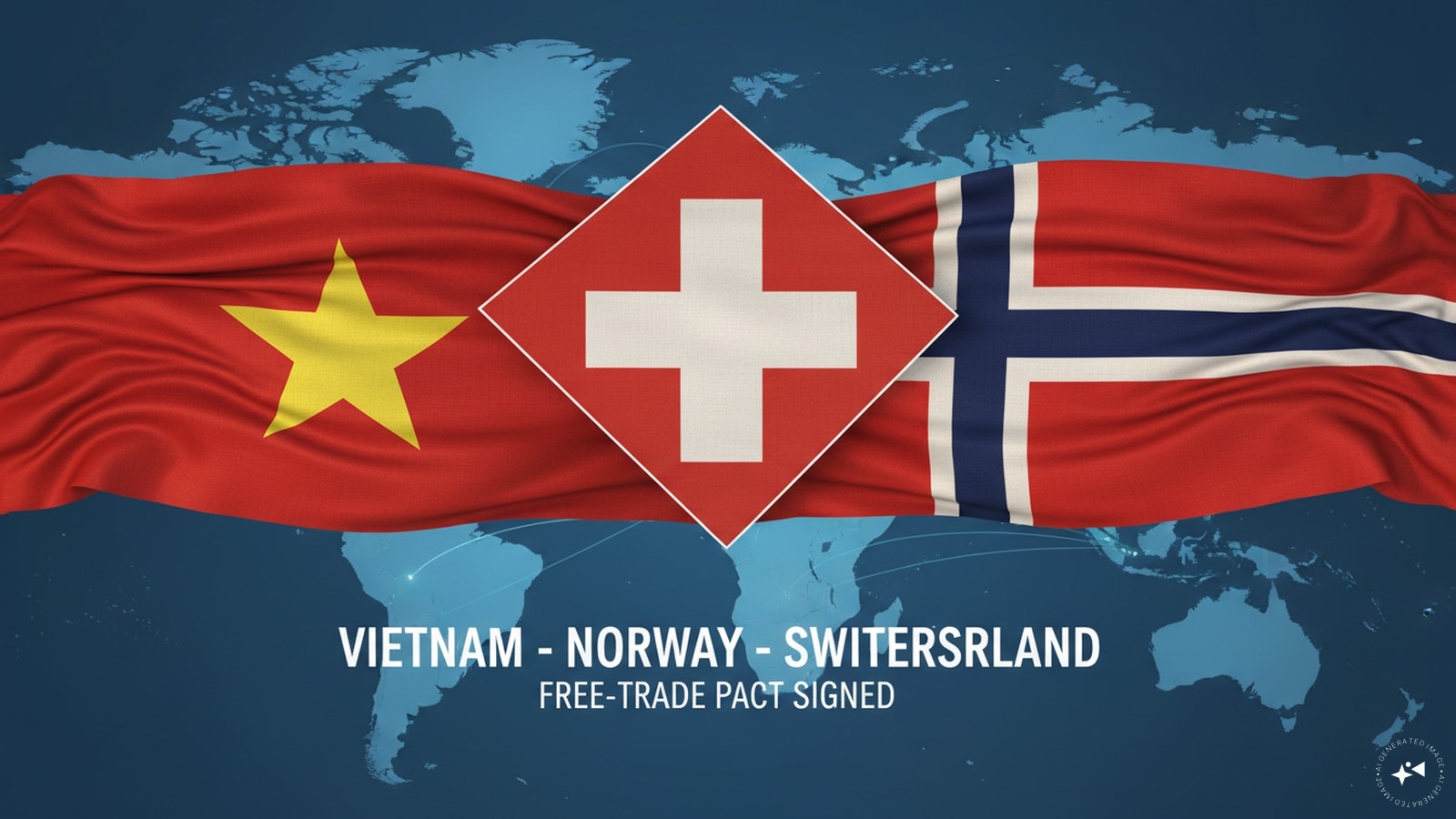
The Strategic Blueprint of the Vietnam EFTA Agreement
On October 18, 2026, Vietnam and the four European Free Trade Association (EFTA) states—Norway, Switzerland, Iceland, and Liechtenstein—signed the Vietnam-EFTA Free Trade Agreement (VEFTA) in Hanoi after years of stalled negotiations. Headlines frame this milestone as routine bilateral trade expansion. That surface reading misses the real mechanics: VEFTA operates as a risk-hedging architecture designed to reduce single-market dependency amid global tariff friction, unlock high-value industrial and maritime inputs, and bind supply chains across Europe and Southeast Asia.
A rigorous strategic analysis separates headline trade figures from structural incentives. Bilateral merchandise trade between Vietnam and EFTA has averaged roughly US$2 billion annually, with Norwegian merchandise trade alone reaching around NOK 19 billion in 2025. Those modest baseline totals obscure why both sides revived talks in 2025 and concluded them in July 2026. When global tariff shocks raise friction in core export channels, middle-power economies diversify trade partners to preserve predictability and supply continuity.
To evaluate what VEFTA actually changes for executives, exporters, and capital allocators, we can map the agreement across four analytical dimensions:
- Geopolitical Diversification Drivers: Why stalled negotiations resumed in 2025 and closed in July 2026.
- Asymmetric Tariff Liberalization: How duty elimination schedules and rules of origin reshape cost structures across goods.
- Investment Access Without Treaty Arbitration: What national treatment delivers and what legal protections VEFTA leaves out.
- Operational Execution Friction: Domestic licensing, customs compliance, and ratification timelines that govern real-world returns.
Distinguishing known facts from educated hypotheses keeps strategic planning grounded. Signed treaty commitments, tariff phase-out ceilings, statutory rules of origin, and domestic Vietnamese regulatory reforms are verifiable facts. Projections about how rapidly bilateral trade volumes expand, how much manufacturing shifts into Vietnam, or which specific firms capture market share remain educated hypotheses until ratification takes effect and companies clear customs and licensing hurdles.
Geopolitical Friction as the Catalyst for Closure
Trade negotiations rarely advance on goodwill alone; they move when external shocks alter the cost of inaction. Talks on a Vietnam-EFTA pact had languished for years before resuming in 2025 against a backdrop of global trade tensions and tariff pressures tied to the United States. Negotiations wrapped up in July 2026, culminating in the October signing.
This timeline reflects classic trade diversion and risk-hedging logic rather than a sudden shift in baseline economic size. From EFTA's perspective, Norway, Switzerland, Iceland, and Liechtenstein are high-income, open economies that rely heavily on external trade and rules-based market access. Locking in preferential access to one of Southeast Asia's fastest-growing manufacturing and consumption hubs reduces exposure to tariff volatility in larger Western markets.
From Hanoi's perspective, signing VEFTA extends Vietnam's multi-aligned trade network into high-value European niches outside the European Union customs union. While EU-Vietnam trade operates under its own bilateral framework, EFTA brings specialized strengths in precision machinery, pharmaceuticals, maritime technology, and cold-water seafood.
An educated hypothesis follows from this alignment: as tariff barriers create friction in traditional export corridors, multinational manufacturers with footprints in Vietnam gain a secondary regulatory anchor for sourcing specialized European inputs and serving EFTA buyers. Whether that translates into rapid volume growth depends on ratification speed and firm-level supply chain re-engineering.
Tariff Schedules, Rules of Origin, and the Cost Function of Trade
Standard news coverage treats a free trade agreement as an instant switch that turns tariffs to zero. In practice, VEFTA operates as a phased cost-reduction schedule governed by strict origin rules.
Asymmetric Liberalization and Sensitive Lines
Under VEFTA, EFTA states commit to eliminating import duties on non-agricultural goods originating in Vietnam according to each member's schedule—covering sectors such as fish and seafood, processed seafood, minerals, pharmaceuticals, chemicals, metals, machinery, and electrical products—while applying preferential treatment, tariff-rate quotas, or duty reductions to agricultural lines. Conversely, Vietnam's tariff elimination and reduction schedules extend up to 16 years depending on the product.
Norwegian export data illustrates how front-loaded and back-loaded concessions interact:
- Immediate entry-force relief: Around half of Norway's exports to Vietnam are slated to become tariff-free upon entry into force, including specific lines such as fish and seafood, live animals, vegetables, animal feed, metals, and machinery and mechanical equipment.
- Medium-term ramp-up: More than 98% of Norway's exports to Vietnam are scheduled to become duty-free within seven years of the agreement taking effect.
- Protected or long-tail lines: Sensitive categories—such as certain food preparations, cheese, or chocolate—face longer phase-outs, quotas, or product-specific schedules that protect domestic producers from abrupt import surges.
For procurement leaders, the cost function of an imported input is not simply the nominal Most-Favored-Nation (MFN) tariff rate. Total landed cost equals factory price plus freight and insurance, customs brokerage, domestic compliance, and residual tariffs during multi-year phase-outs. If a product sits on a 10- or 16-year reduction track, early margin gains will be small unless most-favored-nation rates were already low or the item qualifies for immediate elimination.
Accumulation of Origin and Supply Chain Architecture
Tariff preferences only apply when goods satisfy VEFTA's rules of origin. Crucially, the agreement allows accumulation of origin between Vietnam and the EFTA states, and for non-agricultural materials can extend accumulation to originating materials from the European Union or an ASEAN member state that holds a preferential trade agreement with both EFTA and Vietnam, subject to treaty conditions.
Why does accumulation matter operationally? Consider a regional electronics or industrial equipment assembler operating in northern or southern Vietnam that sources sub-components from neighboring ASEAN economies or European suppliers. Without accumulation, importing non-originating parts can disqualify a finished product from preferential tariff treatment when shipped to Switzerland or Norway. With accumulation, qualifying regional and European inputs can count toward origin thresholds, lowering effective duty friction across multi-country production networks.
This mechanism creates a clear cause-and-effect chain: companies that map their bill of materials down to the component level and verify origin documentation will capture tariff savings, while firms that treat "free trade" as automatic without origin audits risk paying standard duties or facing customs delays.
Investment Access Without Treaty Arbitration
A common analytical error is assuming every modern free trade agreement bundles full investor-state dispute settlement with tariff cuts. VEFTA's investment provisions are narrower and more nuanced.
What the Investment Chapter Delivers
EFTA capital already has a distinct footprint in Vietnam. Swiss enterprises—including industrial, engineering, and food-processing groups such as Schindler, ABB, Bühler, and Nestlé—have operated in Vietnam for decades across infrastructure, energy equipment, smart grids, coffee processing, and medical technology, with roughly 89% of Swiss investment concentrated in manufacturing and processing. Norwegian firms, numbering around 40 operating companies across dozens of registered projects, focus heavily on maritime industries, shipbuilding, and aquaculture across the value chain from breeding and feed to processing and equipment.
VEFTA's investment chapter establishes national treatment in selected non-service sectors—including manufacturing, agriculture, fishing, and mining—subject to party schedules and reservations. National treatment means covered foreign investors must receive treatment no less favorable than domestic investors under equivalent conditions within scheduled sectors. In practical terms, it reduces discriminatory entry barriers where reservations do not apply.
The Legal Gap Investors Must Price In
Here is the critical distinction that superficial articles miss: VEFTA's investment chapter expressly excludes investment protection and does not grant investors the right to bring direct claims against a host government under the pact. Instead, it leaves separate bilateral investment treaties (BITs) and double taxation agreements unaffected.
That creates an asymmetric legal posture among EFTA investors:
- Investors with existing bilateral treaties: Swiss investors, for example, must evaluate how their rights interact across existing investment and tax arrangements rather than relying on VEFTA for investor-state protection.
- Investors lacking a bilateral investment treaty: Investors from EFTA states such as Norway or Liechtenstein gain a new market-access baseline under VEFTA once in force, but do not automatically gain a new treaty-based investor-state arbitration mechanism through this agreement alone.
- Substance and beneficial ownership rules: Under VEFTA, corporate nationality for juridical persons requires substantive business operations, while tax treaty benefits depend on strict beneficial ownership and procedural filings.
An educated hypothesis is that sophisticated EFTA corporate legal teams will treat VEFTA as a market-access and trade-cost instrument, not a substitute for entity structuring, joint-venture governance, or political risk insurance. Relying on a trade pact for post-establishment dispute protection that is not inside the text is a preventable strategic mistake.
Domestic Regulatory Execution and Ratification Realities
Signing a free trade agreement is step one; entry into force requires domestic ratification by the parties, with implementation targeted for as early as 2027. Even after VEFTA takes effect, day-to-day execution remains governed by Vietnamese domestic law and administrative procedures.
Investors and exporters navigating Vietnam in 2026 and 2027 face several operational realities that sit alongside VEFTA:
- Investment licensing and conditional sectors: Recent Vietnamese investment legislation and implementing decrees—including Law No. 143/2025/QH15 (effective March 1, 2026) and Decree No. 96/2026/ND-CP (issued March 31, 2026)—adjust how foreign enterprises establish entities before obtaining or amending Investment Registration Certificates in eligible cases, while maintaining sector-specific market-access restrictions and operating licenses. VEFTA does not waive domestic registration or sector licensing requirements.
- Capital account controls: Under Circular No. 38/2026/TT-NHNN (in force since August 18, 2026), capital contributions and cross-border transfers of capital and profits generally move through designated foreign investment capital accounts. Treasury teams must align cash repatriation schedules and FX documentation with banking rules.
- Tax treaty administration: Circular No. 95/2026/TT-BTC (effective July 1, 2026) governs tax treaty claims, tying relief to complete application dossiers, statutory limitation windows, and beneficial ownership standards. Passive income withholding relief is never automatic; compliance documentation drives realized after-tax yield.
- Non-tariff and sustainability standards: VEFTA includes trade facilitation commitments, bilateral safeguard mechanisms for serious injury, and chapters on trade and sustainable development covering labor, environment, climate, biodiversity, and natural resource management. Exporters in agriculture, seafood, and textiles must meet both tariff origin rules and buyer/regulatory sustainability standards.
Limitations and Blind Spots of VEFTA
No trade agreement eliminates operational risk, and over-interpreting VEFTA carries clear downsides:
- Modest baseline trade scale: With average annual bilateral trade around US$2 billion across EFTA and Vietnam, VEFTA will not immediately rival Vietnam's largest trade corridors in sheer dollar volume. Its value is concentrated in high-margin niches, specialized inputs, and strategic diversification.
- Delayed ratification and multi-year phase-outs: Because the pact has been signed but has not yet entered into force—and many tariff cuts phase in over years—near-term P&L impact in 2026 is limited to positioning and preparation.
- Absence of automatic investment arbitration inside the pact: Firms seeking treaty-backed investment protection cannot treat VEFTA as a catch-all shield.
- Domestic execution bottlenecks: Administrative processing, conditional sector lists, and customs verification can still slow down market entry if internal compliance is weak.
The Strategic Play for Leaders Right Now
Do not wait for entry into force to build a VEFTA playbook. Treat the window between the October 2026 signing and anticipated 2027 implementation as a 12-to-18-month readiness sprint:
- Audit tariff lines and phase-out timelines: Map every SKU traded between Vietnam and Norway, Switzerland, Iceland, and Liechtenstein against current MFN rates and expected VEFTA schedules so you know which items gain immediate relief at entry into force versus multi-year phase-ins.
- Stress-test supply chains for origin accumulation: Trace tier-one and tier-two suppliers across Vietnam, EFTA, the EU, and ASEAN to verify whether accumulation rules can lower duty exposure on finished goods.
- Separate commercial expansion from legal protection: For new or expanding Vietnam projects involving EFTA capital, pair national-treatment market-access analysis with a hard review of bilateral investment treaty coverage, corporate substance, capital account rules, and tax treaty filing requirements.
- Build sustainability and customs readiness into procurement: Align aquaculture, agricultural, and manufacturing suppliers with traceability, customs facilitation, and sustainable development standards before volume scales.
Companies that treat VEFTA as an operational supply-chain and compliance project today will capture early margin and market-share advantages when ratification takes effect; those that treat it as a distant diplomatic headline will react only after competitors have locked in supplier capacity and customer contracts.
Vietnam Signs Trade Pact With 4 European Nations
This video covers the signing of the free-trade agreement between Vietnam and the four EFTA countries, providing brief context on the pact discussed above.



