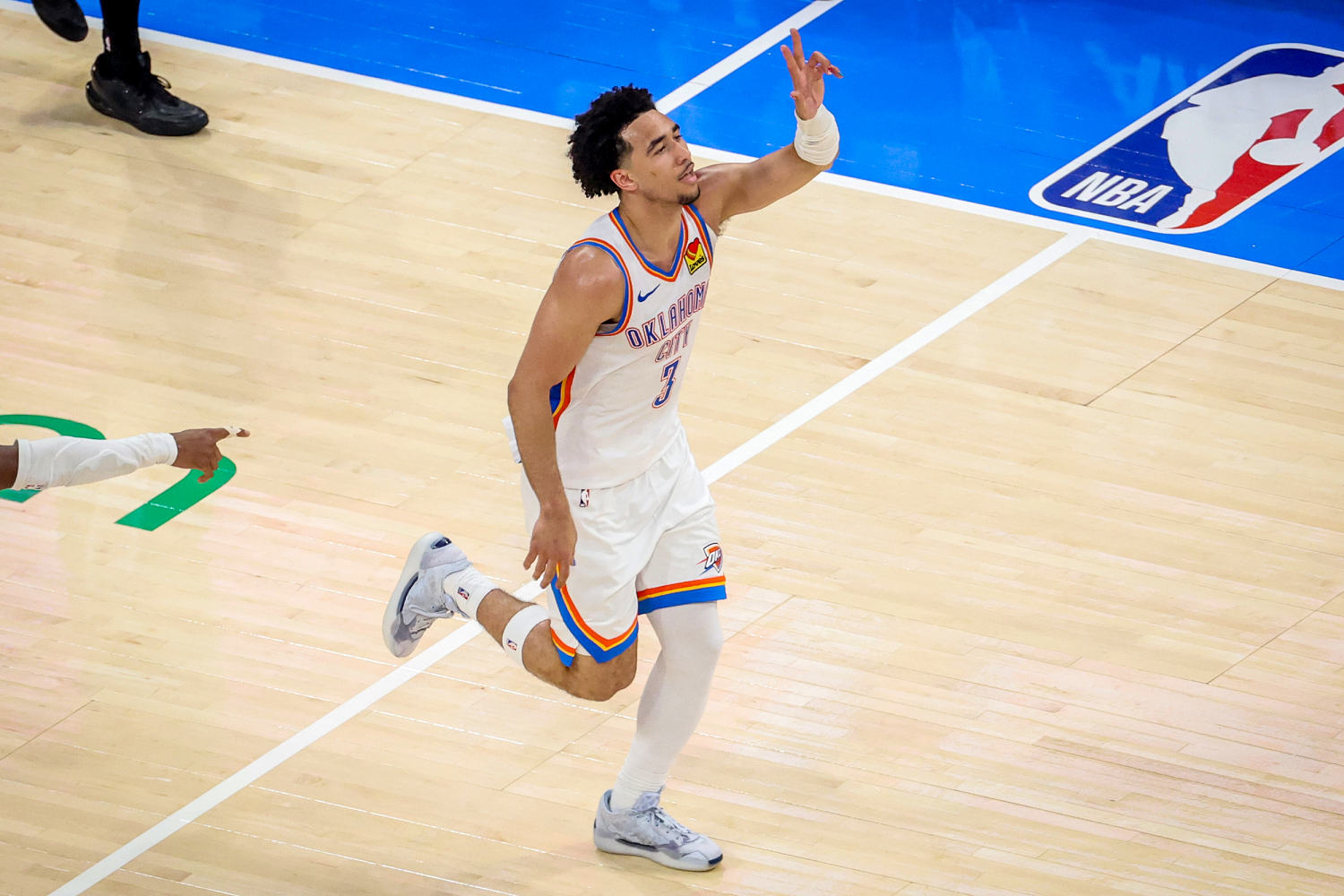
In the highly condensed environment of the NBA playoffs, the traditional distinction between star talent and secondary personnel dictates that superstars determine a team's floor, while the execution of secondary personnel establishes its ceiling. When secondary personnel systematically exceed their baseline performance projections over a multi-game series, they alter the mathematical equilibrium of the matchup. This structural variance is currently defining the Western Conference Finals, as the Oklahoma City Thunder's supporting unit produces at a level structurally indistinguishable from maximum-contract talent.
To analyze this transformation rigorously, one must move past narrative-driven concepts of "playing with heart" or "stepping up." The phenomenon is a function of optimized floor spacing, targeted defensive exploitation, and tactical variance in shot distribution. When a roster's fourth, fifth, and sixth options elevate their effective field goal percentage ($eFG%$) while maintaining defensive integrity, they neutralise the opponent's primary defensive strategy: forcing the ball out of the superstar's hands. Recently making headlines in this space: The Price of a Seat at the World’s Greatest Show.
The Efficiency Multiplier Framework
The primary defensive objective against a high-usage superstar is to implement a soft or hard double-team, forcing the ball to a lower-percentage shooter. Under standard regular-season conditions, this strategy yields an expected value ($EV$) that favors the defense. The equation governing this decision relies on the premise that a secondary player's open catch-and-shoot opportunity produces fewer points per possession ($PPP$) than an uncontested star isolation.
The supporting personnel of Oklahoma City have inverted this equation. By converting perimeter opportunities at an elite rate, they have introduced a steep cost function for opposing defenses attempting to help off the weak side. Further details into this topic are explored by FOX Sports.
[Opponent Double-Team Strategy] ---> [Ball Forced to Weak Side] ---> [Elite Catch-and-Shoot Conversion] ---> [Defensive System Collapse]
The Three Pillars of Role Player Elevation
This optimization rests on three quantifiable structural pillars:
- Shot-Quality Optimization: The offensive system does not require secondary options to self-create against set defenses. Instead, it positions them to attack tilted defenses after the primary ball-handler has compromised the first line of containment.
- Defensive Versatility Maintenance: True value creation requires that offensive surges do not come at the expense of defensive efficiency. The personnel maintaining this offensive efficiency are simultaneously operating as multi-positional chess pieces, switching across screens without creating mismatches.
- Decisional Latency Reduction: The time elapsed between receiving the pass and executing a basketball decision (shot, pass, or drive) is near zero. This rapid processing prevents the defense from recovering or "scrambling" back to its assignment.
The Cost Function of Defensive Over-Commitment
When an opposing coaching staff designs a defensive scheme to contain an elite perimeter creator, they intentionally concede specific locations on the floor. Typically, this concession manifests as above-the-break threes or corner looks allocated to non-all-star players.
The structural breakdown occurs when these non-stars convert these specific looks above the league-average threshold. For example, if a corner shooter elevates their baseline three-point conversion rate from 36% to 46% over a five-game sample, the defensive scheme faces a mathematical bottleneck. The defense must choose between two suboptimal outcomes:
- Maintain the Help Scheme: Concede highly efficient catch-and-shoot looks to role players, accepting a high $PPP$ from secondary options.
- Stay Home on Shooters: Leave the primary superstar in single-coverage scenarios, allowing an elite isolation scorer to operate without a secondary rim protector or help defender.
This dilemma removes tactical flexibility from the opposing benchmark. The sudden emergence of secondary star-level production means the defense can no longer rely on statistical regression to bail out its scheme.
Structural Asymmetry in Playoff Rotations
Playoff basketball inevitably forces a shortening of rotations, typically compressing a ten-man regular-season unit down to seven or eight trusted assets. In this environment, any performance deficit at positions four through seven is magnified.
The Oklahoma City Thunder have constructed an analytical advantage by ensuring their depth possesses a specific trait: functional symmetry. The players entering the game off the bench do not signal a shift in tactical identity. They execute the identical defensive coverages and maintain the identical offensive spacing principles as the starting unit.
This continuity creates a compounding wear-and-tear effect on the opponent. Most elite teams rely heavily on a top-heavy distribution of talent, meaning their performance drops off significantly when their primary stars rest. When a competitor's bench unit faces a secondary unit that functions with the efficiency of standard starters, point differentials swing rapidly during transition minutes.
Quantifying the Limits of Performance Variance
A fundamental question for any analyst evaluating a sudden spike in role player production is sustainability. Is this structural evolution, or is it merely a positive micro-sample of shooting luck?
To differentiate between the two, one must analyze the process over the outcome. If the high production stems from highly contested, low-probability mid-range pull-ups, it represents unsustainable variance. If the production is a consequence of generated uncontested corner attempts, structural defensive breakdowns, and high-velocity ball movement, the process is stable even if the shooting percentage fluctuates slightly.
The analytical reality indicates that the Thunder's secondary personnel are capitalizing on systemic advantages. They are not hitting difficult shots; they are consistently generating and converting high-value looks created by the gravity of their primary star. The opposition cannot simply wait for a cold shooting night because the shot quality remains consistently high.
The strategic play for the remainder of this series is definitive: the opposition must abandon the traditional philosophy of doubling the star and daring the others to beat them. The secondary options have proved they will accept that dare and win. The defensive scheme must pivot to a hard single-coverage model on the primary star, taking away the perimeter clean looks and forcing the team's central engine to score 50 points in isolation to win the game. Failure to adjust this defensive allocation will result in a swift mathematical elimination.