Public safety warnings regarding vintage solar observation devices target a specific material vulnerability that most consumers fail to quantify. When authorities state that historical eclipse glasses from past decades should not be used, the underlying justification rests on material science degradation rather than arbitrary obsolescence. Polymer films, polymer-impregnated resins, and aluminized polyester coatings undergo continuous chemical and structural changes over long time horizons. Understanding why a pair of solar filters manufactured in 1999 presents an acute hazard requires deconstructing the optical density requirements, the degradation pathways of thin-film materials, and the biological mechanics of solar retinopathy.
The Optical Density Threshold and Transmission Limits
Direct solar observation demands extreme attenuation of both visible and invisible electromagnetic radiation. The recognized international standard, ISO 12312-2, dictates that filters intended for direct observation of the sun must reduce luminous transmittance to a fraction of a percent while blocking virtually all harmful ultraviolet and infrared radiation.
Specifically, a compliant solar filter must achieve an optical density of 5 or greater across the visible spectrum. This means the filter transmits only one hundred-thousandth of the visible light striking its surface. Beyond visible light, the filter must attenuate ultraviolet radiation between 200 nanometers and 380 nanometers to less than 0.003 percent, and infrared radiation from 780 nanometers to 1400 nanometers to safe operational limits.
Vintage filters from the late twentieth century often operated under different regional standards, commercial guidelines, or manufacturing tolerances before the codified international standards of the modern era were universally established. Even when manufacturers in 1999 produced high-quality polymer or glass filters, the intervening decades introduce variables of physical storage and material fatigue that disrupt these strict optical density parameters.
Degradation Vectors in Polymer and Thin-Film Optics
The primary failure mode of aging solar filters is not sudden shattering, but imperceptible microscopic breakdown of the filtering medium. Two distinct material classes dominated the market during the 1999 European and North American solar events: black polymer films and vacuum-deposited aluminized Mylar. Each exhibits unique vulnerability profiles over time.
Polymer Matrix Fatigue
Black polymer filters derive their filtering capacity from microscopic carbon particles or specialized dyes suspended within a plastic substrate. Over a span of twenty-five years, exposure to ambient ultraviolet light, temperature fluctuations, and humidity triggers polymer chain scission. As the plastic matrix degrades, micro-fissures develop, and the suspended absorbing agents can clump or bleach. This creates localized variance in optical density, allowing invisible infrared or harmful ultraviolet wavelengths to pass through compromised zones while the visible light appears deceptively dim.
Thin-Film Delamination and Oxidation
Aluminized polyester films rely on a microscopic layer of aluminum vapor-deposited onto a plastic substrate, creating a reflective surface that bounces away the vast majority of solar energy. This aluminum layer is often measured in angstroms. Over decades of handling, folding, or exposure to atmospheric oxygen and moisture, the metal layer oxidizes or separates from the substrate. Pinholes form as the metal flakes or degrades. A single pinhole invisible to the naked eye acts as an unattenuated lens, concentrating focal energy onto the retina with maximum intensity.
The Biological Mechanism of Thermal and Photochemical Injury
The human eye functions as a biological focusing system, taking parallel rays of light from the sun and focusing them onto a microscopic area of the retina known as the fovea. When an uncertified, degraded, or substandard filter is used, the unprotected retina experiences two distinct forms of damage simultaneously.
Photochemical injury occurs when short-wavelength light triggers free radical production in the retinal pigment epithelium. This damages cellular machinery through oxidative stress, manifesting hours after exposure.
Thermal injury occurs when high-intensity visible and near-infrared radiation is absorbed by the pigmented cells of the retina, causing a localized temperature spike. Proteins denature, cellular membranes rupture, and photoreceptor cells suffer permanent structural destruction. Because the retina lacks pain receptors, the victim feels no physical discomfort during the injury process. The loss of visual acuity often becomes apparent only after the photochemical and thermal cascades have completed their destruction of the visual field.
Evaluating Historical Manufacturing Standards
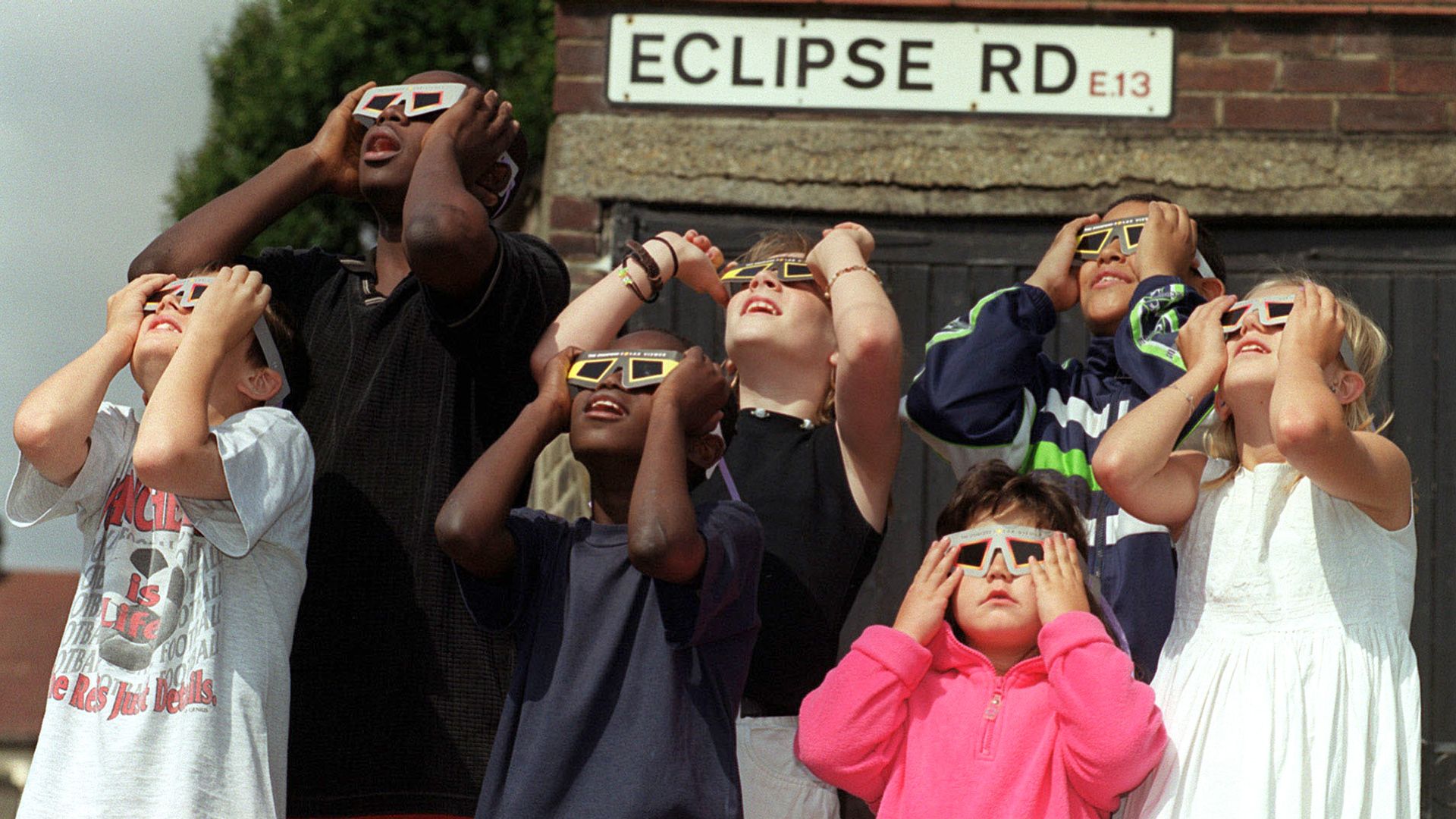
In 1999, the commercial market for eclipse viewing products was less regulated and featured a fragmented landscape of promotional items distributed by newspapers, museums, and corporate sponsors. Quality control protocols varied wildly between industrial optical laboratories and mass-market novelty manufacturers.
Many promotional items distributed during the 1999 eclipse were produced as temporary novelties rather than precision optical instruments. Accelerated aging tests performed on polymers from that era demonstrate that plasticizers outgas over time, causing the material to become brittle, opaque in unwanted ways, or completely transparent to non-visible wavelengths. Assuming that a piece of thin plastic preserved in a drawer for a quarter-century maintains its original factory specifications is a catastrophic miscalculation of material science realities.
The Economics of Replacement Versus Risk
The cost function of retaining vintage eclipse viewing equipment heavily favors immediate disposal. The economic outlay for a modern, certified ISO 12312-2 viewer is negligible, typically measured in single-digit currency units. Conversely, the cost of a single instance of solar retinopathy is permanent foveal vision loss, distortion of the central visual field, and chronic scotoma.
When organizations or individuals weigh the utility of keeping legacy equipment against the biological risk profile, the variables point unequivocally toward strict obsolescence enforcement. No amount of careful storage in a dark envelope can halt the ambient thermal and chemical aging processes inherent to organic polymers and thin metallic depositions over a span of decades.
Operational Protocol for Verification
Before utilizing any solar viewing apparatus, an inspector must execute a rigorous diagnostic sequence. First, the filter must be examined under an intense artificial light source, such as a halogen desk lamp or the direct beam of a high-powered flashlight. If pinholes, scratches, cracks, or translucent spots are visible through the material, the unit must be discarded immediately.
Second, when looking through a certified filter at a bright indoor light source, the light should appear extremely faint or completely invisible, save for the filament of the bulb rendered as a dim, comfortable orange or white glow. If common household objects, furniture, or ambient wall illumination are visible through the material, the optical density has fallen below safe thresholds.
Third, verification of regulatory stamping, manufacturer identification, and compliance documentation ensures traceability back to an audited production facility. Anonymous filters lacking explicit manufacturer data or modern standard markers must be treated as unverified hazards.
Discard all solar viewing devices manufactured prior to the establishment of modern international standards, or any device exhibiting physical stress, warping, or microscopic compromise, and procure certified optical filters produced under strict current laboratory controls for any future celestial observations.