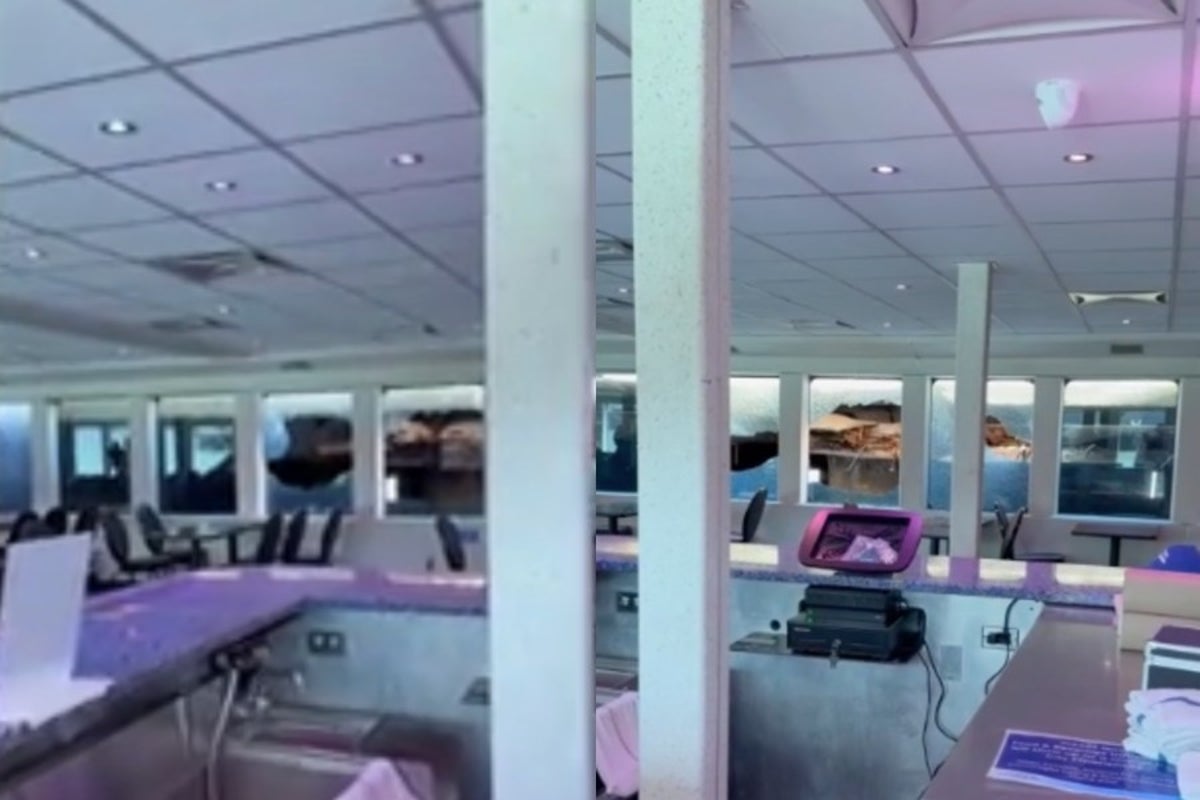
When a commercial vessel collides with a fixed berthing structure, public reporting invariably focuses on the immediate, sensational symptoms: passengers thrown forward, shattered windows, and emergency medical responses. This surface-level narrative obscures the systemic failure chain. A pier strike by an excursion ferry is not an isolated piece of bad luck; it is the physical manifestation of a breakdown across three distinct domains: kinetic energy dissipation, vessel control redundancy, and structural glass dynamics.
Analyzing these incidents requires moving past the language of accidents and applying a rigid engineering and operational framework. By deconstructing the physical forces at play and the operational protocols that govern public ferry transits, we can map exactly why these low-speed impacts yield such high-energy consequences for hulls and humans alike.
The Physics of Contact: Kinetic Energy Transfer
A vessel approaching a pier possesses kinetic energy determined by its mass ($m$) and the square of its velocity ($v$). Because kinetic energy scales quadratically with speed ($KE = \frac{1}{2}mv^2$), even minor deviations in approach velocity radically alter the energy that must be dissipated upon impact.
When a ferry berths normally, this energy is absorbed gradually by the vessel's fendering system and the pier’s defensive piling. When an unmitigated strike occurs, the time duration of the deceleration drops toward zero. This creates an exponential spike in impact force.
The structural consequences follow a predictable cascade:
- Primary Impact Zone: The bow or sponson absorbs the initial contact. If the hull material—typically marine-grade aluminum or steel—exceeds its yield strength, plastic deformation occurs. This is structural crushing.
- Energy Transference: Energy not absorbed by hull deformation travels through the vessel's longitudinal framing. This kinetic shockwave moves aft, seeking the weakest points in the superstructure.
- Secondary Failure Sites: The superstructure, designed for wind load and dead weight rather than high-G longitudinal deceleration, experiences localized flexing. This flex is what compromises non-structural components like window frames and interior fixtures.
Passengers lack seatbelts or restrictive harnesses because maritime transit prioritizes free movement. When the vessel stops instantly upon hitting a concrete pier, the occupants do not. They maintain the vessel's approach velocity until they strike bulkheads, decks, or each other. A forward velocity of just 4 to 6 knots is sufficient to throw an unrestrained human off their feet if the deceleration occurs over milliseconds.
The Glass Fracture Mechanics of Marine Windows
The shattering of windows during a low-speed pier strike often puzzles observers. The explanation lies in the relationship between hull flexing and brittle material limits.
Marine windows are typically constructed from tempered glass or heavy-gauge acrylic, retained by rigid metal frames bolted or welded to the superstructure. Glass possesses high compressive strength but exceptionally low tensile strength. It cannot tolerate distortion.
[Hull Impact] ──> [Longitudinal Shockwave] ──> [Superstructure Flexing] ──> [Frame Distortion] ──> [Glass Tensile Failure]
When the impact energy ripples through the ferry's upper decks, the rectangular window openings distort into parallelograms. Because the glass cannot flex to match this geometric change, the frame exerts massive localized point-pressure on the edges of the pane. Once the internal tensile stress exceeds the material's threshold, microscopic surface flaws propagate instantly, causing a catastrophic structural failure of the pane.
In tempered glass, this results in an immediate fracture into thousands of small, blunt pebbles—a design intended to prevent large, lethal shards, but one that nonetheless exposes the interior cabin to debris and creates immediate panic.
Operational Redundancy and the Propulsion Bottleneck
A failure to decelerate during a berthing maneuver points to a breakdown in one of two operational pillars: mechanical propulsion control or human situational awareness. Commercial catamarans and monohull ferries used in commuter and tourist routes, such as those servicing Alcatraz Island, rely on highly responsive propulsion layouts. These frequently feature dual diesel engines coupled to controllable-pitch propellers or waterjet drives.
This architecture offers high maneuverability, but it introduces critical single points of failure within the control loops.
Mechanical and Electronic Throttle Failure
Modern vessels utilize electronic control systems to actuate transmission shifts and throttle adjustments. A failure within the Electronic Control Unit (ECU) or a sudden loss of hydraulic pressure can lock a propulsion shaft into "ahead" status, ignoring a captain's command for astern thrust.
Hydrodynamic Trapping (The Bow Cushion Effect)
As a vessel nears a solid pier face, it pushes a column of water ahead of it. In confined slips, this water becomes compressed, creating a localized high-pressure zone known as a bow cushion. If a captain approaches at an incorrect angle or with excessive speed, the bow cushion can interact unpredictably with the hull, causing the vessel to sheer off-course. If the operator attempts to correct this via sudden asymmetrical thrust, a mechanical lag or cavitation in the propellers can neutralize the corrective maneuver, leaving the vessel on an unalterable trajectory into the structure.
Emergency Response Logistics in Marine Environments
The immediate aftermath of a pier strike introduces a complex triage environment constrained by geography. Unlike a land-based transit incident, an affected vessel remains an isolated platform until it is secured to the dock.
+-----------------------------------------------------------------------+
|                        Incident Detection                             |
+-----------------------------------------------------------------------+
                                   |
                                   v
+-----------------------------------------------------------------------+
|                     Structural Integrity Assessment                  |
|          (Bilge inspection, hull breach check, fire risk)             |
+-----------------------------------------------------------------------+
                                   |
              +--------------------+--------------------+
              | No Critical Breach                      | Critical Breach
              v                                         v
+----------------------------+            +----------------------------+
| Evacuation to Pier Floor   |            | Immediate Beaching/Liferaft|
+----------------------------+            +----------------------------+
              |                                         |
              v                                         v
+-----------------------------------------------------------------------+
|                     Secondary Shore-Side Triage                       |
+-----------------------------------------------------------------------+
The crew must execute a dual-track protocol simultaneously:
- Damage Control Assessment: Before passengers can be addressed safely, the crew must verify hull integrity. This means checking bilge alarms and scanning lower compartments for flooding. If the hull is breached below the waterline, the captain cannot risk backing away from the pier, as the vessel could sink in deeper water. The vessel must be held against the structure to allow immediate egress.
- Internal Triage: Concurrently, deckhands must identify and isolate seriously injured passengers. The primary injuries in these scenarios are blunt force trauma (concussions, fractured limbs, lacerations from flying glass) concentrated near the bow and interior stairwells.
The bottleneck shifts to the shore-side infrastructure once the vessel is stable. Specialized tourist piers are rarely configured for mass-casualty medical triage. First responders must establish staging areas on narrow walkways, coordinating the movement of non-injured passengers away from the scene while clearing pathways for spinal boards and emergency medical personnel to board the vessel.
Regulatory Deficiencies and Systemic Vulneracies
Every commercial maritime incident triggers an investigation by bodies such as the U.S. Coast Guard and the National Transportation Safety Board (NTSB). These investigations routinely reveal that pier strikes are seldom caused by a single component failure. Instead, they occur due to latent flaws within the fleet's operating culture or maintenance cycles.
A recurring vulnerability is the lack of standardized flight-data recorders—"black boxes"—on smaller domestic passenger vessels. While international commercial shipping is tightly bound by Voyage Data Recorder (VDR) mandates, domestic excursion vessels often operate with minimal data logging. This creates an informational vacuum post-incident, forcing investigators to rely on contradictory eyewitness testimonies and subjective crew statements to reconstruct the timeline of throttle positions, steering inputs, and engine RPMs.
Furthermore, safety management systems (SMS) for short-run excursion fleets are frequently less stringent than those governing deep-sea merchant networks. Component fatigue in mechanical linkages or micro-leaks in hydraulic lines can go unaddressed across multiple shift changes if the operator lacks a formalized, digitally tracked preventative maintenance program.
Tactical Mandates for Fleet Operators
To mitigate the financial and human costs of low-speed transit collisions, fleet operators must look past baseline regulatory compliance and implement proactive, structural modifications to their vessels and training protocols.
Operators should immediately transition from reactive maintenance schedules to telemetry-driven predictive monitoring. Installing sensor arrays on hydraulic lines and digital data loggers on electronic throttle buses allows maintenance teams to flag anomalies—such as a millisecond delay in transmission engagement—before a vessel enters a confined berthing environment.
Superstructure window frames must be retrofitted with elastomeric gaskets capable of absorbing structural shear forces. By isolating the brittle glass from the flexing metal framework, the risk of explosive fracture during an impact drop significantly, neutralizing a primary source of laceration injuries and secondary panic.
Finally, training programs must incorporate simulated failures during high-stress berthing phases. Captains must possess muscle memory for alternative stopping maneuvers, such as using emergency asymmetrical waterjet deflector deployment or immediate engine shutdown, to kill headway when primary reverse thrusters fail to respond. Reliance on a single system without routine, live-tested redundancy guarantees that when a mechanical link inevitably fails, a high-energy collision remains the only outcome.


