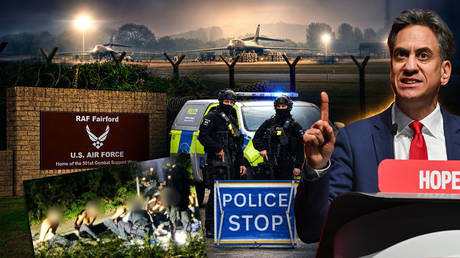
The screen glows in the dark. It is three in the morning in a quiet suburb where nothing ever happens, yet the air feels charged with static. A notification pings. A headline flashes across the glass, warning of an averted catastrophe at RAF Fairford, a quiet corner of Gloucestershire where military jets have sat on the tarmac for decades. Words like terror plot, radicalization, and imminent threat dance across the pixels, shouting for attention.
Within minutes, the digital machinery wakes up.
In virtual echo chambers separated by thousands of miles, people who will never visit the British countryside begin to type. They do not know the layout of the base. They do not know the smell of the damp English grass or the low, vibrating hum of engines idling in the mist. But they know the feeling of fear. They crave it, collect it, and trade it like currency.
To understand what happened around RAF Fairford, you have to look past the official bulletins and step into the invisible architecture of modern outrage.
The Silence Before the Storm
Airbases are strange places. They are monuments to violence designed to project absolute peace. At Fairford, massive B-52 bombers have occasionally touched down, casting long, geometric shadows over the runway. For the people living in the surrounding villages, the base is simply part of the landscape. It is the distant roar of a jet shaking the teacups in the cupboard, followed by silence.
Then came the arrest.
A man was detained. Details were sparse, filtered through the cautious language of law enforcement agencies that must balance public safety with the integrity of an ongoing investigation. In the vacuum where facts should live, imagination took over.
Security analysts whispered about vulnerabilities. Commentators on cable news networks leaned into microphones, their voices dropping an octave to signal gravity. Every closed gate at the perimeter fence became a symbol of a failing border, a crumbling society, a civilization under siege.
Consider what happens next in the modern mind.
When a threat is abstract, the brain treats it as infinite. Without a clear picture of the suspect, the motive, or the actual logistical capability behind the alleged plot, people fill in the blanks with their deepest anxieties. If you lean left, the story is about overreach, Islamophobia, or the surveillance state manufacturing a crisis. If you lean right, the story is about porous borders, fifth columns, and an establishment asleep at the wheel.
The truth is rarely as cinematic as the fear.
The Architecture of the Echo Chamber
We built these rooms ourselves. Every click, every share, every angry retort is a brick in a fortress designed to keep dissenting reality out.
Inside the digital echo chamber, moderation is a sin. Nuance is treated as betrayal. If you suggest that an intelligence agency might have successfully disrupted a lone actor before any real harm occurred—that the system, however flawed, actually worked—you are accused of naivety. If you suggest that the incident reveals deep-seated social fractures that cannot be solved by a heavier boot on the neck, you are branded an alarmist.
The algorithms that govern our feeds do not care about truth. They care about pulse. They want your heart rate elevated. They want your knuckles white against your phone.
When the RAF Fairford story broke, it was fed directly into this meat grinder. Within hours, local context was stripped away. The specific details of the police operation were buried under mountains of recycled commentary from pundits who had never set foot in Gloucestershire.
It felt massive. It felt like a turning point.
It was, in reality, a localized security incident handled by professionals who do this work every single day, largely out of sight.
The Weight of the Invisible Stakes
Let us walk away from the screens for a moment. Imagine the perimeter fence at Fairford at dawn. The dew clings to the chain-link. A security patrol vehicle idles, its headlights cutting through the grey fog.
The men and women working inside that perimeter carry a very specific kind of burden. They do not live in the abstraction of the echo chamber. For them, a security threat is not a talking point on a late-night broadcast; it is a shift that stretches too long, a blurred figure on a thermal camera, a decision made in fractions of a second that could save lives or end them.
When the digital mob turns their workplace into a political football, it changes things. It creates pressure. It tempts institutions to overreact, to trade liberty for theatrical displays of force just to satisfy the baying crowd online.
This is the hidden cost of our hyper-connected paranoia. We are not just consuming news; we are pressuring the actors in the real world to perform for our entertainment. We demand high drama. We punish quiet competence.
If an intelligence service quietly tracks a suspect for months, gathers digital crumbs, and intercepts a threat before a weapon is ever bought, the echo chamber feels cheated. There is no explosion. There is no smoking ruin. There is only a quiet arrest on a rainy Tuesday morning.
That lack of spectacle causes disappointment in the digital amphitheater. So the amphitheater invents the spectacle instead.
Walking Backwards into the Future
We have confused awareness with action. We scroll through updates about global terrorism, domestic radicalization, and geopolitical chess matches while sitting on our couches, feeling as though our anxiety is a contribution to the defense of the realm.
It is not. It is paralysis disguised as vigilance.
The escalation in the UK echo chamber surrounding incidents like the one at Fairford is a symptom of a deeper cultural exhaustion. We are tired of feeling vulnerable. We are tired of complex problems that defy clean, ideological solutions. So we shrink those problems down until they fit inside a two-hundred-character post. We turn neighbors into enemies and complex geopolitical friction into a morality play.
The planes still land at Fairford. The rain still falls on the runway. The villagers still drink their tea as the low rumble shakes the glass.
Outside those fences, the noise continues to rise. The servers hum in air-conditioned rooms in Virginia and Dublin, churning out the next outrage, priming the next wave of panic, waiting to see who will take the bait.
The only way out of the room is to put the phone down, walk to the window, and look at the actual street outside. It is quiet. The air is cool. The threats are real, but they are managed by human hands, in the messy, imperfect light of day—far away from the glow of the screen.


