The train smells of wet wool and stale tobacco. It always does when the rain hits the pavement outside Penn Station, driving the commuters into the subterranean concrete tunnels like ants avoiding a flood. It is a Tuesday evening in February. The New York Knicks are playing a game that, on paper, does not matter. They are three games under .500, the starting point guard is nursing a strained hamstring, and the visiting team is a Midwestern franchise whose name evokes thoughts of cornfields rather than baseline screens.
Yet, a man sits on the downtown local, his knuckles white against the metal pole. His name is irrelevant because his story belongs to thousands. Let us call him Michael. He is forty-two years old, wears a faded blue cap with an orange interlocking logo, and possesses a mental archive of every defensive rotation the Knicks have missed since 1999.
To understand the mechanics of sports fandom in New York is to understand a specific form of beautiful, self-inflicted madness. It is not about winning. If it were about winning, the arenas would have been empty decades ago. It is about the transaction of hope. You exchange your money, your sleep, and your emotional stability for a sliver of collective joy that might never arrive.
Most nights, Michael watches from a couch that has a permanent indentation from his right hip. The screen is forty-two inches of high-definition disappointment. He knows the commentators' voices better than he knows his own cousins' timbres. He knows the exact pitch of the whistle that signals a marginal blocking foul. But the arena itself? The Garden? That is a cathedral built on top of a transit hub, a place where the air tastes different. It is expensive. It is elite. It is, for a man working forty-five hours a week at a logistics firm in Queens, a luxury that belongs to people who do not check their bank balance before buying groceries.
Then, the universe blinks.
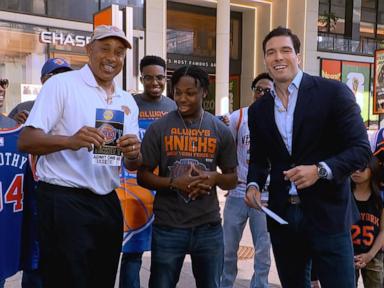
The lottery of human happiness operates on a bizarre ledger. A video surfaced recently—the kind of digital artifact that usually evaporates into the ether within twenty-four hours. It featured a man, not unlike Michael, standing in a nondescript office hallway. A supervisor calls him in, ostensibly to discuss a regional supply chain error. The man’s shoulders are hunched. He expects a reprimand. Instead, he is handed an envelope. Inside are two pieces of heavy, glossy paper.
Section 106. Row D.
The video captures the exact millisecond his brain processes the information. First comes the denial—the nervous, barking laugh of a person who suspects a cruel joke. Then, the physical collapse. His knees buckle slightly. He leans against the faux-wood desk. Finally, the silence. He doesn't scream. He doesn't jump. He simply closes his eyes and presses the paper against his forehead as if trying to absorb the ink through his skin.
Why does a piece of cardstock evoke a reaction that mirrors the birth of a child or a reprieve from a medical diagnosis?
To an outsider, it is absurd. The tickets represent a basketball game. Ten men in shorts running up and down a polished maple floor, chasing a leather sphere filled with compressed air. The outcome of the game will not lower the recipient’s rent. It will not cure his mother’s arthritis. It will not stop the rain from leaking through his kitchen window.
But the outsider miscalculates the value of proximity.
We live in an era of hyper-mediated experiences. We watch the world through glass panels that fit in our palms. We swipe, we double-tap, we comment, but we do not touch. When you watch a basketball game on television, you are viewing a curated narrative. The camera tells you where to look. The graphics department tells you what to feel. The audio engineering smooths out the raw edges of the room until the crowd sounds like a generic waterfall of noise.
To be placed in Section 106 is to be thrust back into the physical world with a violence that borders on the religious.
Consider the sensory reality of that space. You walk through the turnstile, and the scent hits you first—a potent, intoxicating mixture of burnt pretzels, expensive cologne, and the distinct, ozone smell of ice rink cooling systems humming beneath the floorboards. You climb the concrete ramp. The light changes from the dim fluorescent hum of the concourse to the blinding, theatrical wash of the arena bowl.
The court looks smaller in person, yet infinitely more dangerous. You can hear the squeak of sneakers—not the digital chirp from a television speaker, but a sharp, rhythmic percussion that sounds like rubber tearing against stone. You can hear the impact of a two-hundred-and-fifty-pound forward hitting the stanchion. It is a wet, heavy thud that makes the floorboards beneath your own feet vibrate.
There is an old sociological concept known as "collective effervescence." It occurs when a community comes together and simultaneously communicates the same thought and participates in the same action. It is the mechanism that sustained early human tribes during long winters around a fire. It is what happens when nineteen thousand strangers all inhale at the exact moment a ball leaves a shooter’s hand at the buzzer.
For twenty years, the Knickerbocker faithful have traded in a currency of shared suffering. To be a fan of this specific team is to have your heart broken with architectural precision. You watch leads evaporate like morning mist. You watch draft picks turn into cautionary tales. You endure the mockery of colleagues who root for teams with modern trophy cases.
Yet, when the surprise happens—when the envelope is opened—that history shifts from a burden into a badge of honor. The suffering becomes the justification for the joy.
Imagine the ninety-foot walk from the concourse entry down to Row D. With every step downward, the world becomes more vivid. The players transform from two-dimensional figures into giants with visible sweat glistening on their shoulders. You can see the tattoos that tell the stories of their childhoods in Chicago or Compton. You can hear the coach barking a defensive coverage in a voice that has been reduced to sandpaper by forty games of screaming.
The recipient of those tickets isn't just going to watch a game. He is being validated. For one night, the invisible barrier between the citizen and the spectacle dissolves. He is no longer a consumer of a product; he is a witness to an event.
The game itself becomes secondary to the ritual. He will buy a beer that costs more than his first hour of labor as a teenager. He will high-five a stranger wearing a bespoke suit, their societal differences erased by a successful pick-and-roll. For two and a half hours, the anxieties of the looming mortgage payment, the broken alternator, and the general weight of being alive in the twenty-first century are suspended.
As the third quarter begins, the home team makes a run. The lead shrinks from twelve to eight, then to four. The arena begins to sway. The sound is no longer a noise; it is a physical pressure against the chest cavity. The man from the office hallway stands up. His throat is already raw. He screams a defense instruction that the players cannot possibly hear, yet he screams it with the conviction of a general ordering a charge.
His face is flushed. His hat is crooked. In this moment, he is entirely alive.
The final buzzer sounds. The home team loses by two on a missed layup that rolls around the rim for what feels like an eternity before dropping off. The crowd thins out, leaving behind a sea of crumpled cups and discarded programs.
Michael walks back down the concrete ramp toward the rain-slicked street. His feet hurt. He has to wake up in five hours. The Knicks are now four games under .500. Nothing has changed.
Except everything has. He has the ticket stub in his pocket, a small piece of cardboard that proves he was there when the room shook, a tiny shield against the grey reality waiting for him at the bottom of the subway stairs.