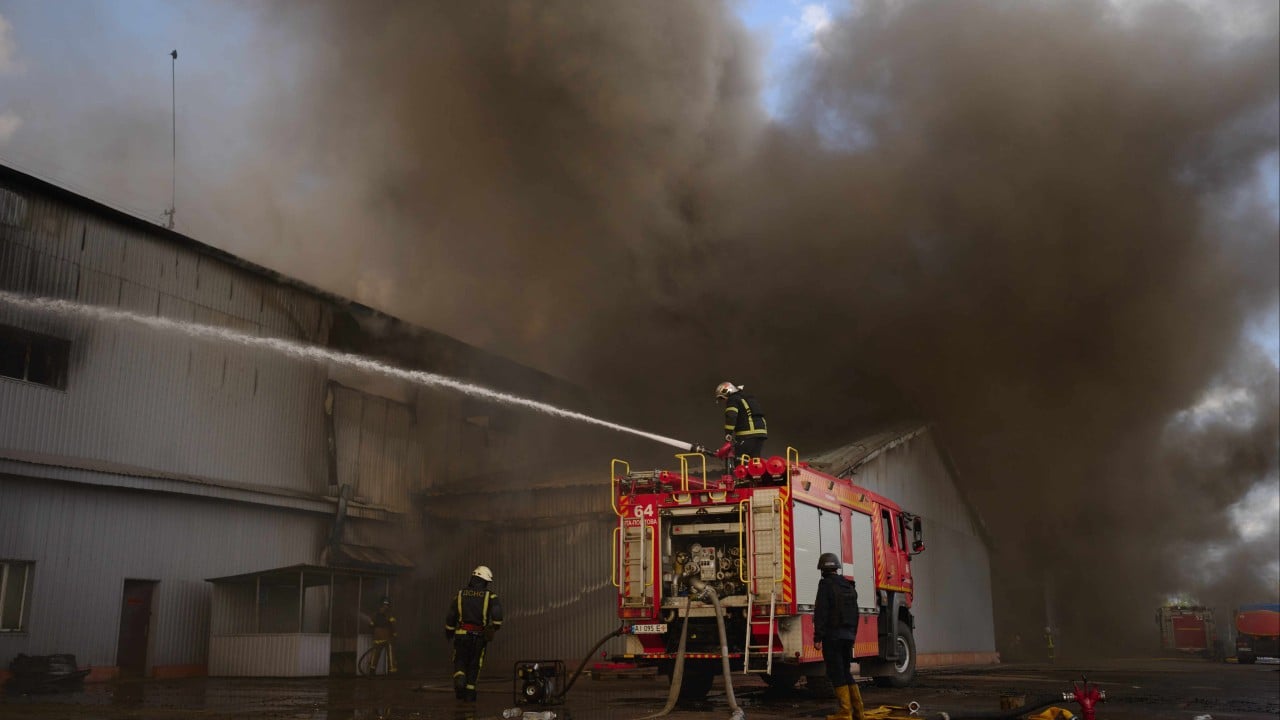
Decentralization failures in wartime logistics create compounding vulnerabilities that routinely eclipse the direct kinetic impact of enemy strikes. When a Russian drone impact in the Bucha district near Kyiv triggered massive secondary detonations at an industrial enterprise in Myla, the resulting blast killed at least 37 people, injured dozens more, and devastated surrounding residential infrastructure. Surface-level reporting frames this event strictly as an aerial bombardment. A systemic audit reveals an entirely different operational reality: a catastrophic failure of internal safety compliance, spatial regulation, and risk dispersion within state-managed defense infrastructure.
The Cost Function of Regulatory Evasion
To understand why a single drone strike yields mass civilian casualties, one must examine the economic and operational incentives that drive high-risk storage practices. Ukrainian law strictly mandates the separation of military or industrial ordnance facilities from high-density civilian populations. These legal buffers exist to establish a physical tolerance limit against blast overpressure.
When state-owned enterprises or defense conglomerates bypass these buffers, they externalize risk onto civilian populations to reduce real estate and transport costs. The cost function of this evasion is asymmetric. Management saves capital on remote logistics and land acquisition, while the hidden liability accumulates silently until a kinetic trigger exposes the deficit.
The mechanism of failure follows a predictable arc:
- High-explosive components or propulsion boosters are consolidated inside urban or semi-urban enterprise zones to streamline distribution.
- Spatial density breaches minimum safe distance metrics relative to residential zones and eldercare facilities.
- An incoming aerial vector breaches air defenses, delivering kinetic energy to a concentrated mass of volatile material.
- Secondary thermal and kinetic chain reactions amplify the initial blast radius exponentially, converting a localized industrial hit into a regional humanitarian crisis.
The Systemic Cost of Institutional Amnesia
The Myla disaster did not occur in a vacuum. Just weeks prior, a remarkably similar failure occurred in Vyshneve, where an attack on a munitions depot killed eight people and drew explicit promises of accountability from national leadership. The recurrence of an identical operational failure point weeks later points to a systemic breakdown in institutional learning.
In high-threat environments, institutional learning requires a closed feedback loop between incident analysis and operational enforcement. When an investigation reveals that enterprise officials illegally authorized ordnance storage near civilian populations, the remediation must extend beyond individual firings. It requires an automated auditing architecture across all state-owned defense assets.
The absence of this architecture creates a dangerous equilibrium. Bureaucrats weigh the low statistical probability of a direct drone hit against the immediate administrative friction of decentralizing storage facilities. Because dispersal slows down production cycles and increases logistical overhead, administrative inertia wins out. The system prioritizes throughput efficiency over blast-containment safety, effectively gambling civilian lives against mathematical probability.
The Physics of Secondary Amplification
A rigorous analysis of the casualty figures requires separating the direct effects of the drone payload from the secondary effects of the targeted inventory. Unmanned aerial vehicles carrying standard military warheads possess limited explosive payloads. By themselves, they cannot account for the scale of destruction observed in the Bucha district, which left residential blocks scorched and required the evacuation of hundreds of residents.
The destructive force was generated by the facility's own inventory. Munitions components, launch boosters, or explosive precursors act as force multipliers for the attacker. In defense economics, storing high-value or high-risk materials in centralized hubs creates high-value target profiles.
When military planners evaluate supply chain security, they calculate vulnerability based on two variables: asset concentration and hardening thresholds. Industrial warehouses near Kyiv routinely lack the subterranean hardening or modular compartmentalization required for frontline ordnance storage. By maintaining soft, high-concentration inventories within the geographical footprint of the capital region, logicians provide adversaries with high-yield kinetic return on low-cost munitions.
Re-Engineering Wartime Supply Chain Protocols
Mitigating this vulnerability demands a fundamental shift from punitive remediation to architectural enforcement. Supply chains operating under constant aerial threat cannot rely on self-regulation or retrospective investigations.
Defense logistics must adopt a decentralized dispersion matrix where high-risk inventory is partitioned into sub-critical quantities and moved away from municipal boundaries entirely. Automated compliance monitoring must supersede administrative discretion, ensuring that no facility can override spatial zoning laws under the pressure of wartime production quotas. Until the cost of regulatory non-compliance exceeds the operational friction of decentralization, industrial zones near population centers will remain acute risk vectors.