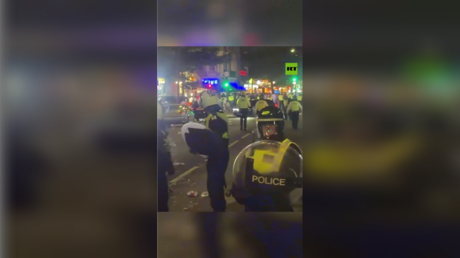
A World Cup semifinal defeat is a volatile catalyst. When France eliminated Morocco from the 2022 tournament, the immediate media narrative focused on sudden, chaotic street violence in London. Sensational headlines splashed across platforms, framing the subsequent unrest as an isolated, unpredictable riot fueled purely by sporting disappointment. That narrative is shallow. The brief, intense clashes between pockets of supporters and the Metropolitan Police in areas like Piccadilly Circus were not spontaneous outbursts generated in a vacuum; they were the predictable manifestation of deeper geopolitical tensions, identity politics, and systemic crowd-management failures.
To understand what actually transpired on those central London streets, one must look beyond the immediate smartphone footage of flashing blue lights and smoke bricks. The match was never just ninety minutes of football. It carried the heavy baggage of colonial history, migration, and a complex sense of belonging that stretches across North Africa and Europe. For the sprawling Moroccan diaspora in the United Kingdom, the national team's historic run was a profound assertion of visibility. When that journey collided with France—the former colonial power—the emotional stakes reached a critical mass long before the first whistle blew. Meanwhile, you can explore similar developments here: The Chaos Behind Norway Last Minute Hotel Switch Before the England Clash.
The Match that Transcended Sport
Football matches involving former colonies and their past occupiers are inherently high-risk events for urban police forces. The Metropolitan Police approached the evening with a standard public-order blueprint, treating it with a similar risk profile to a high-profile domestic derby. This was a fundamental miscalculation.
Throughout the tournament, the Moroccan diaspora had transformed public squares across Europe into spaces of celebration. Piccadilly Circus had become a de facto hub for these gatherings. When the final whistle blew, confirming France's 2-0 victory, the atmosphere shifted rapidly from celebratory anticipation to defensive frustration. To see the full picture, we recommend the excellent report by Yahoo Sports.
It did not take thousands to spark the disorder. A microscopic fraction of the thousands gathered began throwing projectiles, targeting both passing vehicles and police cordons. The response from law enforcement was immediate, utilizing containment tactics that frequently exacerbate crowd volatility rather than defusing it. By treating the entire gathering as a singular, hostile entity, police actions inadvertently unified the disillusioned crowd against a common adversary: the uniform.
The Failure of Standard Crowd Control
Urban policing in the United Kingdom relies heavily on the concept of policing by consent. However, when faced with large, emotionally charged crowds celebrating or mourning an international sporting event, that consent frequently fractures. The deployment of riot-equipped officers into the heart of Piccadilly Circus acted as a visual accelerant.
Crowd dynamics shift the moment defensive gear is introduced. What the police view as necessary protection, a passionate crowd interprets as an imminent threat of state force.
The Met's reliance on kettle tactics—containing a crowd within a confined space—often forces peaceful bystanders into direct physical proximity with the small minority actively seeking conflict. On this specific night, the strategy squeezed hundreds of fans, including families who had gathered to watch the game in nearby venues, into the same geographic footprint as the agitators. The resulting friction was inevitable. Fireworks were lit, barricades were pushed, and the media obtained the precise, chaotic imagery required to feed the 24-hour news cycle.
A History of Discontent Beyond the Pitch
To attribute the unrest solely to a football loss is to ignore the socioeconomic realities facing migrant communities in major European capitals. London's Moroccan community, while deeply integrated, still navigates the subtle and overt pressures of marginalization. Football serves as one of the few arenas where national pride can be expressed without apology or filter.
Consider the contrast in how different fanbases are policed. When domestic fans engage in widespread property damage and assault during events like the Euros, the media often frames it as an unfortunate byproduct of British drinking culture—a societal flaw, but an internal one. When a diaspora community experiences a flashpoint, the framing shifts subtly but decisively toward questions of integration, culture, and inherent criminality. This dual standard is not lost on the youth who filled the streets of London. The aggression witnessed after the match was as much a reaction to feeling perpetually scrutinized as it was a reaction to Theo Hernandez's opening goal.
The Media Illusion of the Monolithic Rioter
The viral videos that circulated in the hours following the match provided an incomplete picture. They captured the apex of the confrontation: the smoke, the shouting, the arrests. They omitted the hours of peaceful assembly that preceded the match, and they ignored the older Moroccan community members who actively attempted to de-escalate tensions and separate the youth from police lines.
High-end journalism requires distinguishing between a systemic riot and a localized public order breakdown. What occurred in London was the latter. A small, disaffected segment of the crowd used the shield of a massive gathering to engage in anti-social behavior. By labeling the entire event a "Moroccan football riot," commentators played into a reductive script that damages community relations and provides zero insight into how city administrators can prevent future occurrences.
The reality of modern sports fandom is that the stadium walls no longer contain the energy of the game. Cities are the new arenas. Until municipal governments and police forces acknowledge that international fixtures carry profound domestic social implications, the streets of London will remain susceptible to the fallout of matches played thousands of miles away. The solution lies not in heavier policing, but in sophisticated, culturally literate community engagement before the tension ever reaches the street.