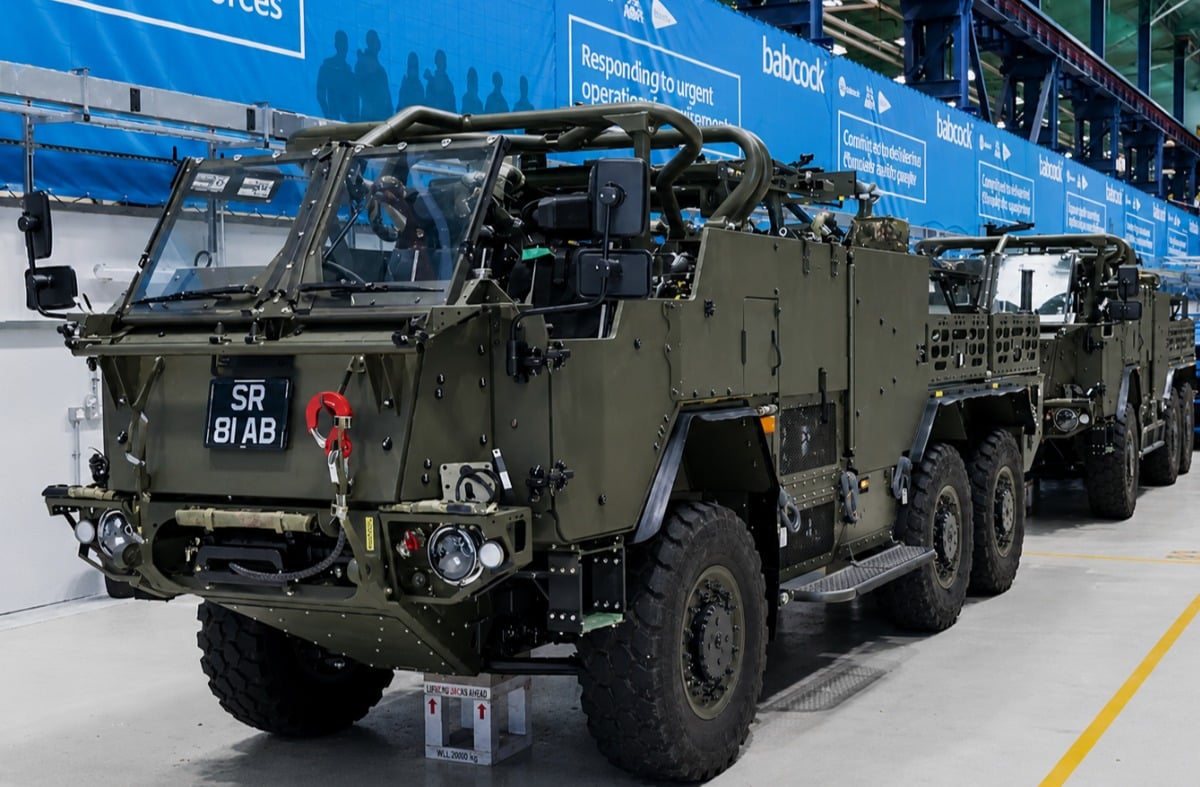
The delivery of the final Jackal 3 Extenda vehicle off the Babcock International production line in Devonport marks the completion of a 123-vehicle order for the British Army. Comprising 70 standard four-wheel-drive Jackal 3 High Mobility Transporters (HMTs) and 53 six-wheeled Extenda variants, this program represents a tactical modernization milestone. However, treating the completion of this order as a unilateral victory ignores the broader logistical bottlenecks and industrial dependencies of contemporary land warfare.
To understand the operational realities of the Jackal 3 program, one must analyze it through three distinct analytical frameworks: platform physics, procurement economics, and fleet consolidation dynamics.
The Physics of Mobility: The Two-Axle vs. Three-Axle Trade-off
The Jackal 3 architecture relies on a modular High Mobility Transporter chassis designed by Supacat. The primary engineering evolution between the initial 70 Tranche One vehicles and the subsequent 53 Tranche Two Extenda variants centers on structural load distribution and gross vehicle mass (GVM).
- The 4x4 Core Configuration: The baseline Jackal 3 configuration optimizes low-weight, high-speed reconnaissance. It introduces upgraded crew protection systems and an enhanced suspension package over legacy Jackal 2 designs, yet remains fundamentally constrained by its footprint regarding sustained combat payload.
- The 6x6 Extenda Mechanism: The Extenda variant integrates a removable or permanent third axle. This mechanical expansion acts directly upon the vehicle’s weight-bearing equation. By distributing the hull's mass across six points of contact rather than four, the vehicle reduces ground pressure while expanding the available load bed.
This structural variation changes the vehicle's operational profile:
$$GVM_{Extenda} > GVM_{Baseline}$$
This increased capacity allows the platform to transition from a pure deep-battlespace reconnaissance asset into a heavy weapons carrier, tactical logistics vehicle, or platform for integrated air-defence and mortar systems. The trade-off manifests in systemic complexity: an extra axle increases mechanical drag, drivetrain friction, and the tactical maintenance burden per unit.
Procurement Economics: The Single-Source Subcontract Model
The industrial execution of this contract reveals a specific risk-mitigation framework employed by the Ministry of Defence (MoD). Rather than utilizing a single prime contractor capable of handling both engineering design and mass assembly, the program operates via a split architecture:
[UK Ministry of Defence]
           │
           ▼
     [Supacat] (Design Authority & Prime Contractor)
           │
           ▼ (Single-Source Subcontract)
     [Babcock International] (Mass Manufacturing / Devonport Facility)
This model solves a critical capacity bottleneck. Supacat, an agile engineering Small to Medium Enterprise (SME) based in Honiton, possesses the intellectual property and design capability but lacks the heavy industrial footprint required for rapid, volume-based assembly. By leveraging Babcock's industrial infrastructure in the Devonport Freeport Zone, the program successfully compressed production timelines.
However, this bifurcated supply chain introduces systemic risks. A single-source subcontract relies entirely on seamless transfer-of-technology protocols. Any friction between design authority revisions and factory-floor tooling calibrations directly translates into delivery delays. While the 123rd vehicle marks a nominal success for this partnership, the model's scalability across larger vehicle classes remains unproven.
Furthermore, the economic justification of the project leans heavily on localization metrics: over 95% of the supply chain is UK-based, with approximately 50% concentrated in the South West. While this structure insulates the program from certain cross-border supply chain shocks, it increases localized cost-inflation risks and restricts components to domestic manufacturing capacities.
The Consolidation Bottleneck: The Land Mobility Programme
The introduction of the Jackal 3 occurs against the backdrop of the British Army’s Land Mobility Programme (LMP). The stated objective of the LMP is to compress a bloated, fragmented fleet of roughly 16 distinct protected mobility vehicle types down to approximately five core designs.
The Jackal 3 family is positioned to absorb the operational duties of several legacy platforms, including various iterations of the Wolfhound, Mastiff, Ridgeback, Foxhound, and older utility fleets. The logic behind this consolidation centers on reducing the life-cycle cost function of the land environment:
$$\text{Total Logistics Cost} = f(\text{Number of Unique Chassis Types}, \text{Supply Chain Variations}, \text{Training Pipelines})$$
By standardizing on a modular chassis like the HMT Mk3, the Army aims to simplify spare-parts management and reduce specialist mechanic training times.
The strategy, however, faces a severe numerical limitation. While a fleet of 123 highly capable, modular vehicles improves tactical flexibility for Light Cavalry and specialist units, it represents a minor volume injection for an army tasked with fielding a division-sized combat force. The open-top nature of the Jackal 3, designed deliberately for high visibility and rapid situational awareness, inherently limits its deployment to low-to-medium threat environments. It cannot replace the heavy, fully enclosed protected mobility required for high-intensity, peer-to-peer armored conflict.
Strategic Recommendation
The British Army must avoid treating the Jackal 3 fleet as a direct replacement for heavier armored transport platforms. The immediate operational play is to exploit the modularity of the 53 Extenda variants to rapidly field specialized sub-units. Instead of deploying them purely as enhanced logistics or patrol vehicles, the MoD must prioritize outfitting the 6x6 chassis with integrated 120mm mortar systems and Ground-Based Air Defence (GBAD) suites. This specific allocation maximizes tactical lethality per unit footprint, mitigating the structural vulnerabilities inherent in the platform's open-cab design.


