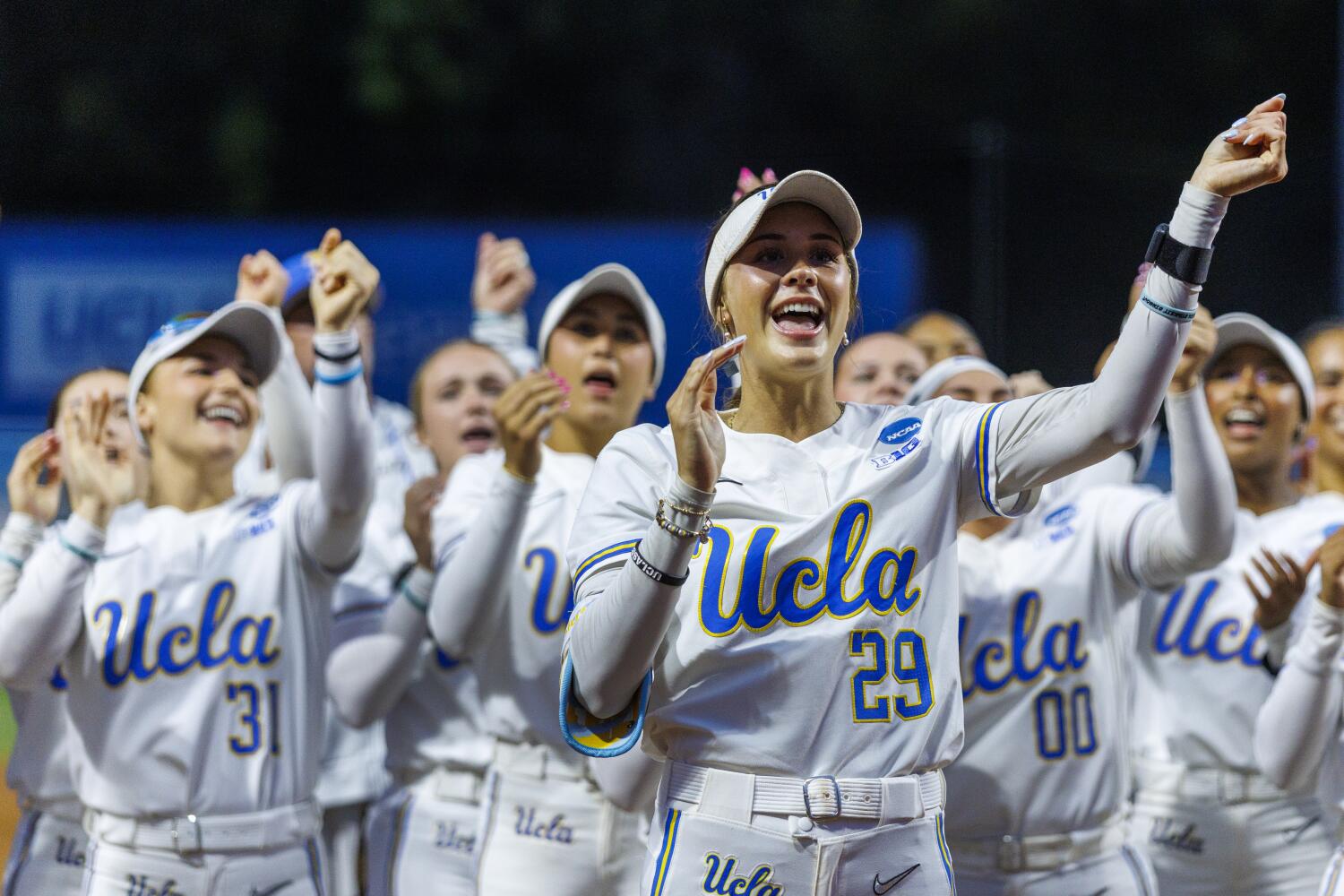
Traditional soft-ball metrics view the leadoff position through a singular lens: on-base percentage. The historical mandate requires a hitter who can drain a pitcher’s pitch count, draw walks, and occupy first base so the power hitters behind them can drive them home. However, the 2026 collegiate softball landscape reveals a fundamental shift in optimal lineup construction. Rylee Slimp’s historic season at UCLA, culminating in an NCAA-record 94 runs scored heading into the Women’s College World Series (WCWS), provides an empirical case study on how elite performance at the top of the order mitigates strategic pressure and reshapes run-production dynamics.
Analyzing Slimp's output requires moving past raw statistics and evaluating the structural mechanics of how an aggressive, high-slugging leadoff hitter changes the opponent's defensive calculus and pitcher psychology.
The Run-Scoring Production Function: Deconstructing the 94-Run Outlier
To evaluate how Slimp surpassed Natasha Watley’s 25-year-old school record of 75 runs, her season must be modeled as a production function where run output ($R$) is dependent on independent baseline variables. The classical model assumes:
$$R = f(\text{OBP}{\text{leadoff}} \times \text{SLG}{\text{heart_of_order}})$$
This traditional framework operates under the assumption that the leadoff hitter is purely a passive asset dependent on downstream productivity. Slimp’s empirical data overrides this model. Batting at a .452 clip with 16 home runs, her production function introduces a self-suturing mechanism.
When a leadoff hitter possesses a high isolated power (ISO) metric, the downstream dependency drops. Slimp's five leadoff home runs this season represent instances where the run production function is completely internalized—the probability of scoring matches the probability of her hitting the ball over the fence ($P(R) = 1.0$).
This dual-threat capability causes a cascading effect on opposing pitching staffs:
- The First-Pitch Strike Bottleneck: Pitchers naturally seek to get ahead in the count against leadoff hitters to avoid a high-OBP walk. This creates a predictable distribution of first-pitch strikes.
- The Power Counter-Measure: Slimp’s high-slugging profile exploits this predictability. By aggressively hunting first-pitch strikes, she turns a defensive pitch into an offensive leverage point.
- The Secondary Base Displacement: When Slimp reaches base via a hit rather than a walk, she frequently secures extra bases (doubles and triples), immediately entering scoring position. This alters the subsequent intentional walk strategies for hitters like Megan Grant and Jordan Woolery, preventing pitchers from pitching around the "Bruin Bombers."
Pressure Mitigation Frameworks: The Psychological Leverage of Downstream Insulation
The subjective concept of "managing pressure" at the WCWS can be quantified through a psychological leverage framework. Athletes at this level experience performance anxiety when the perceived demands of the situation outweigh their perceived capabilities or resources.
Slimp’s operational philosophy—stating her primary objective is merely to "touch first base" because of the eight elite bats trailing her—functions as an explicit cognitive optimization strategy.
The Distribution of Cognitive Load
In a weak or top-heavy lineup, a leadoff hitter experiences high situational pressure because failure at the top of the order causes an exponential drop in the team's inning-by-inning expected runs ($E(R)$). Conversely, UCLA’s structural depth isolates the leadoff hitter from this risk. Because the entire starting lineup has demonstrated home-run capability this postseason, the structural penalty for an individual out is minimized.
This structural insulation creates a psychological paradox. By shrinking her operational target to a binary metric—reaching first base—Slimp removes the cognitive paralysis associated with high-stakes postseason environments. This behavioral reduction maximizes sensory processing and mechanical execution, allowing her to maintain her high-contact profile even against elite WCWS pitching.
The Pitcher’s Resource Dilemma
The true locus of pressure shifts entirely to the opposing pitcher. A pitching staff facing UCLA cannot utilize a standard preservation strategy.
Traditional Lineup Strategy:
[Pitcher] ---> (Careful Approach) ---> [Leadoff Hitter (High OBP)] ---> (Normal Approach) ---> [Power Hitters]

Modernized UCLA Lineup Strategy:
[Pitcher] ---> (High-Risk Tradeoff) ---> [Slimp (High OBP + Power)] ---> (Fatigue/Stress) ---> [Bruin Bombers (Grant/Woolery)]
If a pitcher attacks Slimp aggressively to avoid walking her, they risk giving up an immediate extra-base hit or home run. If they pitch around her, they put a runner with elite speed on base ahead of a historic middle-of-the-order. This creates an immediate cognitive tax on the pitcher before the game's first out is recorded, inducing early-game fatigue and structural execution errors.
Strategic Implementation and Structural Limitations
While Slimp’s deployment at the top of the order optimizes run efficiency, the model is not without structural limitations that field managers must calculate.
Lineup Balance and Efficiency Trade-offs
Placing a high-slugging asset at the top of the order guarantees they receive the maximum possible plate appearances over a seven-inning game. However, it also guarantees that in the first inning, that asset will always hit with zero runners on base, mathematically capping the maximum RBI yield of their home runs to a value of one.
UCLA counters this structural limitation through the optimization of the nine-hole hitter. By deploying high-OBP or high-contact players in the final spot of the batting order, the Bruins effectively turn Slimp's subsequent plate appearances into multi-run opportunities. This turns the traditional linear lineup into a continuous loop, where the bottom of the order feeds the power-leadoff hybrid.
The Variance of Aggression
The primary risk of an aggressive leadoff approach is an increase in low-pitch-count outs. If a leadoff hitter swings at the first pitch and flies out, the opposing pitcher gains immediate confidence while preserving their pitch count. Slimp’s profile mitigates this through elite zone awareness. The strategy only yields a positive return on investment if the hitter possesses a highly calibrated strike zone discipline, ensuring that early-count aggression is strictly confined to high-probability pitches.
Strategic Forecast for the Women’s College World Series
Heading into Devon Park as the No. 8 seed against No. 1 Alabama, the opening matchup will be decided by the efficiency of this leadoff framework against elite, drop-ball dominant pitching. Alabama's defensive strategy will likely focus on neutralizing Slimp's early-count aggression by throwing off-speed or spin pitches outside the zone on pitch one, attempting to force weak contact or generate chasing behavior.
UCLA's optimal tactical play is to maintain Slimp's aggressive mandate but shift her target zone horizontally rather than vertically. By forcing Alabama's pitchers to elevate the ball into the upper half of the strike zone early in the count, Slimp can exploit the natural flattening of rise and drop balls in warm Oklahoma City conditions. If Slimp secures a minimum .500 on-base percentage over the opening two games of the series, the resulting statistical pressure on opposing pitching will open the floodgates for the Bruin Bombers, making an extended championship run mathematically probable.
UCLA Softball Press Conference gives direct access to the operational language and strategic mindset utilized by Coach Inouye-Perez and Rylee Slimp following their high-stakes postseason games.