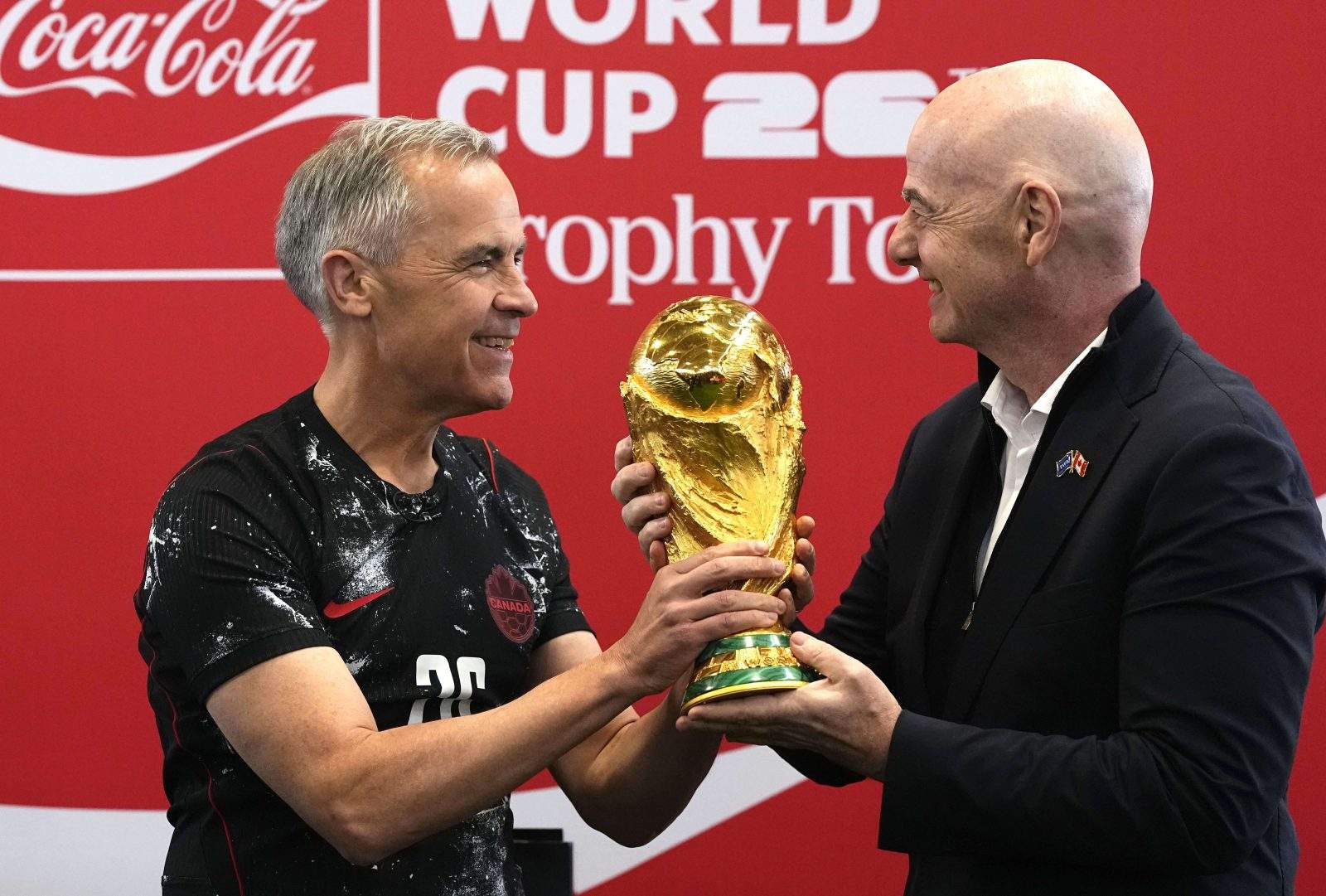
Modern sports administration operates under the illusion that massive revenue generation excuses structural opacity. When Canadian Prime Minister Mark Carney publicly withdrew his confidence in FIFA President Gianni Infantino following the collapsed attempt to privatize World Cup commercial rights through a newly minted subsidiary, he targeted a foundational flaw in global sports governance: executive overreach divorced from stakeholder consultation. This event is not merely a political spat between a national leader and a sports executive; it is a clinical demonstration of how centralized authority without institutional checks creates systemic risk for public assets.
The crisis materialized around an abandoned proposal to construct a commercial vehicle known as FIFA Forward Enterprise. The mechanics of the proposal involved carving out core tournament operations into a corporate entity valued at twenty billion dollars, with the intent of liquidating a twenty percent equity stake to private investment vehicles, including entities linked to the Kushner family network, for roughly four billion dollars. By attempting to monetize the premier international sporting property outside the formal review structures of core executive boards and operational chiefs, the executive leadership committed a fatal procedural error.
To understand why this administrative misstep triggered an existential threat to leadership, one must examine the operational cost function of global football governance.
The Cost Function of Centralized Power
In any enterprise managing a global public good, organizational survival depends on a delicate equilibrium between commercial acceleration and stakeholder consensus. When an executive bypasses internal structural controls—such as omitting the chief operating officer, regional confederations, and national association boards from preliminary architecture—the internal friction coefficient spikes exponentially.
The strategy behind the commercial carve-out relied on a fundamental miscalculation of institutional elasticity. While private equity infusion promises immediate liquidity and capital expenditure freedom, it introduces external stakeholder incentives that clash directly with the public-trust mandate of international sports bodies.
- Loss of structural alignment: Regional bodies like UEFA and CONCACAF operate as autonomous federations with distinct regulatory priorities. Privatizing tournament equity externalizes control to financial entities whose primary fiduciary duty is capital return, not sporting development.
- Information asymmetry: By developing high-consequence financial instruments in isolation, the executive office eliminated the internal feedback loops necessary to stress-test market and political reception.
- Retaliatory threat credibility: The speed and severity of the counter-response—specifically UEFA threatening an absolute boycott of FIFA competitions—proved that national associations retain massive deterrent leverage when institutional channels are ignored.
The Mechanics of the Backlash
The immediate collapse of the initiative illustrates the limits of executive fiat. When key technical advisors, such as former chief of global football development Arsene Wenger, and administrative leaders distance themselves from a proposal post-announcement, the internal fracture becomes public. This transforms a policy disagreement into a crisis of legitimacy.
National leaders stepping into the fray, including Carney and British counterpart Andy Burnham, change the vector of pressure. Governments control stadium infrastructure, security logistics, tax exemptions, and diplomatic entry points. When state executives signal a lack of confidence in sports leadership, the implicit social contract underpinning major tournaments fractures. The state provides public security and municipal integration for global events under the assumption that the governing body operates transparently and in alignment with public interest. Monetizing core tournament equity via private equity placement without legislative or confederation-level buy-in violates that tacit agreement.
The structural fallout leaves the current administration in a severe defensive posture. Emergency meetings held in regional hubs to shore up delegate alignment ahead of upcoming electoral cycles highlight a classic political survival loop. Yet, patching over structural dissent with short-term political maneuvering does not resolve the underlying architecture failure.
Strategic Forecast
The governance crisis facing international football governance cannot be resolved through cosmetic personnel shifts. The structural exposure is permanent unless institutional reforms codify mandatory multi-stakeholder clearance for asset restructuring.
To restore functional stability, the governing body must institutionalize three operational adjustments. First, any proposal involving equity dilution or commercial subsidiarity must require a supermajority vote from regional confederations before entering the exploratory phase. Second, executive compensation and retention metrics must be unlinked from aggressive asset monetization strategies that prioritize short-term liquidity over long-term sporting integrity. Third, operational transparency mandates must legally bind the executive office to disclose material financial structuring to the chief operating officer and internal audit committees prior to public disclosure.
Without these structural constraints, future leadership will inevitably encounter identical systemic breakdowns, as the structural incentives for central executives to capture capital remain unchecked by internal design.