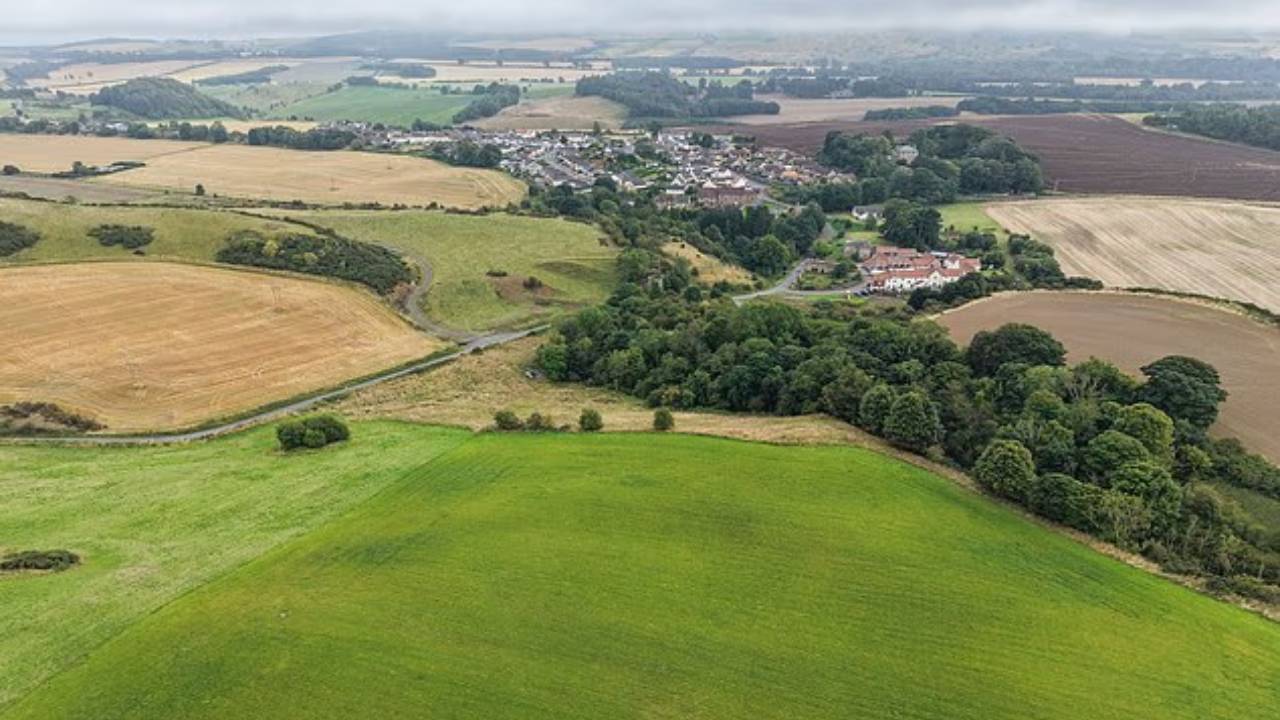
The convergence of heavy digital infrastructure and rural land use has created a severe friction point in modern spatial planning, exposed by the intense civic pushback against the proposed Cato data centre in Auchtertool, Fife. With a footprint exceeding one hundred football pitches positioned directly adjacent to a community of roughly two hundred homes, this 600-megawatt development represents a fundamental stress test for energy grids, zoning frameworks, and public trust.
Evaluating this conflict requires moving past superficial local grievances to examine the structural mechanics of contemporary computation scaling, transmission economics, and regulatory lag.
The Power-Density Equation and Grid Allocation
The primary driver of rural site selection is not land availability in isolation, but the spatial economics of electrical distribution. Hyperscale computation facilities require vast, continuous blocks of power to sustain high-density server racks running artificial intelligence models and cloud services continuously.
When a facility demands 600 megawatts, it approaches the baseline consumption of mid-sized industrial towns, forcing developers to look for high-capacity grid interconnects rather than urban proximity. Agricultural and rural tracts often sit near high-voltage transmission lines or designated energy zones originally mapped out for heavy industry or fossil fuel infrastructure.
This creates a severe resource-competition dynamic. Data centres operate on a flat-load profile, pulling maximum current twenty-four hours a day. Unlike residential zones that exhibit demand curves peaking in mornings and evenings, a hyperscale facility acts as an unyielding baseload sink.
When these facilities tie into regional grids, they consume local renewable generation capacity or force reliance on baseline carbon-intensive sources during periods of low renewable output. Developers routinely attempt to resolve this via Power Purchase Agreements linked to remote green energy projects, such as pumped storage hydro developments miles away.
However, this accounting trick does not mitigate the local physical reality: electrons drawn from the nearest substation are drawn from the shared regional pool, altering local voltage stability and carbon metrics.
The Environmental Externalities Matrix
Traditional zoning laws evaluate industrial projects through predictable vectors like vehicular traffic, localized smokestack emissions, and standard operating hours. Hyperscale infrastructure invalidates these metrics by introducing entirely different forms of environmental disruption that current planning statutes struggle to quantify.
- Acoustic Signature: Continuous cooling infrastructure—comprising banks of high-capacity industrial fans and HVAC compressors—generates a low-frequency ambient hum that travels vast distances across flat rural topography, fundamentally altering the acoustic baseline of rural environments.
- Thermal Island Effect: Large-scale heat rejection systems displace massive volumes of thermal energy into the immediate atmosphere, creating microclimate shifts that can affect local flora, fauna, and agricultural yields directly adjacent to the perimeter fences.
- Hydrological Strain: Closed-loop and evaporative cooling architectures demand significant water resources for heat dissipation. Combined with the sealing of permeable agricultural land under concrete foundations and server halls, stormwater runoff coefficients spike, escalating downstream flood risks for neighboring communities.
- Landscape Scale Mismatch: A thirty-five-metre-high continuous mass breaks the visual horizon of low-rise rural settlements, introducing an architectural scale completely disproportionate to historical vernacular architecture and destroying the visual amenity of the region.
The Employment-to-Footprint Asymmetry
A central justification deployed by proponents of industrial infrastructure is regional economic stimulus. In traditional manufacturing or logistics hubs, spatial footprint correlates linearly with job creation. Hyperscale computation facilities completely break this economic model.
[Massive Land Footprint: 100+ Football Pitches]
       │
       ▼
[High Capital Expenditure: Billions in Hardware]
       │
       ▼
[Extremely Low On-Site Labor: ~120 Operational Jobs]
Because modern server architecture relies heavily on automation, remote management, and robotic maintenance, a facility spanning over one hundred football pitches typically supports only a fraction of the workforce that a traditional factory or commercial park would generate.
Consequently, the local population absorbs all negative externalities—noise, visual intrusion, construction disruption, and environmental risk—while capturing negligible direct employment benefits. The tax revenues generated flow primarily to centralized municipal authorities or national treasuries, leaving the host community bearing the localized depreciation of property values without proportional economic compensation.
The Regulatory Vacuum and Policy Lag
The sheer velocity of the artificial intelligence boom has outpaced national and regional spatial planning frameworks. Most legislative planning guidelines were drafted decades ago, under assumptions that industrial development would adhere to traditional urban-industrial corridors or designated brownfield sites.
When developers submit applications for remote rural sites, they frequently exploit loopholes or ambiguities in environmental impact assessment thresholds. For instance, projects often attempt to segment their infrastructure or bypass comprehensive scrutiny by leveraging outdated zoning designations originally assigned to nearby defunct industrial plants.
This regulatory lag forces communities to organize defensive actions reactively, flooding local councils with thousands of formal objections and compelling governments to issue emergency directives.
When regional parliaments are forced to retroactively lower intervention thresholds—such as requiring mandatory government notification and environmental reviews for any data centre exceeding 50 megawatts—it signals a systemic policy failure. Spatial planning should anticipate technological inflection points rather than scrambling to catch up after multi-billion-dollar footprints are already staked out on rural maps.
Establish a mandatory national spatial strategy that restricts hyperscale computation developments to designated brownfield zones with pre-existing heavy industrial power infrastructure, prohibiting greenfield agricultural conversion until cumulative regional grid capacities and acoustic impact thresholds are legally codified.