Human survival at extreme altitude is governed by a strict physiological countdown. Above 7,500 metres, atmospheric pressure drops to approximately one-third of sea-level value, reducing the partial pressure of oxygen ($P_{O_2}$) to levels insufficient to sustain cellular metabolism over extended periods. When high-altitude guide Dawa Sherpa disappeared on May 30, 2026, near Camp Four ($7,950\text{ m}$), his survival window was calculated in hours. His unassisted descent over six subsequent days without supplemental oxygen or logistical support challenges established models of human endurance and exposes deep systemic friction within commercial expedition management.
To evaluate how an individual survived six days alone on the upper reaches of Mount Everest, the incident must be broken down into its three component elements: the physiological mechanics of hypoxic exposure, the micro-decisions of step-by-step descent risk, and the organizational structural failures that delayed rescue operations.
The Physiological Mechanics of Hypoxic Survival
The primary threat to life above the South Col is the acute lack of oxygen, which triggers a rapid cascade of systemic degradation. In commercial mountaineering, the survival equation relies heavily on open-circuit supplemental oxygen systems. When these systems fail or are exhausted, the human body enters a state of rapid deterioration characterized by specific medical vectors.
Ambient Oxygen vs. Metabolic Demand
At $8,000\text{ m}$, the effective oxygen percentage remains 21%, but the lower barometric pressure means fewer oxygen molecules are inhaled per breath. For an unacclimatized individual, this induces immediate unconsciousness. For an elite high-altitude worker like Dawa Sherpa, decades of intermittent hypoxic exposure have induced epigenetic adaptations, including elevated hemoglobin concentrations, increased capillary density, and optimized mitochondrial efficiency.
These adaptations shift the threshold of the hypoxic ventilatory response. The body survives by down-regulating non-essential metabolic processes, prioritizing cerebral and myocardial oxygenation at the expense of peripheral tissue perfusion.
The Hypothermia-Frostbite Trade-Off
In sub-zero environments, the core body temperature is maintained through vasoconstriction—the narrowing of blood vessels to peripheral extremities to protect vital organs. The cost function of this survival mechanism is direct tissue damage.
- Phase 1: Freezing Injury: Extracellular fluid freezes, forming ice crystals that mechanically disrupt cell membranes.
- Phase 2: Vascular Stasis: As the tissue thaws and refreezes, endothelial damage leads to platelet aggregation, microvascular occlusion, and localized tissue death (gangrene).
Medical evaluations at HAMS Hospital in Kathmandu confirmed that Dawa Sherpa sustained frostbite and cold injuries, yet avoided catastrophic systemic hypothermia. This indicates that while peripheral perfusion was sacrificed, metabolic heat generation was maintained at a level sufficient to prevent the core temperature from dropping below the critical $35^\circ\text{C}$ threshold.
Dehydration and Kinetic Energy Depletion
At extreme altitude, dehydration accelerates at an exponential rate due to hyperventilation. Breathing dry, cold mountain air strips moisture from the respiratory tract, requiring up to five litres of fluid replacement daily to maintain blood viscosity. Without water for six days, Dawa Sherpa’s blood would have thickened significantly, increasing the workload on his cardiac system and elevating the risk of stroke or high-altitude pulmonary edema (HAPE).
Survival under these conditions implies a state of hypometabolic stasis, where physical movement was constrained strictly to downward kinetic trajectory, minimizing metabolic expenditure.
Tactical Separation and The Anatomy of Descent Risk
The timeline of the incident reveals how small variances in a descent schedule compound into life-threatening isolation. On May 29, 2026, Dawa Sherpa successfully guided British climber Chris Thrall to the summit, returning to Camp Four late in the day. The subsequent separation on May 30 outlines the stark choices forced by high-altitude emergencies.
[May 29, 17:00] Summit Achieved -> [May 30, Morning] Descent from Camp Four -> [Separation Point] Dawa Stops to Rest
                                                                                      |
         +----------------------------------------------------------------------------+
         |                                                                            |
         v                                                                            v
[Path A: Chris Thrall]                                                     [Path B: Dawa Sherpa]
Encounters distressed Polish climber                                       Left behind without oxygen support
Shares oxygen; 11-hour descent to Camp Three                               Enters solo hypometabolic survival state
The decision-making matrix during a descent is constrained by resource availability. When Dawa Sherpa sat down to rest with his payload below the Death Zone, he displayed signs of profound physical exhaustion. Thrall, descending ahead, encountered a Polish climber suffering from advanced frostbite and oxygen depletion.
In this scenario, high-altitude rescue ethics and survival probabilities dictate prioritizing the individual showing acute, visible failure. Thrall shared his remaining supplemental oxygen with the Polish climber, executing an arduous 11-hour descent to Camp Three—a route that normally requires two hours.
This structural delay created a physical and temporal gap. Dawa Sherpa was left behind without an operational partner or a functioning secondary oxygen supply. As the rest of the expedition infrastructure dismantled around him due to the impending end of the climbing season on May 29, he was isolated in a low-density human environment.
Structural Bottlenecks in Expedition Management
While Dawa Sherpa's physical endurance allowed him to crawl down the mountain, his prolonged exposure was exacerbated by institutional friction between corporate entities. The operational framework of modern Everest climbs frequently splits accountability, creating systemic blind spots during emergencies.
The first breakdown occurred via a corporate liability loop:
- The Permitting Entity: 8K Expeditions secured the official government climbing permits for the team.
- The Operating Entity: Himalayan Traverse was responsible for the on-mountain logistics, guiding staff, and daily execution.
When Dawa Sherpa failed to arrive at Base Camp, a bureaucratic impasse emerged. Each company passed the administrative and financial responsibility for initiating a search-and-rescue operation to the other. Because high-altitude helicopter charters require guaranteed financial clearance or upfront insurance verification, the lack of immediate corporate ownership halted aerial reconnaissance for the first five days of his disappearance. A formal search flight was not organized until June 3.
The second breakdown involved the seasonal decommissioning of the mountain. The Sagarmatha Pollution Control Committee (SPCC) is contracted to maintain the route through the volatile Khumbu Icefall, installing and removing the system of ladders and fixed ropes.
Because the official season concluded on May 29, the SPCC had already begun dismantling this safety infrastructure. Dawa Sherpa was forced to navigate the collapsing topography of the Khumbu Icefall alone, crawling over sections where structural ladders had already been removed.
The SPCC Discovery and Clinical Stabilization
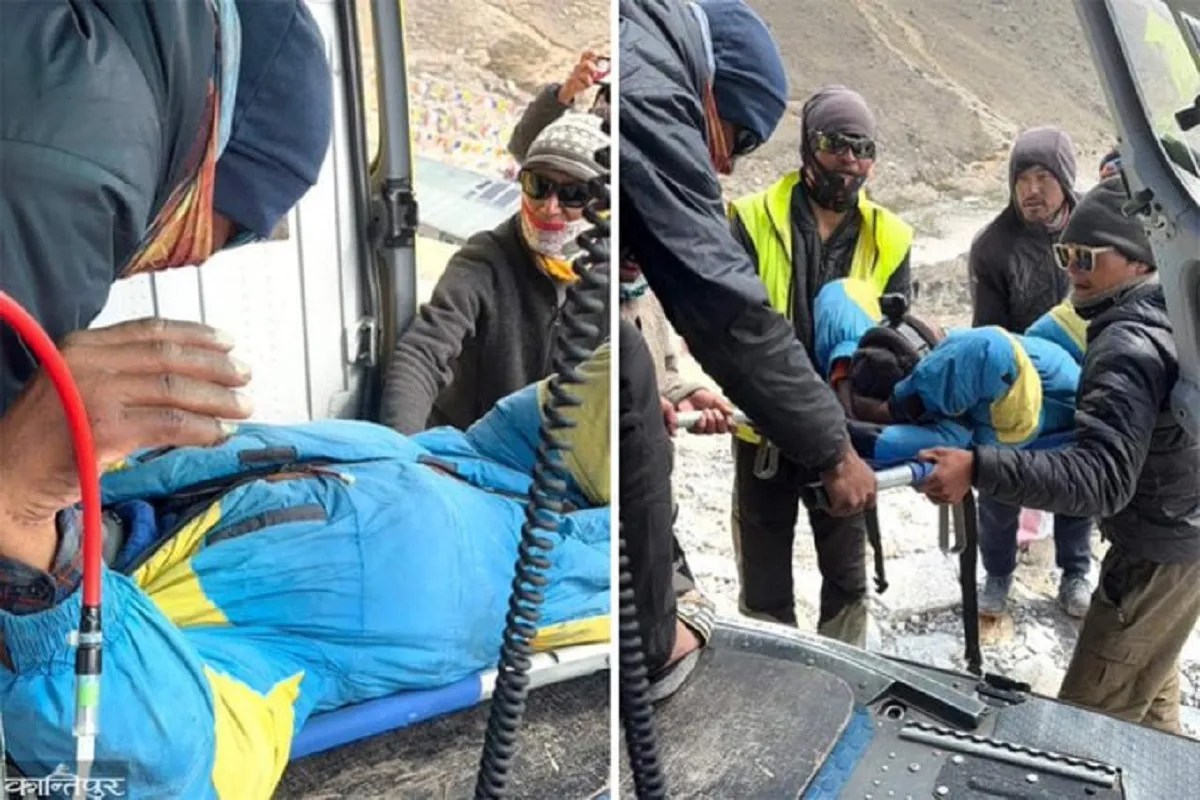
Dawa Sherpa was located on the morning of June 4, 2026, near Crampon Point, just above Base Camp, by an SPCC waste-clearing crew consisting of Bhim Bhattarai and Durga Rai. The fact that he was discovered crawling independent of a formal rescue operation confirms that his survival was a product of self-rescue rather than external intervention.
Upon discovery, the immediate clinical priorities for a patient exposed to extreme altitude and deprivation for 144 hours follow a strict protocol:
1. Fluid Resuscitation (Isotonic crystalloids to reverse severe hemoconcentration)
2. Thermal Rewarming (Controlled external rewarming to protect compromised extremities)
3. Anticoagulation Therapy (Low-molecular-weight heparin to counter vascular stasis)
4. Hyperbaric/Oxygenation Therapy (Reversal of systemic cellular hypoxia)
Data from the intensive care unit at HAMS Hospital indicates that Dawa Sherpa arrived conscious and capable of speech, with trauma and frostbite limited primarily to epidermal peeling on his digits. This clinical presentation is atypical for prolonged high-altitude exposure and indicates an extraordinary physiological tolerance to extreme hypoxia and environmental stress.
Systemic Mandates for High-Altitude Commerce
The survival of Dawa Sherpa exposes flaws within the commercial mountaineering industry that cannot be ignored. To prevent future systemic failures of this nature, the Ministry of Tourism and expedition operators must implement rigid operational changes.
First, regulatory bodies must mandate absolute financial and operational co-responsibility between permitting agencies and ground operators. Joint indemnity bonds should be held in escrow prior to the season, ensuring that search-and-rescue operations are triggered automatically within four hours of a missed check-in, bypassing corporate disputes.
Second, the hard cutoff dates for route maintenance by the SPCC must be dynamically linked to active satellite tracking data of all personnel on the mountain. Safety infrastructure in the Khumbu Icefall must remain intact until GPS telemetry confirms that 100% of registered climbers and high-altitude workers have cleared Crampon Point.
Finally, the industry must transition from passive radio check-ins to mandatory, real-time biometric and satellite tracking arrays for all support staff, ensuring that separation on descent immediately alerts base operations before environmental and physiological exhaustion sets in.