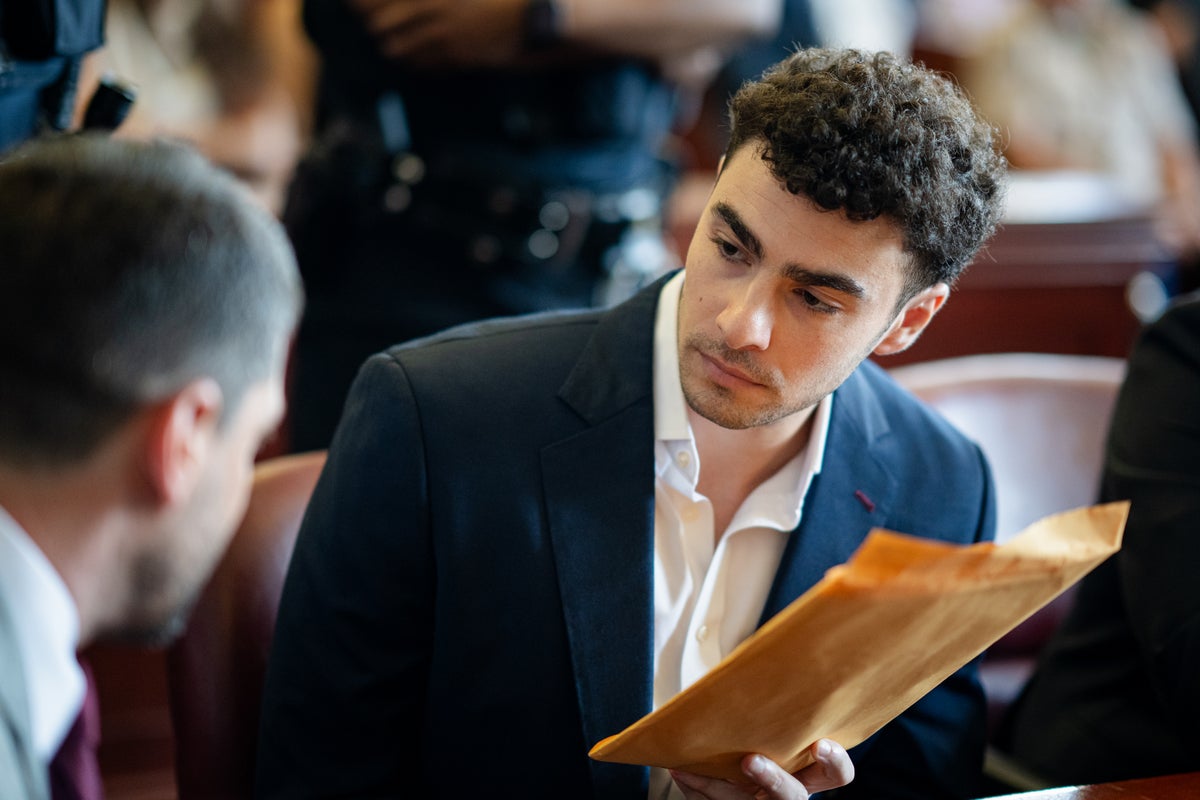
The air inside Manhattan Criminal Court Part 32 carries the specific, deadening chill of institutional bureaucracy. On June 17, 2026, the room filled with the usual rustle of loose-leaf paper, the low murmur of legal clerks, and the heavy thud of wooden mallets. Sitting at the defense table, sandwiched between his attorneys, was twenty-eight-year-old Luigi Mangione. He wore a crisp blue suit and a light-colored button-down shirt. Physically, he looked very much like the Ivy League graduate he is, a young man from a prominent, wealthy Maryland family.
But the narrative surrounding him has ceased to be about pedigree. It is now entirely about what happened inside his mind.
During the morning hearing, Judge Gregory Carro unsealed a piece of the legal strategy that will define the upcoming September 8 trial. Mangione’s defense team is mounting an affirmative psychiatric defense. Specifically, they will argue that when Mangione allegedly stood on a cold Midtown Manhattan sidewalk in December 2024 and shot UnitedHealthcare CEO Brian Thompson from behind, he was suffering from an "extreme emotional disturbance."
To understand this strategy is to understand a fundamental pivot in the American legal machine. By introducing a psychiatric defense, Mangione’s lawyers are no longer participating in a whodunit. They are not challenging the surveillance footage, nor are they contesting the 3D-printed pistol or the handwritten notebook recovered during his arrest at a Pennsylvania McDonald's.
Instead, they are conceding the act to interrogate the motive. They are turning the trial from a question of who to a question of why.
The Friction of Parallel Realities
The strategy is a precise legal instrument, but it carries immense risk. Under New York law, proving an extreme emotional disturbance does not absolve a defendant. It does not mean "not guilty by reason of insanity," which would send a person to a psychiatric hospital rather than a prison cell. Instead, it acts as a mitigator. If the jury buys the argument, the top charge drops from intentional second-degree murder to manslaughter. The difference is measured in decades of human life spent behind bars.
Yet, what works as a shield in a state courtroom can become a vulnerability elsewhere. Mangione’s lead attorney, Karen Friedman Agnifilo, argued fiercely against unsealing the transcripts of the secret hearings regarding his mental state. Her reason was simple: Mangione is facing two entirely separate prosecutions for the exact same set of facts.
Consider what happens next on the legal calendar. Just weeks after the state murder trial begins in September, Mangione is scheduled to face a federal jury on October 13 on charges including interstate stalking. In the federal arena, the concept of extreme emotional disturbance as a mitigating factor for this type of conduct does not exist. Agnifilo warned that exposing his psychiatric defense now could deeply prejudice his federal case, effectively giving federal prosecutors a roadmap to his mental vulnerabilities before they even select a jury.
The legal system functions like a pair of heavy, unsynced gears. A maneuver that eases the pressure on one side can cause a catastrophic crush on the other.
The Words Left Behind
The public perception of this case has never been neutral. When police searched Mangione’s backpack five days after the shooting, they found a notebook that read less like a legal brief and more like a manifesto. It spoke of a desire to rebel against what it termed "the deadly, greed-fueled health insurance cartel." More damningly, the ammunition used in the shooting was reportedly inscribed with three words: delay, deny, depose.
Those three words are deeply familiar to anyone who has ever fought with an insurance algorithm over a denied claim or a delayed surgery. They are standard industry shorthand for the bureaucratic hurdles faced by patients. Because of this, the shooting immediately transcended the boundaries of a standard criminal case. It became a dark, polarizing mirror for a broken national healthcare apparatus.
The prosecution initially attempted to channel that public resonance into something heavier. They filed terrorism-related charges, arguing that the attack was a targeted strike meant to terrorize an entire corporate infrastructure. But the law demands strict definitions, not emotional resonance. In September, Judge Carro dismissed those terrorism counts, ruling that a corporation’s employees do not legally constitute a "civilian population."
The state trial will not be an ideological referendum on the ethics of American healthcare. It will be a clinical dissection of a single person’s breaking point.
The Final Line
The state has already agreed not to seek the death penalty, removing the absolute highest stakes from the table. What remains is a quiet, desperate calculation of time. If the defense cannot convince twelve citizens that Mangione’s mind was fractured by an unimaginable emotional weight on that December morning, he will likely spend the rest of his natural life in a maximum-security facility.
As the hearing concluded, the guards prepared to escort Mangione back to his cell. The blue suit, the Ivy League background, the furious notebook entries, and the corporate tragedy outside the Midtown hotel all faded into the background, leaving only the cold mechanics of a Sept. 8 trial date. We are no longer waiting to see what the evidence shows. We are waiting to see how much of a man's internal undoing a jury is willing to believe.