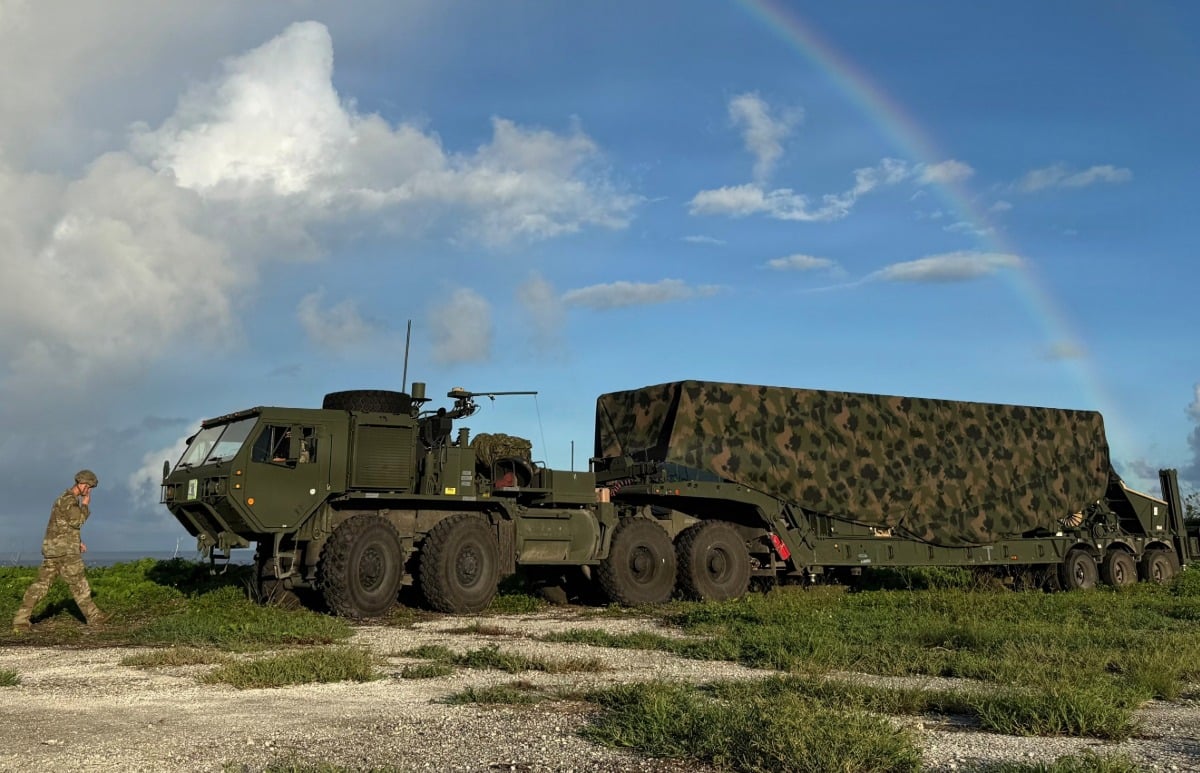
The operational deployment of the United States Army’s Long-Range Hypersonic Weapon (LRHW), designated Dark Eagle, to the island of Guam introduces a structural shift in regional deterrence mechanics. While public discourse frequently focuses on the weapon’s velocity profile, the strategic reality centers on a calculated repositioning of theater architecture. This deployment does not represent a simple hardware upgrade; it is an active re-engineering of the cost-imposition formula against adversarial anti-access and area-denial (A2/AD) networks.
Understanding this development requires moving past vague headlines to analyze the hard mechanics of boost-glide trajectories, regional geography, and the operational limitations inherent to first-generation hypersonic technology. For a deeper dive into this area, we suggest: this related article.
The Mechanics of the Boost-Glide Trajectory
Standard ballistic missiles follow a predictable parabolic arc, where peak altitude scales predictably with operational range. This allows long-range early warning radars to calculate impact points early in the flight regime. The Dark Eagle system alters this calculus via a two-stage rocket booster that accelerates an unpowered Common-Hypersonic Glide Body (C-HGB) to velocities exceeding Mach 5 before releasing it within the upper atmosphere.
Rather than exiting and re-entering the atmosphere along a standard ballistic path, the C-HGB utilizes aerodynamic lift to glide along a depressed trajectory at lower altitudes. This introduces three specific problems for existing air defense grids: For further background on this issue, in-depth analysis can be read at MIT Technology Review.
- Radar Horizon Compression: By flying significantly lower than a traditional ballistic missile, the glide body remains below the line of sight of ground-based and shipborne early warning radars for a greater portion of its flight. This reduces the defender's detection and tracking windows from tens of minutes to mere seconds.
- Non-Ballistic Maneuverability: Because the C-HGB maneuvers erratically during its descent, its flight path cannot be modeled using standard ballistic trajectory equations. This neutralizes the predictive intercept algorithms used by mid-course and terminal defense systems like the S-400 or Type 055 destroyer variants.
- Kinetic Damage Delivery: Reports indicate the warhead mechanism is highly compact, designed primarily to deploy payload elements or maximize raw kinetic energy transfer. Traveling at high hypersonic speeds, the vehicle's structural mass possesses immense kinetic energy ($E_k = \frac{1}{2}mv^2$), rendering traditional chemical explosive payloads secondary to the physical impact force delivered against hardened command installations or subsurface facilities.
Guam as a Strategic Node
The choice of Guam as a forward operating position exposes the core geographic tension of the Indo-Pacific theater. Recent confirmations place the operational range of the Dark Eagle system at approximately 2,175 miles (3,500 kilometers). This specific range envelope transforms Guam from a purely defensive logistics base into an offensive staging ground capable of threatening high-value targets across the First Island Chain and into mainland Asia.
[ Guam Staging Area ] ---> (2,175-Mile Operational Envelope) ---> [ Near-Peer Command & Control Nodes ]
                                                            ---> [ Fixed Radar & Early Warning Networks ]
                                                            ---> [ Anti-Access Missile Batteries ]
This positioning alters the theater cost function. In a conventional contingency scenario, the United States has historically relied on carrier strike groups or forward-deployed air wings operating within the First Island Chain. However, modern anti-ship ballistic missiles like the DF-21D and DF-26 create a highly contested environment inside that boundary.
Placing a land-based, mobile hypersonic battery on Guam provides a solution to this vulnerability. It allows the joint force to execute immediate, high-speed strikes against critical time-sensitive targets—such as enemy air defense radars and command-and-control hubs—without risking high-value naval assets. This opens an operational corridor, softening the adversarial A2/AD umbrella so that conventional air and naval forces can move into theater with a significantly lower risk of attrition.
Operational Constraints and System Vulnerabilities
A rigorous strategic assessment must look past capabilities to map the distinct operational bottlenecks and vulnerabilities of the LRHW program. The platform is not a universally applicable solution, and its deployment reveals deep logistical trade-offs.
High Cost and Low Production Volume
Each Dark Eagle round carries an estimated unit cost of approximately $41 million. This extreme cost function dictates that the weapon cannot be used for sustained bombardment or low-value attrition warfare. It must be strictly reserved for high-value target classes where destruction yields theater-level effects. This low production volume means the entire infrastructure is vulnerable to saturation strategies; an adversary can deploy inexpensive decoys or force the utilization of these multi-million dollar assets on non-critical nodes.
Fixed Logistical Footprint
Although the system is mobile on land—utilizing M983 tractor-trailers in an eight-missile battery configuration—it relies on the highly concentrated infrastructure of Guam. Guam is a single, isolated island target. An adversary can easily monitor the movement of these oversized launch vehicles via satellite reconnaissance, and the limited landmass restricts the battery’s ability to employ effective maneuver-to-conceal tactics.
The Air Defense Imperative
Because the battery is bound to Guam, its survival depends entirely on the island's integrated air and missile defense architecture. The system cannot protect itself against incoming counter-strikes. This explains why the deployment of the offensive Dark Eagle battery occurs alongside defensive upgrades, such as the Marine Corps' testing of the Medium-Range Intercept Capability (MRIC) and the integration of components from the Iron Dome network. Without a layer of defense to intercept low-flying cruise missiles and high-altitude ballistic threats, the forward hypersonic battery remains a high-value target vulnerable to preemptive destruction.
Strategic Playbook for Theater Commanders
To maximize the value of the Dark Eagle system given these structural limitations, theater planners must deploy it through a highly disciplined operational framework.
First, commanders must resist using the platform as an open-ended threat mechanism. Instead, it must be electronically integrated with regional electronic warfare and cyber assets to execute coordinated, multi-domain suppression strikes. The primary mission must be restricted to disabling the long-range sensor networks of an adversary's A2/AD bubble during the opening hours of a conflict.
Second, the operational battery on Guam must be managed under a strict shell game protocol. Planners must build multiple hardened, dummy launch positions across the island and rotate the actual transporter-erector-launchers during periods of heavy cloud cover or satellite blind spots. Increasing the adversary's targeting uncertainty is the only way to protect a land-bound asset on a small island.
Finally, logisticians must prepare for a rapid air-mobility model rather than assuming the platform will remain permanent on Guam. The batteries should be routinely loaded into C-17 or C-5 transport aircraft and flown into austere runways in allied nations throughout the region on a short-notice, unannounced basis. Distributing the system dynamically across multiple geographic points disrupts adversarial targeting models and forces the competitor to dilute their defensive resources across a massive operational front.