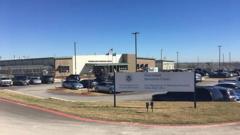
A federal judge handed down a combined 450 years in prison to eight defendants following a chaotic, hours-long confrontation outside a regional Immigration and Customs Enforcement (ICE) detention facility that culminated in the shooting of a federal officer. The sentences, which range from 40 to 70 years per individual, mark one of the most severe judicial crackdowns on political violence in modern American history. While prosecutors framed the ruling as a necessary defense of the rule of law, civil liberties attorneys argue the massive sentences represent a dangerous escalation in how the justice system penalizes collective civil unrest.
The incident began as a scheduled demonstration against federal immigration enforcement policies. It deteriorated into an anti-ICE riot after a small, highly coordinated group broke away from peaceful demonstrators to breach the facility's outer perimeter security fencing.
Federal prosecutors relied heavily on conspiracy laws to secure the convictions. This legal strategy allowed the government to hold all eight defendants accountable for the actions of the group, regardless of who pulled the trigger.
The Breaking Point at the Perimeter
The escalation from peaceful assembly to a federal emergency did not happen in a vacuum. Tension had been building for months around the facility, which had recently expanded its bed capacity to house high-security detainees transferred from out-of-state jurisdictions. Local activist groups had staged weekly vigils, which were generally cooperative with local law enforcement.
Everything changed on a Tuesday evening when an influx of outside groups arrived with specialized tactical gear. Security footage showed individuals carrying industrial bolt cutters, reinforced shields, and smoke canisters hidden inside heavy backpacks.
The perimeter fell within minutes. Attackers cut through the chain-link barriers, blinded security cameras with industrial lasers, and flooded the facility's intake courtyard. When a rapid-response team of federal officers deployed to push the crowd back, a firefight erupted. A single round struck a veteran ICE officer in the upper torso, narrowly missing his body armor.
The Conspiracy Pivot in the Courtroom
Securing a conviction for an officer shooting during a chaotic riot is historically difficult for prosecutors. Identifying a single shooter in a crowd of masked, similarly dressed individuals often leads to hung juries or lesser charges. To bypass this hurdle, the Department of Justice deployed the pinkerton liability doctrine, a legal precedent establishing that a conspirator can be held responsible for all foreseeable crimes committed by their co-conspirators in furtherance of a shared plot.
The prosecution built its case around encrypted chat logs recovered from the defendants' mobile devices. These logs showed weeks of meticulous planning. The discussions focused on tools needed to breach federal property and methods to neutralize law enforcement resistance.
[Excerpts from Encrypted Trial Exhibits]
User 1: "Perimeter needs to come down within the first five minutes before local PD can spin up a response."
User 2: "Bring heavy tools. If they push back, we lock it down and hold the courtyard by any means."
By proving the defendants entered the property with a shared plan to commit a violent felony, prosecutors did not need to prove which specific defendant fired the weapon. Under federal law, the collective intent to execute the riot made every member of the core group legally liable for the attempted murder of the officer.
The Cost of Deterrence
The sheer length of the sentences sent shockwaves through the legal community. A 70-year sentence for a non-homicide offense is exceptionally rare in the federal system, usually reserved for large-scale terrorism plots or high-tier espionage.
The defense argued that the government used the defendants to send a political message, effectively criminalizing the act of protest by association. They highlighted that several of the convicted individuals had no prior criminal records and were not carrying firearms when arrested.
| Defendant Group | Average Age | Prior Record | Sentence Length |
|---|---|---|---|
| Core Organizers (3) | 26 | None | 65-70 Years |
| Tactical Breach Team (3) | 24 | Misdemeanors | 50-55 Years |
| Perimeter Support (2) | 29 | None | 40 Years |
The sentencing judge rejected appeals for leniency, stating that the deliberate choice to bring firearms and breaching equipment to a civilian demonstration crossed the line from protected speech into domestic insurgency. The court aimed to set a precedent that would deter future coordinated assaults on federal infrastructure.
Accountability Versus Overreach
The legal fallout from this verdict will reshape how public demonstrations are managed and prosecuted across the country. Law enforcement agencies are already using the case as a textbook example of how early intelligence gathering and aggressive conspiracy charges can dismantle violent networks before they scale.
Conversely, civil rights organizations warn that the threshold for federal conspiracy charges has been lowered significantly by this ruling. If a peaceful demonstrator stands near an individual who decides to damage property, the line between an innocent bystander and a co-conspirator becomes dangerously blurred.
Federal appellate courts will likely spend years untangling the constitutional implications of these sentences. The convictions stand as a stark warning that the federal government will use its most aggressive legal mechanisms to protect its personnel, transforming the legal risks of radical activism overnight.