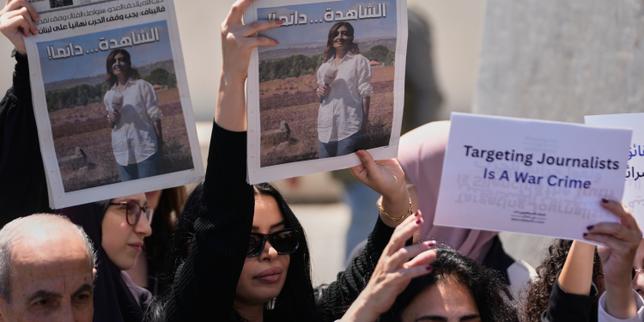
International watchdogs have finally attached a legal designation to what survivors already knew. When investigative findings from Amnesty International and Human Rights Watch declared the targeted killing of veteran Lebanese journalist Amal Khalil a war crime, they did not just document a single tragedy. They mapped out an explicit mechanics of state-sponsored obstruction.
Khalil, a seasoned correspondent for the daily newspaper Al-Akhbar, did not die in the initial crossfire of the southern Lebanese frontier. She bled to death beneath concrete rubble while emergency medical teams sat stranded at military checkpoints, blocked for hours by the very forces that brought the building down.
The sequence of events in the village of al-Tiri reveals a terrifying blueprint for silencing press members reporting on active conflict zones.
The Timeline of a Controlled Death
On April 22, Khalil and freelance photojournalist Zeinab Faraj were navigating the volatile border landscape on assignment. An initial Israeli drone strike struck a civilian vehicle ahead of them, instantly killing its occupants. Seeking refuge, Khalil and Faraj ducked beneath a damaged tin roof next to an abandoned structure.
Surveillance feeds tell a chilling story of constant, close-range monitoring. Israeli military drones did not merely observe the area; forensic analysis of video footage verified that unmanned aerial vehicles hovered mere meters above the terrified women. The military optics possessed clear resolution capability. The operators knew civilians were on the ground.
Yet, a second strike targeted the journalists' parked vehicle. Shrapnel tore through the area, leaving Khalil severely wounded in the head, nose, and leg. Trapped and unable to move, Khalil made desperate phone calls to civil defense coordinators.
Minutes later, a third, direct missile strike collapsed the three-story building where they had sought shelter, entombing both women.
What followed is the most damning indictment of the operation. Lebanese Red Cross ambulances and civil defense teams mobilized immediately, attempting to secure passage through formal deconfliction channels. They were denied entry. Israeli forces stalled the rescue mission for hours, even dropping stun grenades near the humanitarian workers and firing small arms at approaching vehicles.
Forensic data later showed that Khalil survived her initial injuries for hours under the debris. She died around 7:00 PM from cardiac arrest brought on by severe trauma and unchecked blood loss—expiring while medical help sat idling less than two kilometers away, legally cleared by local coordination mechanisms but physically barred by military force.
The Architecture of Denial
The standard playbook deployed by military press offices following the death of media workers relies on swift obfuscation. Standard statements express generic regret while vaguely linking victims to militant infrastructure.
In Khalil's case, the Israeli military claimed the initial strike targeted two individuals allegedly affiliated with Hezbollah. Rights investigators found zero evidence supporting these combatant designations. More critically, even if the initial targeting claims were accepted for the sake of argument, international humanitarian law maintains an uncompromising threshold: the presence of nearby fatalities does not strip surviving civilians, let alone identified press members, of their protected status.
Surveillance footage confirms that military operators overhead watched the initial targets perish. The subsequent escalation involving two separate strikes on a clearly marked press vehicle and a civilian refuge cannot be written off as collateral damage or standard friction of war. It represents an intentional erosion of legal boundaries designed to shield reporters from harm.
The targeting of Khalil fits a broader, systemic strategy. Months prior to her assassination, Khalil received direct threats from foreign numbers warning her to abandon her coverage of southern Lebanon or face decapitation and the destruction of her home. When a state labels a journalist a security threat, the transition from verbal intimidation to lethal kinetic force becomes an administrative formality rather than an operational accident.
The Cost of Persistent Impunity
The joint findings issued by Amnesty International, Human Rights Watch, and local watchdogs underscore a grim reality. Investigations matter very little when structural accountability remains absent.
When international bodies document war crimes without triggering tangible enforcement mechanisms—such as comprehensive arms embargoes, targeted asset freezes, or immediate referrals to international criminal tribunals—they inadvertently validate a license to kill. The deliberate blocking of emergency medical personnel transforms a targeted strike into a slow execution, sending an unmistakable message to every reporter still operating in high-intensity combat zones.
The ink on legal briefs and human rights dossiers dries quickly under the desert sun. The physical evidence of a collapsed concrete slab in al-Tiri remains. Every minute Amal Khalil spent suffocating under the weight of a ruined building while humanitarian workers watched helplessly from a blocked checkpoint represents a calculated dismantling of the international legal order, executed in real time under the unblinking lens of an overhead drone