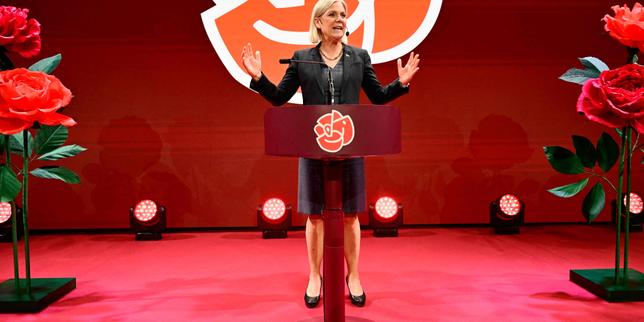
Electoral outcomes determined by marginal vote differentials expose the structural fragility of modern parliamentary governance. When a national legislature divides by a razor-thin margin—such as the 50,359-vote differential that reconfigured the Swedish Riksdag, allocating 176 seats to the centre-left bloc against 173 for the incumbent conservative coalition—the resulting political transition cannot be understood merely as a shift in public sentiment. It represents a systemic realignment governed by institutional constraints, coalition mathematics, and asymmetric policy demands. Prime Minister Ulf Kristersson's subsequent resignation marks the initiation of a high-friction government formation process defined by three structural variables: legislative fragmentation, ideological distance between potential coalition partners, and the cost of legislative compliance.
The Mechanics of Marginal Shifts
In proportional representation systems with low effective barriers to entry, macroeconomic dissatisfaction and localized voter mobilization operate as primary swing vectors. The 2026 Swedish general election demonstrated how minor shifts in turnout within specific demographic centers can compress a governing majority into non-existence. The conservative bloc, anchored by Kristersson’s Moderates and supported by the Sweden Democrats, faced a dual friction coefficient: voter fatigue with incumbent economic management and the diminishing returns of external support agreements.
When a governing arrangement relies on an external party—such as the Tidö Agreement framework linking the Moderates, Christian Democrats, Liberals, and the Sweden Democrats—the stability of the administration is inversely proportional to the divergence of its constituent parts. The right-wing bloc suffered from a structural ceiling; while security and immigration hardening dominated the previous legislative term, economic pressures shifted the median voter's utility function back toward public service funding and welfare maintenance, directly benefiting the Social Democrats under Magdalena Andersson.
The Coalition Cost Function
The arithmetic of 176 versus 173 seats creates an operational bottleneck for the incoming administration. A three-seat majority is historically volatile, subjecting the executive branch to individual defections or absences. To model the stability of Andersson’s prospective government, analysts must evaluate the internal friction among the supporting parties:
- The Ideological Divergence Vector: The center-left bloc is not a monolith. It encompasses the pragmatic-left Social Democrats, the green-transition focused Green Party, the urban-centric Left Party, and the economically liberal Centre Party.
- The Policy Conflict Matrix: While the Left Party demands expanded public sector expenditure and wealth redistribution, the Centre Party traditionally advocates for fiscal restraint, labor market deregulation, and tax cuts. These positions occupy mutually exclusive coordinates on the fiscal policy plane.
- The Ministerial Distribution Constraint: Parties such as the Left Party have explicitly conditioned their parliamentary backing on direct cabinet influence or explicit policy vetoes, raising the administrative cost of consensus-building.
This dynamic creates a high-entropy negotiating environment. If the cost of maintaining internal coalition discipline exceeds the legislative output of the government, executive paralysis ensues.
Policy Continuity Amid Institutional Turnover
Despite the executive turnover resulting in Kristersson's resignation, structural inertia dictates that policy shifts will be constrained by pre-existing legislative frameworks. Over the preceding four years, the political center of gravity in Sweden migrated significantly rightward regarding penal code severity, border control, and law enforcement resource allocation.
A newly formed centre-left administration cannot instantaneously dismantle these statutory changes without losing the support of pivotal centrist factions like the Centre Party or alienating security-conscious median voters. Consequently, the practical manifestation of the left-wing victory is constrained to fiscal adjustments—such as targeted tax modifications and welfare spending recalibrations—rather than a complete institutional reset. The structural architecture constructed by the previous parliament remains largely intact, insulated by administrative bureaucracy and long-term legislative timelines.
Strategic Forecast
The resolution of the government formation phase depends on the Speaker of the Riksdag's management of exploratory talks. Because the numerical margin leaves zero room for error, minority governance under a three-seat majority requires transactional legislative bargaining on a bill-by-bill basis. The incoming executive must establish a stable matrix of compromises, balancing the egalitarian demands of the Left Party against the fiscal conservatism of the Centre Party. Failure to optimize this legislative trade-off will trigger systemic deadlock, rendering the new administration structurally incapable of executing long-term structural reforms.
This video provides additional context on the immediate aftermath of the election and the resignation of Prime Minister Ulf Kristersson.



