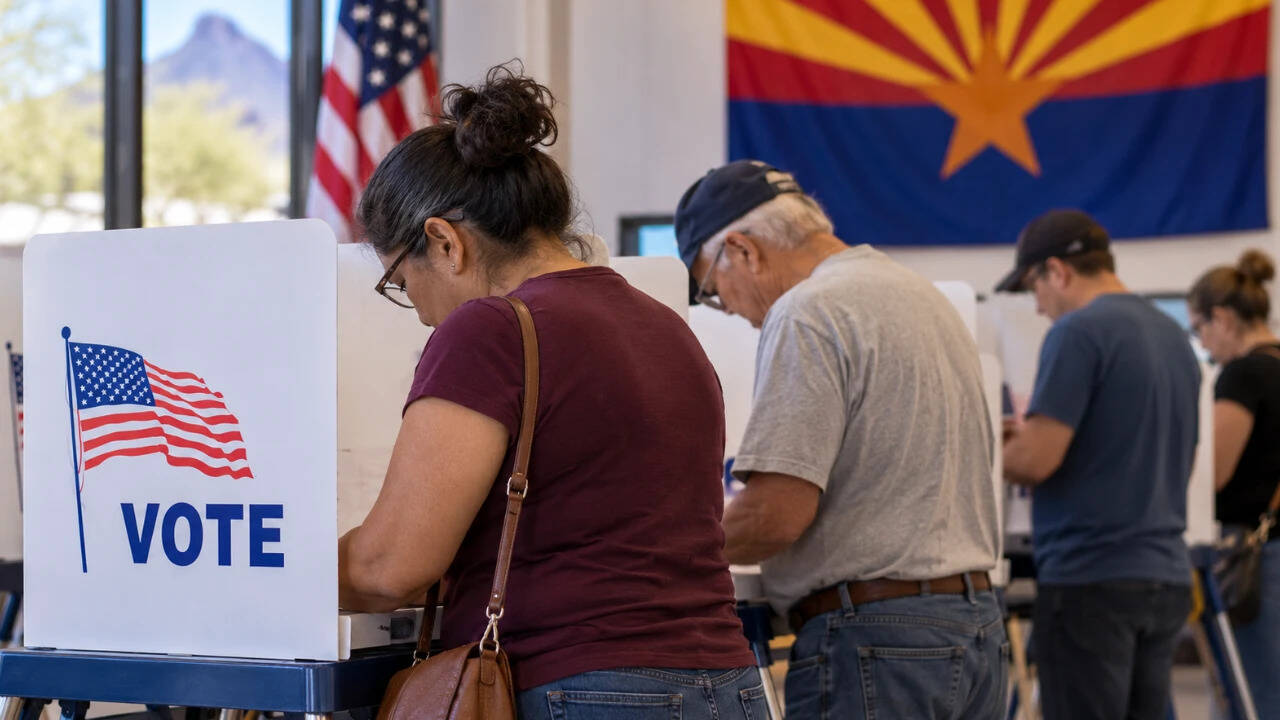
When administrative data verification systems rely on incomplete database cross-matching, legitimate participants get purged from public registries. According to reporting on Arizona's pre-midterm voter roll disputes, 25 eligible Arizona voters had their voting rights restored days before the midterm elections after being wrongly flagged under federal verification initiatives associated with the Trump administration. This incident exposes a recurring operational vulnerability in election administration: the friction between aggressive list-maintenance mandates and the statistical realities of imperfect cross-agency data matching.
Standard coverage of voter roll disputes frames these events as simple binary conflicts between ballot access and election security. That framing misses the underlying systems architecture. To evaluate what happened in Arizona, analysts must examine the mechanics of database reconciliation, the asymmetric cost of false positives versus false negatives in civic infrastructure, and the statutory constraints governing pre-election list maintenance.
The Architecture of Database Reconciliation Errors
Voter roll maintenance requires reconciling two fundamentally different types of data systems: state-level registration databases and federal citizenship or identity repositories. In Arizona, where state law (specifically Proposition 200 and subsequent legislative updates) mandates documented proof of citizenship for state-level ballots, election officials frequently cross-reference state Motor Vehicle Division (MVD) records with federal databases such as the Systematic Alien Verification for Entitlements (SAVE) program managed by the Department of Homeland Security.
When federal initiatives or administrative directives push for rapid audits of voter rolls against federal immigration or citizenship records, three systemic failure modes emerge:
- Temporal Latency in Status Updates: Federal databases do not update instantaneously when a lawful permanent resident naturalizes into a U.S. citizen. A citizen who naturalized months or even years prior may still appear as a non-citizen in legacy snapshots of federal databases or state MVD records if they have not updated their driver's license status. Flagging records based on stale snapshots generates immediate false positives against newly naturalized citizens.
- Deterministic Matching vs. Probabilistic Reality: Many administrative sweeps rely on rigid field matching—combining first name, last name, date of birth, and partial identification numbers. Transposed digits, hyphenated surnames, cultural naming conventions, or clerical data-entry errors at the point of registration cause matching algorithms to misclassify eligible citizens or fail to link a voter's current record to their updated federal status.
- Scope Mismatch Across Interagency APIs: Databases like SAVE were engineered to verify eligibility for public benefits using specific alien registration numbers, not to audit millions of existing voter registrations using name-and-birthdate queries. Repurposing a benefits-verification tool for bulk electoral auditing introduces structural error rates that the underlying database schema was never designed to minimize.
In the Arizona case, the restoration of voting rights for the 25 affected individuals demonstrates that post-flagging manual review—or legal intervention—was required to override automated or bulk-administrative determinations. While 25 voters represent a tiny fraction of Arizona's total electorate, the operational significance lies in the timing: the corrections occurred just days before midterm voting, when administrative bandwidth is at its lowest and voter confusion carries the highest probability of permanent disenfranchisement for that cycle.
The Asymmetric Cost Function of Electoral Verification
In statistical decision theory and quality control, every classification system trades off Type I errors (false positives) against Type II errors (false negatives). Applied to voter list maintenance, a Type I error occurs when a legitimate, eligible citizen is flagged as ineligible and removed or restricted from voting. A Type II error occurs when an ineligible individual remains on the active roll.
The operational policies pursued by the federal administration and state election officials reflect fundamentally different weightings of these two error types. Proponents of aggressive federal verification audits assign an extraordinarily high cost to Type II errors, arguing that even a single ineligible registration undermines institutional legitimacy and public trust. Under this weighting, casting a wide net that flags questionable records—even with a high rate of false positives—is treated as an acceptable administrative byproduct.
Conversely, federal election statutes and constitutional jurisprudence assign an acute, immediate cost to Type I errors. Removing an eligible citizen from the rolls deprives them of a fundamental constitutional right, and the harm is irreversible once an election passes. The restoration of the 25 Arizona voters days before the midterms illustrates the legal and administrative system forcibly recalibrating this cost function. When challenged, the burden of proof shifts back to the administering agencies, which must validate the accuracy of their flagging criteria before stripping a citizen of ballot access.
Statutory Constraints and the Quiet Period Bottleneck
The timing of the Arizona restorations highlights a critical legal boundary in U.S. election administration: the National Voter Registration Act (NVRA) of 1993. Under Section 8 of the NVRA, states are prohibited from conducting systematic programs to remove the names of ineligible voters from official lists fewer than 90 days before a federal primary or general election.
This 90-day "quiet period" exists specifically because database errors are common and late-stage corrections are operationally expensive. When federal or state entities initiate verification sweeps, issue flags, or alter voter statuses inside or immediately adjacent to this window, they trigger a cascade of administrative bottlenecks:
- Compressed Cure Windows: Voters flagged late in the cycle have minimal time to locate physical proof of citizenship—such as naturalization certificates or birth records—and submit them to county recorders.
- Provisional Ballot Friction: If a flagged voter's status is not resolved before Election Day, they are typically shunted into provisional voting. Provisional ballots require secondary manual adjudication by county election boards after polls close, delaying result certification and increasing the likelihood that a ballot is rejected due to minor procedural errors.
- Resource Diversion: County election offices in populous jurisdictions like Maricopa or Pima County operate on strict logistical timelines during the final week before an election, managing early ballot processing, logic and accuracy testing, and poll worker deployment. Diverting senior staff to audit individual citizenship flags and process emergency restorations degrades overall operational readiness.
Differentiating Verified Mechanics from Analytical Hypotheses
Rigorous assessment requires separating established operational facts from broader analytical inferences regarding the Arizona incident:
- Established Facts: Federal and state voter verification efforts resulted in 25 eligible Arizona voters being erroneously flagged as ineligible; those flags were overturned, and the individuals regained their voting rights shortly before the midterm elections. Database mismatches between state licensing agencies and federal citizenship records are a documented cause of false-positive citizenship flags in Arizona, which maintains a bifurcated registration system (separating "federal-only" voters who have not provided documentary proof of citizenship from "full-ballot" voters who have).
- Analytical Hypotheses: While public reporting confirms the restoration of the 25 voters, the exact distribution of root causes among those specific cases—whether driven primarily by outdated MVD records post-naturalization or clerical transcription errors—depends on individual county-level audit logs. Furthermore, while 25 represents the confirmed cohort whose rights were restored prior to the election, systems analysis suggests that bulk-matching errors rarely occur in isolated batches; the 25 restored voters likely represent the subset of affected citizens who were notified, possessed the documentation to contest the flag, and successfully navigated the administrative appeals process before the deadline.
Limitations of Automated List Maintenance
No technical architecture can eliminate errors in voter roll management entirely. Relying exclusively on automated cross-agency data matching introduces systemic false positives because human life events—naturalization, name changes, interstate moves—outpace bureaucratic synchronization. Conversely, abandoning database cross-checks altogether leaves voter rolls bloated with outdated records of deceased or relocated individuals, creating logistical inefficiencies and public skepticism.
Effective list maintenance requires strict adherence to institutional guardrails rather than ad-hoc pre-election sweeps.
Operational Protocol for High-Integrity List Maintenance
Election administrators and policy architects managing voter registration systems must enforce four structural controls to prevent late-cycle disenfranchisement while maintaining database accuracy:
- Enforce Hard Cutoffs for Bulk Audits: All automated cross-agency database comparisons must conclude at least 120 days prior to any federal election. This creates a 30-day buffer before the NVRA 90-day quiet period begins, ensuring sufficient runway for multi-step notice and cure procedures without colliding with peak election operations.
- Require Multi-Source Corroboration Before Status Alteration: Never downgrade or suspend a voter's active registration based on a single database mismatch. An automated flag from a federal repository must trigger an internal human review against secondary state records—such as vital statistics or prior verified registration filings—before any external notice is issued or status is restricted.
- Standardize Asynchronous API Synchronization: Replace periodic bulk-file transfers between state licensing agencies, federal citizenship databases, and county election systems with continuous, event-driven synchronization. When an individual completes naturalization or updates citizenship documentation at a state agency, that state transition should propagate automatically to voter registration rolls rather than waiting for an audit cycle.
- Mandate Transparent Error-Rate Auditing: Any agency deploying a verification filter against voter rolls must publish the false-positive rate of the matching algorithm prior to deployment. If a proposed audit methodology generates a false-positive rate exceeding a strict pre-defined threshold, the protocol must be rejected or recalibrated before touching live voter records.


