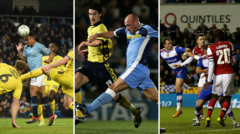
High scoring fixtures in single elimination knockout tournaments are rarely random distributions. They are structural anomalies born from specific systemic pressures unique to cup football. When examining extreme scorelines in the EFL Cup, observers frequently attribute the output to pure variance or defensive collapse. This interpretation misses the underlying operational mechanics. Extreme goal anomalies in domestic cup matches emerge from asymmetric tactical risk appetites, severe squad depth differentials, and feedback loops generated by early game state shifts.
Understanding why certain EFL Cup ties explode into double digit goal tallies requires evaluating the structural environment of the competition itself. Unlike league formats where teams optimize for aggregate points over a thirty eight game horizon, knockout tournaments operate on a binary survival function. A team that concedes an early goal faces an immediate existential threshold. The penalty for defensive conservatism in a losing knockout state is total elimination. This reality distorts normal risk management protocols.
The Asymmetry of Squad Depth and Resource Allocation
The primary driver of blowout scores in the EFL Cup is the structural disparity between elite Premier League clubs and lower division opponents, compounded by managerial rotation strategies.
The Rotation Gradient
Premier League managers competing in multiple European and domestic competitions treat early rounds of the EFL Cup as resource optimization puzzles. They deploy fringe players and academy prospects to preserve core starters for league fixtures. This rotation creates a dual system failure for the opposition:
- Pace and Physicality Delta: Academy players from elite clubs possess superior athletic metrics compared to League One or League Two journeymen, even if tactical awareness is still developing. When these prospects attack tired or lower tier blocks, the athletic mismatch compounds exponentially as the match progresses.
- Tactical Disjointedness: A heavily rotated side lacks the granular positional synchronicity of a first XI. This disruption often paradoxically helps high octane transition attacks because the team relies on individual technical superiority rather than structured buildup.
Conversely, lower tier clubs face an acute dilemma. To secure a famous cup upset, they must either maintain a suffocating defensive block for ninety minutes or commit bodies forward to exploit the opponent's makeshift lineup. Committing bodies forward breaches the safety margin. Once the elite side breaks the first line of press, the structural integrity of the underdog dissolves.
Game State Feedback Loops and Momentum Amplification
A standard league match features emotional and tactical calibration. If a team goes three goals down, the tactical objective often shifts to damage limitation, goal difference preservation, and energy conservation for the next fixture. In the EFL Cup, that rational calculation is frequently abandoned due to psychological factors and the absolute nature of elimination.
The Threshold of Despair
When a lower tier team concedes two quick goals to a superior opponent, the defensive blueprint collapses. The psychological shift moves from strategic containment to desperate equalization. This transition forces the trailing team to abandon their compact defensive block and push higher up the pitch.
- The Counter Press Trap: Pushing higher against technically superior players creates vast central corridors. Elite attackers exploit these spaces with vertical progression passes that bypass entire midfield units.
- The Fatigue Multiplier: Defending without the ball against a dominant possession side drains metabolic energy twice as fast as controlled possession. By the seventieth minute, the physical collapse of the trailing side correlates directly with a surge in defensive errors, unforced turnovers, and uncontested shooting opportunities inside the eighteen yard box.
This creates a self-reinforcing feedback loop. Each subsequent goal accelerates the tactical abandonment of the losing side, leading to defensive disintegration within compressed timeframes.
Historical Context and Structural Rule Changes
The historical frequency of extreme scores in the EFL Cup must be contextualized against regulatory shifts. The abolition of two legged semi finals in certain eras, alterations to extra time rules, and the removal of away goals in various domestic contexts have all influenced how teams approach game management.
Historically, matches that went to extra time produced disproportionate goal spikes because tired legs met tactical desperation under the lights. Without the safety net of a replay at lower league grounds, visiting teams were forced to chase winners deep into stoppage time. This dynamic eliminated passive play entirely. When both teams realize a draw is statistically insufficient for their operational goals, the game transitions from a strategic contest to an open transition duel.
Tactical Vulnerabilities of Lower Block Execution
To understand why scores mount rapidly, we must deconstruct the failure modes of the low defensive block under sustained pressure. A low block relies on three variables: spatial compression, defensive discipline, and clearance efficiency.
- Spatial Compression Decay: As cumulative pressure mounts, central defenders drop deeper toward their own goal, unintentionally compressing their own goalkeeper and inviting sustained wave attacks. This reduces the reaction time for defensive clearances.
- Second Ball Recovery Failures: When elite teams shoot from distance or launch crosses into a packed box, the resulting rebounds rarely clear the danger zone cleanly. Under physical fatigue, the reaction time to contest second balls drops significantly. Lower division sides frequently fail to secure these secondary possessions, allowing the attacking side multiple bites at the cherry within a single phase of play.
When these three failure modes synchronize, goals cease to be isolated events and instead arrive in rapid clusters. A single defensive lapse triggers a cascading failure across the entire defensive unit.
Operational Execution for Tournament Survival
Analyzing these historical goal surges provides a clear framework for clubs navigating the modern EFL Cup landscape. Underdogs cannot survive by merely absorbing pressure indefinitely; the statistical probability of a defensive breach approaches certainty over a ninety minute sample against elite technical opposition.
The strategic imperative for lower tier clubs is to disrupt the opponent's rhythm through calculated disruption and hyper-efficient set piece execution, while avoiding the fatal trap of opening the match architecture too early. Conversely, elite managers must enforce strict positional discipline on rotated squads to prevent transitional chaos, ensuring that athletic dominance translates into controlled dominance rather than wild, unpredictable shootouts.