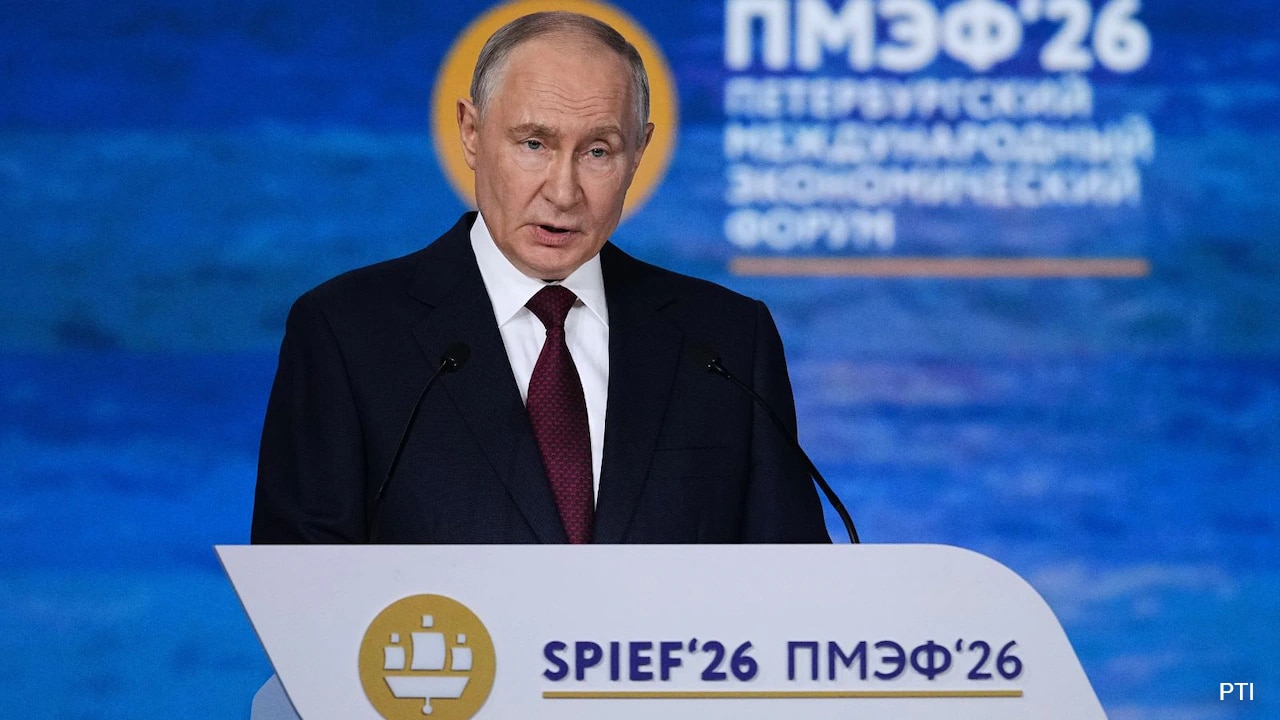
High-level diplomatic rejections are rarely matters of personal pique; they are calculated moves within a broader matrix of strategic signaling, leverage optimization, and domestic audience cost. Vladimir Putin’s public declaration at the St. Petersburg International Economic Forum that he sees "no point" in a face-to-face meeting with Volodymyr Zelensky cannot be understood merely as a reaction to a "boorish" open letter. Instead, this rejection functions as a deliberate exercise in conflict asymmetric bargaining.
By analyzing the mechanics of this diplomatic breakdown, we can map the structural barriers preventing executive-level negotiations. The deadlock is governed by three distinct strategic calculations: the signaling asymmetry of open diplomacy, the legalistic pretexting of regime legitimacy, and the shift in geopolitical focus toward secondary theaters. Learn more on a connected subject: this related article.
The Asymmetry of Open Diplomacy and Public Bargaining
The publication of Zelensky’s open letter proposing a direct summit alters the cost-benefit equation for both leaders. In structural negotiation theory, public appeals are typically deployed when a state lacks the leverage to secure concessions through private, backchannel diplomacy. By making the appeal public, Ukraine attempted to impose an international audience cost on the Kremlin, framing a refusal as a rejection of peace.
The Kremlin’s response utilizes a counter-strategy designed to neutralize this audience cost by altering the perceived sequence of negotiation. Additional analysis by USA Today explores similar perspectives on this issue.
- Pre-negotiation vs. Ratification: Standard diplomatic protocol dictates that executive summits occur at the end of a negotiation pipeline to ratify pre-agreed terms, not at the beginning to establish them. By demanding comprehensive, long-term agreements prior to any sit-down, Putin enforces a structural bottleneck. A meeting without predefined parameters carries a high downside risk for a dominant military actor, as it implies a willingness to compromise without securing structural concessions first.
- Tactical De-escalation Neutralization: Zelensky’s framework aimed at securing immediate, localized outcomes, specifically a ceasefire. From a military standpoint, a temporary ceasefire introduces an operational pause that disproportionately benefits the defending force by allowing logistical reorganization. Putin’s insistence on "long-term, durable agreements" rather than tactical pauses is an explicit rejection of this operational relief.
The Legitimacy Pretext and Legalistic Barriers
A recurring mechanism in Russia's diplomatic architecture is the exploitation of legalistic ambiguities to deny a counterpart status equality. Putin’s repeated critiques of Zelensky’s constitutional status serve a precise structural purpose: they establish an escape hatch to avoid binding commitments.
The argument relies on the expiration of the standard Ukrainian presidential term under martial law. By framing the Ukrainian executive as legally ambiguous, the Kremlin constructs a strategic paradox. If Moscow enters a formal treaty with a leader it defines as illegitimate, the treaty itself becomes legally volatile and easily voided by a future Russian administration. Conversely, if Moscow refuses to negotiate based on this illegitimacy, it successfully shifts the blame for the prolonged conflict onto Ukraine's internal constitutional arrangements.
This legalistic barrier is not an arbitrary talking point. It functions as a risk-mitigation tool for Russia, ensuring that any future negotiations must either bypass the current Ukrainian executive or force a structural restructuring of Ukraine's political representation—such as negotiating directly with the leadership of the Ukrainian parliament.
Geopolitical Pivot and the Dilution of Western Attention
The timing of this diplomatic rejection corresponds with a shifting global security architecture, specifically the reallocation of United States strategic assets and political attention.
[Global Security Architecture]
       │
       ├─► Primary Focus: Middle East Conflict (Iran)
       │
       └─► Secondary Focus: Eastern Europe (Ukraine) ──► Strategic Deprioritization
Zelensky’s acknowledgement that Ukraine cannot simply wait for U.S. attention to return highlights a critical calculation in the Kremlin’s strategy.
The intensification of conflict involving Iran has forced Washington to prioritize the Middle East, diluting the political capital and logistical oversight available for Eastern Europe. This distraction reduces the efficacy of Western security guarantees—a core component of any potential peace framework.
When the primary patron of a combatant is preoccupied with a separate theater, the bargaining power of that combatant decreases. Putin's public reference to Trump’s previous interactions with Zelensky serves to emphasize this asymmetry, signaling that the Kremlin views the conflict not as a bilateral dispute with Kyiv, but as a secondary front in a broader systemic confrontation with the West. With Washington's focus fractured, the strategic value of granting Ukraine a high-profile diplomatic platform evaporates.
Kinetic Catalysts and Negotiating Baselines
While structural frameworks dictate the long-term strategy, kinetic actions on the ground provide the immediate justification for diplomatic freezing. The Kremlin explicitly cited a Ukrainian drone strike in the Russian-controlled Luhansk region, which resulted in civilian casualties, as a direct cause for the cancellation of potential talks.
In security analysis, such events function as tactical vetoes. For a state actor maintaining an offensive posture, entering talks immediately following a significant cross-border or asymmetric strike creates an unacceptable domestic political cost. It signals vulnerability, suggesting that kinetic pressure can force political concessions.
By utilizing the strike as a hard boundary, Putin re-establishes a negotiating baseline that requires the cessation of deep-theater asymmetric operations as a prerequisite for even low-level diplomatic engagement.
The Strategic Play
The diplomatic gridlock will persist because the structural conditions for negotiation have not been met. For a summit to occur, one of two shifts must manifest: either Ukraine must experience a significant degradation of its defensive capabilities that forces a capitulation-style negotiation, or the Western coalition must consolidate its geopolitical focus to offer a unified, un-bypassable negotiation framework that addresses Russia's core structural demands. Until these variables alter, public letters and rhetorical rejections will remain the dominant mode of interaction, serving as tools for international signaling rather than pathways to de-escalation.