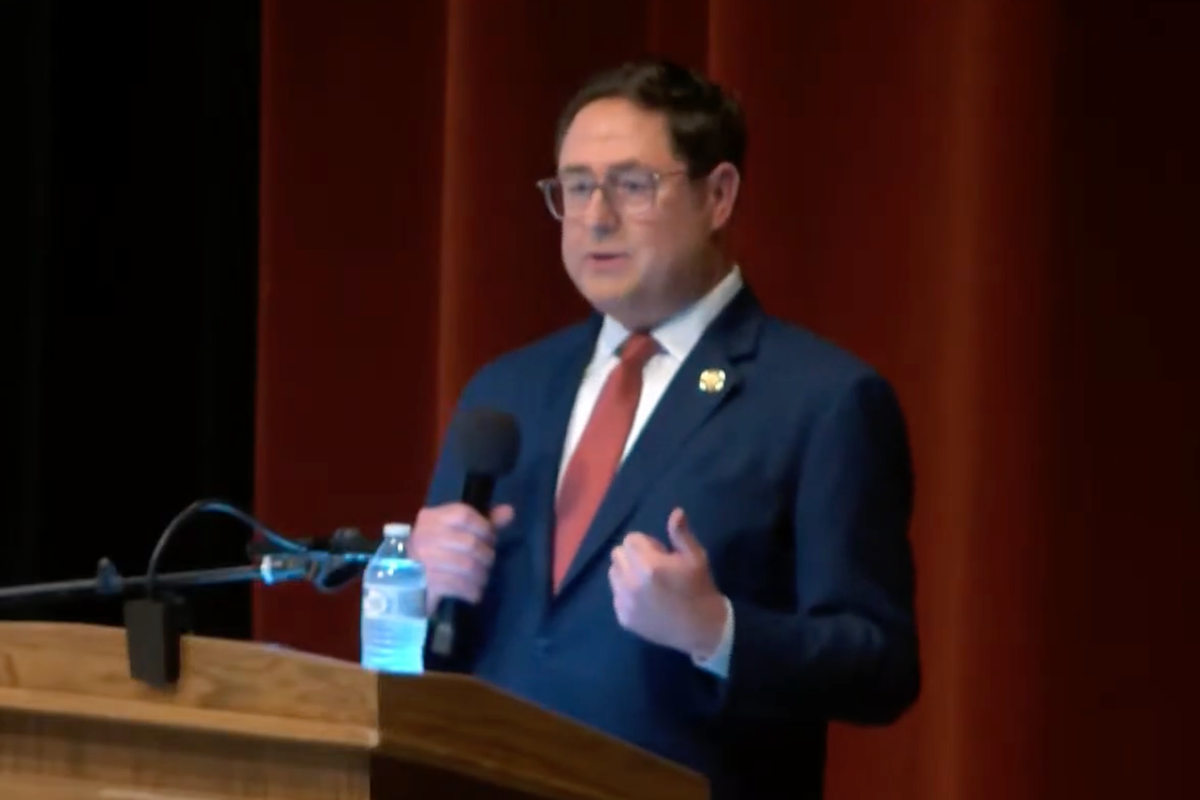
Political volatility in localized town hall forums is rarely a product of random emotional outbursts. Instead, it serves as a leading indicator of systemic friction between representative voting records and grassroots policy expectations. When a congressional representative faces intense pushback from constituents, the friction typically clusters around two distinct high-stakes vectors: discretionary executive fiscal authority and the escalation risks of foreign military intervention.
By analyzing these confrontations through the lens of political risk and public accountability frameworks, we can isolate the underlying mechanisms driving public alarm. The primary drivers are not merely partisan disagreements; they are structural anxieties regarding executive overreach—specifically the deployment of unappropriated or loosely monitored federal funds—and the strategic implications of shifting foreign policy doctrines in highly volatile regions like the Middle East.
The Dual-Vector Friction Model
To understand the mechanics of constituent-driven political friction, the grievances must be separated into independent variables. A crowd raising alarms over executive fiscal mechanisms and escalating war risks is reacting to a perceived breakdown in traditional checks and balances.
       [Systemic Public Friction]
         /                     \
        /                       \
 [Vector 1: Fiscal Opacity]   [Vector 2: Geopolitical Risk]
  - Executive Discretion       - Brinkmanship Dynamics
  - Oversight Asymmetry        - Kinetic Escalation Costs
Vector 1: Executive Fiscal Discretion and Oversight Asymmetry
The concept of a political "slush fund" refers technically to any large-scale pool of capital or federal allocation that operates with low transparency, minimal legislative oversight, and high executive discretion. When constituents voice alarm over these funds, they are responding to an asymmetric distribution of information and control.
The mechanism of this friction operates along three distinct lines:
- The Allocation Gap: Congress holds the constitutional power of the purse, yet legislative mechanisms frequently grant broad execution authorities to the executive branch or specific federal agencies. When these funds are perceived to be diverted toward partisan objectives or unvetted projects, the legislative representative faces the blame for failing to enforce oversight.
- The Monitoring Deficit: Public transparency tools often lag months or years behind actual capital deployment. This structural delay creates an environment of acute distrust, where constituents assume the worst regarding the destination and impact of federal outlays.
- The Accountability Loop: Representatives who support broad executive funding authorities without ironclad reporting requirements find themselves unable to defend the precise utility of those funds during direct public questioning.
Vector 2: Geopolitical Escalation and Kinetic Risk
The second vector of constituent friction involves the perceived trajectory toward armed conflict, specifically regarding protracted tensions with state actors like Iran. In a town hall environment, public anxiety regarding foreign policy is rarely abstract; it is calculated against the direct human and economic costs of kinetic warfare.
The friction in this vector escalates due to specific strategic patterns:
- The Brinkmanship Paradox: While policymakers may view aggressive rhetoric or targeted sanctions as deterrence mechanisms designed to avoid war, localized electorates frequently interpret these actions as a deterministic path to escalation.
- The Asymmetrical Cost Function: Electorates understand that the costs of foreign interventions are distributed unevenly. The financial burden adds to the national debt, while the human cost falls heavily on families within working-class congressional districts. When a representative aligns with hawkish foreign policy positions, they encounter immediate resistance from a constituency factoring in these localized cost calculations.
The Logistics of Public Confrontation
A town hall meeting is a high-density feedback loop where the traditional barriers between a politician and the electorate are temporarily suspended. The mechanics of a "heckling" event reveal a specific structural vulnerability in standard political communication strategies.
The Breakdown of Controlled Messaging
Politicians rely heavily on controlled media environments, pre-packaged talking points, and structured press releases to maintain a specific narrative equilibrium. The town hall format disrupts this equilibrium by introducing unvetted, high-velocity interactions.
When a representative is confronted simultaneously on fiscal opacity and foreign military risk, the structural flaw in their communication strategy becomes apparent. They are forced to shift from a proactive policy narrative to a reactive defense posture. Because these two issues span distinct policy domains (domestic fiscal policy vs. international security), the representative must pivot rapidly between complex justifications, which often compromises their rhetorical authority.
The Amplification of Localized Dissent
Public dissent within a town hall functions as a force multiplier for broader political liability. A single concentrated confrontation serves several strategic functions for opposition movements:
- Validation of Narrative: It provides empirical proof that opposition to the representative’s voting record is not confined to digital spaces but exists as a physical, motivated force within the district.
- Media Catalyst: Localized friction creates a highly visual, dramatic event that easily transitions into regional and national news cycles, amplifying the perceived vulnerability of the incumbent.
- Signal to Leadership: Sustained constituent pushback signals to party leadership that a specific district or policy stance has become a structural liability, potentially altering future legislative priorities or campaign resource allocations.
Managing the Contradictions of Legislative Representation
The core dilemma exposed by public pushback is the fundamental tension between a representative's national alignment and their localized accountability.
A representative often faces systemic pressure to support party-line initiatives, executive agendas, or national security doctrines that may run counter to the immediate preferences of their home district. When voting to authorize broad executive funding mechanisms or supporting aggressive geopolitical stances, the representative is frequently balancing national party loyalty against localized electoral survival.
The risk management strategy for a politician in this scenario requires a precise recalibration of their public engagement framework. Attempting to dismiss constituent concerns as mere partisan disruption ignores the underlying structural anxieties driving the dissent.
To mitigate this friction, the strategic imperative shifts toward aggressive transparency and explicit boundary-setting. A representative must be capable of deconstructing complex fiscal allocations into clear, auditable components to neutralize accusations of supporting "slush funds." Concurrently, on matters of foreign policy, the communication strategy must pivot away from open-ended brinkmanship and toward clearly defined parameters of engagement, reassuring the electorate that diplomatic and legislative avenues remain the primary mechanisms for conflict resolution.
The persistence of intense public pushback indicates that standard political rhetoric is no longer sufficient to bridge the gap between legislative action and constituent expectations. Representatives who fail to adapt their communication architecture to address these specific, quantifiable vectors of concern will face accelerating erosion of their political capital within their home districts.


