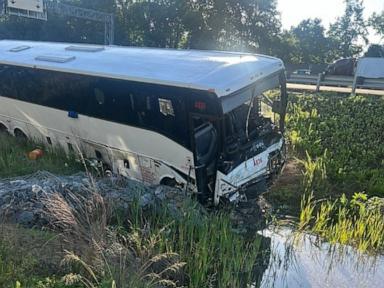
The fatal commercial motorcoach crash on Interstate 95 in Stafford County, Virginia, which resulted in five fatalities and dozens of injuries, exposes a systemic breakdown in the oversight of mass transit safety. While mainstream reporting frames this tragedy as an isolated incident of driver error or a generic failure to adopt safety measures, a rigorous operational analysis reveals a structural disconnect between investigative findings, regulatory mandates, and market incentives.
The core bottleneck in commercial vehicle safety is not a lack of diagnostic insight, but an institutional misalignment: the agency responsible for discovering why accidents happen has zero power to enforce its solutions, while the agency with enforcement power operates under strict cost-benefit constraints that stall implementation for decades. Discover more on a related issue: this related article.
The Bifurcated Regulatory Framework
To evaluate why critical safety technologies remain absent from commercial motorcoaches, one must map the structural friction between the National Transportation Safety Board (NTSB) and the National Highway Traffic Safety Administration (NHTSA). These entities operate under entirely separate mandates, creating an operational chasm where safety recommendations stall indefinitely.
The Pure Safety Mandate (NTSB)
The NTSB operates as an independent investigative body. Its sole objective is to determine the probable cause of transportation accidents and issue recommendations to prevent recurrence. By design, the NTSB is legally insulated from economic considerations. It does not conduct cost-benefit analyses, nor does it factor in the financial viability of its mandates on private industry. However, the NTSB possesses zero regulatory or enforcement authority. Its outputs are strictly advisory. More reporting by NPR delves into similar perspectives on this issue.
The Administrative Cost-Benefit Function (NHTSA)
Conversely, NHTSA is the regulatory body housed within the Department of Transportation (DOT) that holds the authority to promulgate Federal Motor Vehicle Safety Standards (FMVSS). Unlike the NTSB, NHTSA is bound by executive orders and federal statutes requiring rigorous economic scrutiny before any rule becomes law. NHTSA’s decision-making process can be mathematically modeled as a net-benefit optimization problem:
$$NB = \sum (VSL \times \Delta L) - \sum (C_{tech} + C_{maint})$$
Where:
- $NB$ is the Net Benefit of the regulation.
- $VSL$ is the Value of a Statistical Life (a standardized federal metric, currently floating around $12.5 million).
- $\Delta L$ is the expected reduction in fatalities and severe injuries.
- $C_{tech}$ is the capital expenditure of hardware installation per vehicle across the entire domestic fleet.
- $C_{maint}$ is the ongoing operational and maintenance cost imposed on operators.
Under this framework, if the macro-economic cost of equipping every commercial motorcoach in the United States with advanced hardware exceeds the statistical value of the lives saved—weighted by the low probability of catastrophic bus fleet accidents relative to passenger vehicles—the regulation fails to meet the threshold for finalization. This mathematical constraint explains why automatic emergency braking (AEB) and collision-avoidance systems, which became standard on passenger cars years ago, remain in a state of perpetual regulatory delay for commercial buses. A rule requiring these systems was proposed in 2023, yet it remains unfinalized.
The Economics of Fleet Degradation and Labor Exploitation
The underlying mechanics of safety failures cannot be decoupled from the microeconomics of low-margin interstate bus operations. Motorcoach transport frequently relies on high vehicle utilization and compressed labor costs to maintain profitability. This dynamic manifests in two distinct risk vectors: capital asset stagnation and operational labor pressure.
The Capital Expenditure Bottleneck
A new commercial motorcoach requires an initial capital expenditure of approximately $650,000. For small to mid-sized fleet operators running thin margins, the payback period on these assets is prolonged. Macroeconomic interventions, such as a 10% tariff environment on components and vehicles, directly inflate acquisition and maintenance costs.
When capital costs rise, operators defer fleet renewal, extending the operational lifecycle of legacy vehicles. Because advanced safety features like electronic stability control, lane departure warnings, and AEB enter the market primarily through original equipment manufacturer (OEM) integration on new models, a slower fleet turnover rate guarantees that the active national fleet remains technologically obsolete for longer periods.
The Principal-Agent Problem in Fleet Management
A profound misalignment of risk occurs between fleet owners (the principals) and drivers (the agents). Regulatory enforcement and criminal prosecutions frequently target the driver after a catastrophic event. In this instance, the operator faces multiple counts of involuntary manslaughter and reckless driving. However, this legal focus overlooks the structural choices mandated by the corporate hierarchy.
+-------------------------------------------------------+
|                 Corporate Logistics                   |
|  - Sets unyielding route timelines                    |
|  - Manages scheduling and shift allocations           |
|  - Absorbs revenue upside / minimizes capital outlay  |
+-------------------------------------------------------+
                           |
                           v
+-------------------------------------------------------+
|                  Operational Driver                   |
|  - Executes overnight shifts (e.g., 2:30 AM window)   |
|  - Faces binary choice: accept shift or lose income   |
|  - Bears direct liability and criminal exposure       |
+-------------------------------------------------------+
Drivers are price-takers in the labor market; they do not control fleet maintenance schedules, vehicle technology procurement, or route timing. When an operator establishes an overnight route—such as a New York to North Carolina transit operating at 2:30 AM—the driver is placed in a high-risk window for circadian rhythm disruption. The corporate entity captures the economic upside of maximizing vehicle uptime during off-peak hours, while shifting the physical and legal liabilities entirely onto the asset operator.
Human Factors Engineering and Tracking Deficiencies
The physical mechanism of the Virginia crash points directly to driver fatigue and a failure to modulate speed based on environmental conditions. Analysis of court records indicates a pattern of non-compliance: the driver had a prior conviction for operating a motorcoach at 73 mph in a 55 mph zone in 2024, and a subsequent citation in March 2026 for traveling 72 mph in a 50 mph zone. Another driver from the exact same carrier was involved in a major rear-end collision in North Carolina in 2024 under similar conditions of failing to reduce speed.
This repetitive pattern exposes specific breakdowns in the behavioral tracking mechanisms designed to remove high-risk operators from the road.
Chronobiological Realities vs. Electronic Logging Devices
Federal law prohibits motorcoach drivers from driving more than 10 hours or remaining on duty for more than 15 hours without a consecutive 8-hour off-duty rest period. While the transition from paper logbooks to Electronic Logging Devices (ELDs) has reduced overt record manipulation, ELDs possess a fundamental engineering limitation: they only measure compliance with time elapsed, not the quality of rest or the circadian alignment of that rest.
A driver operating at 2:30 AM, five hours into a shift, may be in full compliance with the 10-hour federal limit. Yet, from a human factors perspective, that driver is operating during the circadian trough—the period of peak biological sleepiness. During this window, endogenous melatonin levels are elevated, and core body temperature drops, leading to:
- A geometric degradation of psychomotor reaction speeds.
- Lapses in visual attention known as microsleeps.
- A severely impaired ability to perceive closing distances behind slower moving or stopped traffic.
Without active in-cab driver monitoring systems—such as infrared gaze tracking and steering wheel torque sensors—ELD compliance acts as a false proxy for operational alertness.
Screening and Disqualification Friction
The current statutory framework for commercial driver's license (CDL) suspension fails due to bureaucratic latency and jurisdictional silos. Under Federal Motor Carrier Safety Administration (FMCSA) rules, a CDL holder must be disqualified for 60 days only if they are convicted of two serious traffic violations (including speeding 15 mph or more above the limit) within a three-year window, provided those violations occurred in separate incidents.
The structural failure points in this tracking model are threefold:
- Conviction Lag: There is an operational delay between the issuance of a citation and the final judicial conviction. A driver under a pending citation remains legally permitted to operate heavy passenger vehicles, despite demonstrating a continuous pattern of reckless operation.
- Information Asymmetry: Small, low-cost carriers frequently fail to perform continuous query monitoring on the FMCSA Commercial Driver’s License Information System (CDLIS). They rely on annual reviews, meaning a driver can accumulate critical safety violations in adjacent states without the employing carrier receiving real-time alerts.
- Fragmented State Licensure Compliance: The FMCSA is currently investigating whether state licensing authorities fully adhered to federal verification rules when issuing and maintaining the driver’s commercial credentials. When state DMVs fail to rapidly upload out-of-state convictions to a driver's master record, the regulatory safety net tears completely.
Tactical Strategic Plays for Fleet Operators and Regulators
Resolving these vulnerabilities requires moving away from reactive judicial prosecutions and shifting toward a proactive risk mitigation model. The following plays outline the necessary steps for industry stabilization.
Immediate Closed-Loop Fleet Telematics Deployment
Operators must bypass the slow cadence of federal rulemaking by deploying aftermarket closed-loop telematics systems immediately. These systems must pair dual-facing, AI-enabled cameras with active chassis monitoring.
- Execution: Configure inward-facing optical sensors to track periorbital metrics, blink frequency, and head-tilt angles to detect early-stage fatigue before a microsleep occurs.
- Operational Integration: Link these sensors via cellular telemetry to a central dispatch desk authorized to order mandatory, immediate roadside rest stops if fatigue thresholds are breached, neutralizing the corporate scheduling pressure.
Predictive Risk Profiling Over Annual Checks
Fleet compliance officers must transition from the legally mandated annual driving record check to a continuous, predictive risk scoring model.
- Execution: Integrate third-party driver monitoring software that cross-references state court dockets and real-time citation databases weekly.
- Risk Thresholds: Establish internal corporate triggers that mandate immediate driver suspension or reassignment to non-passenger duty upon a single citation for speeding more than 15 mph over the limit, completely ignoring the lenient 60-day, two-conviction federal statutory grace period.
Decoupling Safety Budgets via Capital Structuring
To mitigate the impact of tariffs and the $650,000 unit replacement cost, operators must separate their safety technology budgets from physical vehicle procurement.
- Execution: Implement a retrofit strategy utilizing modular ADAS (Advanced Driver Assistance Systems) packages that can be installed on legacy chassis. This lowers the capital barrier to entry from a full fleet replacement down to a minor capital expenditure per vehicle, accelerating the deployment of lane-keeping and collision-warning capabilities across older fleets.
This systemic overview demonstrates that the interstate bus industry cannot rely on federal mandates to dictate its survival parameters. The financial penalties of catastrophic failure—measured in liability litigation, soaring commercial insurance premiums, and total business dissolution—outweigh the capital costs of proactive technical and structural adaptation.
NTSB Commercial Bus Investigation Procedures
This report outlines the immediate on-the-scene steps federal investigators take following a catastrophic highway incident to isolate vehicle mechanics from human factors.


