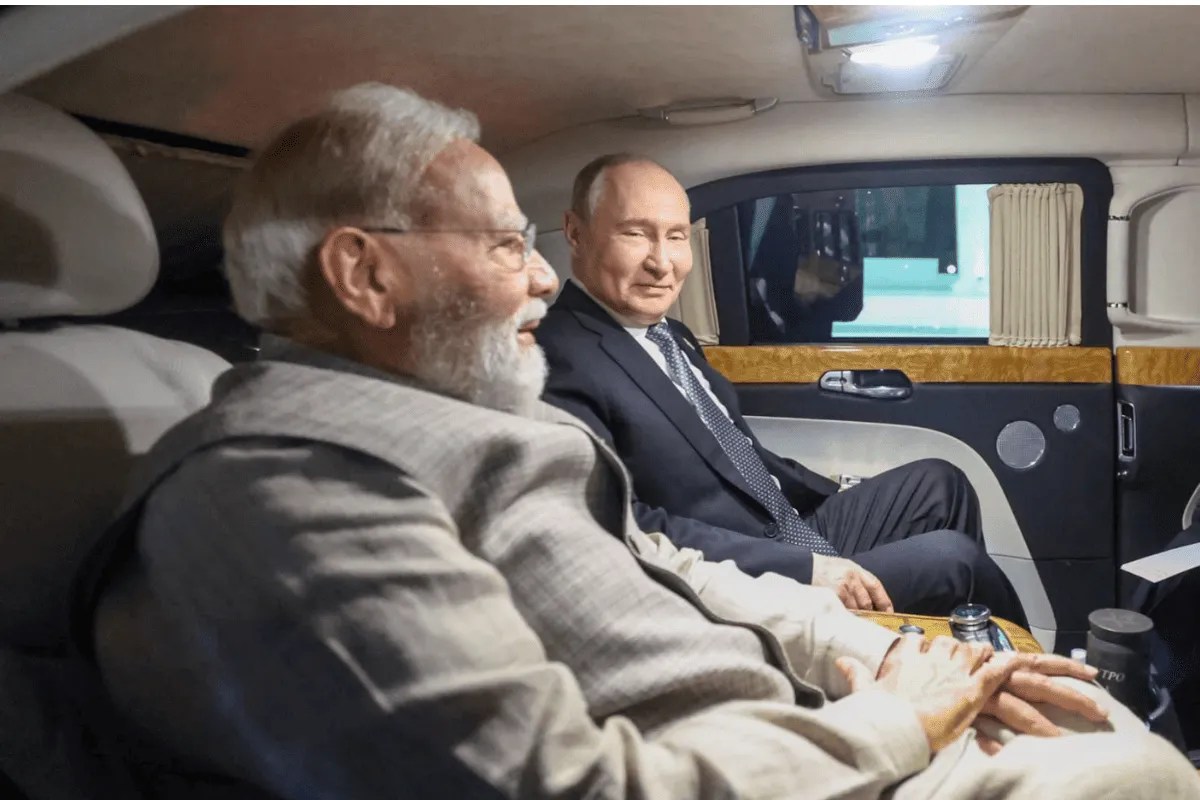
Statecraft often relies on non-verbal signals to communicate strategic alignment or dissent across international borders. Traditional bilateral diplomacy depends on highly choreographed summits, multilateral communiqués, and carefully timed press releases. However, operational constraints in modern media environments have elevated informal visual tokens—such as shared vehicular transit—into primary instruments of geopolitical signaling.
When heads of state bypass motorcade protocol to ride in a single automobile, the action functions as a compressed data packet designed for external intelligence analysts, domestic constituencies, and competing superpowers. Deconstructing this phenomenon requires moving past surface-level media narratives to analyze the structural utility, economic drivers, and security calculations governing these transit choices.
The Architecture of Spatial Diplomacy
Physical proximity in high-security environments is a scarce resource. State leaders operate within heavily guarded bubbles designed to eliminate risk and project absolute institutional control. Bypassing these protective layers to occupy an enclosed cabin alters the power dynamics of a meeting.
Traditional bilateral talks occur across large mahogany tables flanked by bureaucratic delegations, translators, and note-takers. This setting introduces friction, institutional delay, and performative posturing for domestic audiences. Conversely, a closed vehicle strips away bureaucratic mediation.
The spatial mechanics of a shared cabin enforce intimacy. Without a retinue of advisors present, negotiation velocity increases. Sensitive intelligence or pragmatic concessions can be floated without generating an immediate paper trail in ministerial archives.
For instance, repeated transit pairings between Indian Prime Minister Narendra Modi and Russian President Vladimir Putin—ranging from tarmac transfers to summit venues in Tianjin and Bishkek—replace structured conference rooms with unmonitored dialogic space. The elimination of aides alters the cost-benefit matrix of communication, allowing leaders to test policy boundaries directly.
The Cost Function of Protocol Deviations
Standard diplomatic protocols dictate strict adherence to security matrices. State security apparatuses typically prohibit leaders of nuclear-armed nations from sharing transit vectors to mitigate catastrophic single-point-of-failure risks. When these protocols are deliberately suspended, the implicit diplomatic cost function shifts.
The decision to ride together involves three distinct variables:
- Security Vulnerability: Elevating physical risk by concentrating high-value targets into a single chassis.
- Signaling Intensity: Broadcasting an unshakeable bilateral bond to external adversaries and sanction-imposing bodies.
- Protocol Friction: Overridding domestic and foreign security details that demand separate, heavily armored motorcades.
When Vladimir Putin utilized a vehicle alongside Narendra Modi during international summits, or when Modi broke protocol to receive him in domestic transit setups, the diplomatic yield outweighed the operational risk.
External actors, particularly Western security and trade blocs monitoring sanction compliance on Russian energy imports, interpret these optics as an explicit rejection of diplomatic isolation. The visual of two leaders bypassing independent armored transport for a shared ride communicates economic and strategic resilience that formal communiqués frequently fail to convey.
Asymmetric Signaling in Multilateral Forums
Multilateral summits like the Shanghai Cooperation Organisation function as competitive arenas where middle powers and major states vie for narrative control. In these settings, a formal meeting is routine; a shared transit arrangement is exceptional.
By converting routine transit into a media event, leaders manufacture breaking news cycles that eclipse competing agendas at the summit. The choice of vehicle matters as a secondary data point. Whether utilizing a host nation's infrastructure, a domestic utility vehicle, or an imported presidential limousine, the choice dictates the narrative tone.
The absence of third-party negotiators inside the vehicle ensures that the content of the discussion remains strictly bilateral, insulating the participants from immediate leaks or premature media speculation. This operational secrecy serves leaders navigating complex multi-alignment strategies, allowing them to balance competing global partnerships without alienating opposing economic blocs.
Strategic Execution Matrix
State actors aiming to decode or replicate this mode of high-level signaling must evaluate three operational parameters before initiating informal transit coordination:
- Threshold Assessment: Determine whether current bilateral tensions justify a high-visibility breach of standard security protocol. If institutional trust is low, the physical vulnerability outweighs the optical gain.
- Audience Segmentation: Identify the primary target of the signal. If the goal is to deter secondary economic sanctions or signal strategic autonomy to external trade partners, the transit must occur in plain sight of international press pools.
- Deniability Calibration: Utilize the unrecorded nature of the transit to test policy positions that require testing before formal bureaucratic adoption.
Informal transit arrangements will remain a permanent fixture of executive statecraft. As formal multilateral institutions face gridlock, the most consequential diplomatic negotiations are increasingly conducted away from the negotiating table, mediated entirely by spatial proximity and calculated informality.



