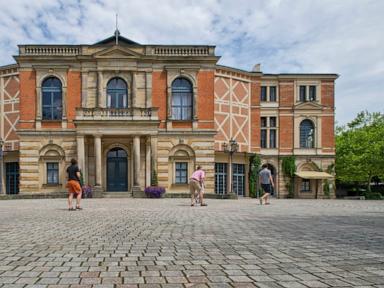
Artistic tradition operates under strict social contracts. When the Bayreuth Festival—the bastion of Wagnerian orthodoxy—introduced artificial intelligence to assist with stage direction and visual staging, the resulting audience hostility was not a random outburst of luddism. It was a predictable systemic rejection. The integration of machine intelligence into a medium defined by human interpretive friction exposes a fundamental mismatch between computational optimization and theatrical meaning-making.
To understand why the experiment drew immediate boos, one must deconstruct the operational economics of opera production, the mechanics of directorial authorship, and the specific failure modes of algorithmic design when applied to high-culture performance art. Also making waves lately: Why Everything You Know About Asian American Art is Wrong.
The Production Function of Opera Staging
Traditional opera staging relies on a high-friction, multi-variable production function. A director, a set designer, and a lighting crew negotiate a physical space over weeks of rehearsal. Every cue, movement, and visual metaphor is manually calibrated to match the musical score and the acoustic properties of the Festspielhaus.
When computational tools enter this workflow, they disrupt three distinct operational layers: More details regarding the matter are detailed by The Hollywood Reporter.
- The heuristic layer: The intuitive leaps a human director makes by sensing the psychological state of the performers in a physical room.
- The execution layer: The manual synchronization of lighting, projections, and mechanical scene changes with the live orchestra.
- The economic layer: The reduction of rehearsal hours through predictive spatial modeling and automated generation of visual backdrops.
The conflict at Bayreuth arose because the algorithmic intervention attempted to optimize the economic and execution layers while fundamentally degrading the heuristic layer. Machine learning models predict patterns based on historical data. Opera direction, particularly in contemporary Regietheater, relies on subverting historical patterns to create friction and contemporary relevance. An algorithm trained on past productions outputs statistical averages of theatrical choices. In a festival dedicated to monumental, singular artistic visions, statistical averaging reads as creative sterility.
The Three Failure Modes of Automated Direction
The negative audience response highlights specific vulnerabilities when computational systems cross from administrative support into creative decision-making.
1. The Semiotic Mismatch
Algorithmic generation excels at interpolation. Given a dataset of Wagnerian motifs, a generative model can produce infinite variations of swords, Valhallas, and mystical forests. However, these visuals operate on statistical correlation rather than semiotic intent. When a human designer places a modern chair on a classical stage, it is a deliberate semiotic provocation. When an algorithm places an object based on contextual probability within a training set, the object loses its rhetorical weight. It becomes visual noise rather than argument.
2. The Temporal Disconnect
Live performance is defined by its unforgiving real-time latency. A conductor breathes with the orchestra; a singer holds a high note an extra beat to ride an acoustic wave. Algorithmic staging systems, particularly those controlling projections or automated lighting cues based on audio analysis, operate on fixed processing loops. Even with low latency, predictive rendering cannot account for the micro-fluctuations of a live performance. This creates a perceptible stutter between human artistic expression and computational response, shattering the suspension of disbelief.
3. The Authorship Vacuum
Audiences at elite cultural institutions consume authorial intent. The boos at Bayreuth were directed not just at the visual output, but at the perceived abdication of human responsibility. When a staging choice fails to resonate, audiences engage in a critical dialogue with the creator. If the creator is an algorithmic pipeline tuned by engineers, that dialogue collapses. Accountability vanishes into a black box of hyper-parameters and training sets.
The Economics of Cultural Resistance
Why do audiences at heritage festivals react with such hostility to technical modernization, while welcoming it in commercial cinema or pop music? The answer lies in the asset class of the experience.
Commercial entertainment operates on a maximization of novelty and visual spectacle. In that domain, generative tools lower production costs while satisfying consumer demand for high-fidelity eye candy. Heritage high art, conversely, trades on scarcity, human suffering, and authorial struggle. The value of a Bayreuth production is directly correlated with the perceived difficulty and singularity of its human realization.
When computational tools make staging easier or faster, they devalue the asset. The audience perceives the intervention not as an elevation of the art form, but as a cost-cutting measure disguised as innovation. The economic incentive of the festival administration—reducing overhead and rehearsal friction—directly opposes the economic incentive of the ticket holder, who pays premium prices for scarce human genius.
Systemic Integration vs. Creative Substitution
The failure of the Bayreuth experiment offers a clear boundary condition for technology in the arts. Tools that expand human physical capability—such as advanced acoustic mapping, better weight distribution in stage rigging, or digital score archiving—succeed because they respect the locus of artistic authority.
Tools that attempt to automate interpretive choices fail because interpretation is not an optimization problem. An optimization problem has a clear objective function: minimize cost, maximize throughput, reduce error. Art has no objective function. Its value is generated precisely by its inefficiencies, its contradictions, and its stubborn adherence to human subjectivity.
Strategic Outlook for Cultural Institutions
Administrators seeking to integrate computational systems into performance art must abandon the premise of creative automation. Instead of deploying models to generate staging concepts or direct visual narratives, organizations should redirect technical talent toward internal operational logistics. Predictive models can optimize backstage crew scheduling, track acoustic anomalies across complex seating geometries, and model crowd flow during intermissions.
Creative direction must remain strictly analog. The moment a festival delegates the conceptual weight of a production to a machine, it ceases to be a dialogue between living minds and becomes an exhibition of software capabilities. The audience at Bayreuth proved that they are willing to endure radical, baffling, and even offensive human choices, but they will actively reject the sterile efficiency of an algorithmic proxy.