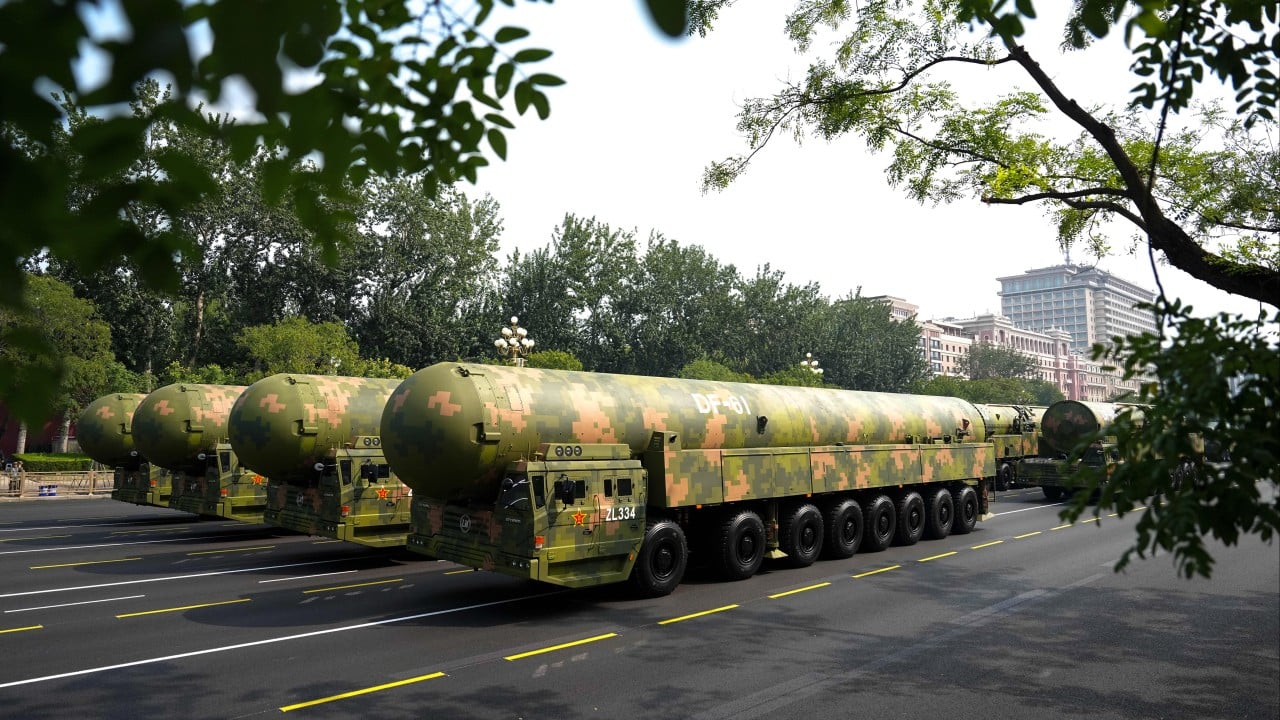
Yes, China is getting faster at integrating new nuclear missiles into its operational forces. Much faster.
If you still picture the People's Liberation Army Rocket Force (PLARF) as a slow-moving bureaucracy that takes a decade to field a single weapon system, your mental model is outdated. Over the last few years, Beijing hasn't just been building more warheads and digging holes in the desert. They've fundamentally changed how quickly a missile goes from a factory floor in Inner Mongolia to an active combat brigade ready to launch.
Most coverage fixates on the raw numbers. You've probably seen the headlines quoting Pentagon reports about China crossing the 600-warhead mark and racing toward 1,000 by 2030. Counting warheads is easy. Watching a military overhaul its entire training, logistics, and command pipeline to absorb those weapons at breakneck speed is harder—and honestly, it matters way more.
Why Integration Speed Matters More Than Raw Numbers
Building a missile is an engineering problem. Integrating that missile into a fighting force is a human, logistical, and doctrinal nightmare.
Think about what actually has to happen before a new intercontinental ballistic missile (ICBM) becomes a credible deterrent. You can't just park a shiny new DF-41 transporter-erector-launcher (TEL) in a garage and call it a day. Crews need years of muscle memory to drive massive 16-wheel vehicles over rough terrain in the dark. Maintenance teams have to learn how to troubleshoot solid-fuel stages and sensitive guidance electronics without blowing themselves up. Command centers need updated communications links to ensure launch orders actually reach the field under heavy electronic jamming.
Historically, the PLARF took a cautious, step-by-step approach to this. A new missile would enter service with a single test brigade. They'd spend years writing the manuals, ironing out mechanical bugs, and slowly training instructors before rolling the system out to other bases.
That slow-burn era is dead.
Satellite imagery analyzed by researchers at the Federation of American Scientists (FAS) and the James Martin Center for Nonproliferation Studies (CNS) shows a dramatic shift. New brigades are standing up simultaneously across multiple bases. Instead of waiting for one unit to master a system before equipping the next, China is fielding missiles, training crews, and building support infrastructure in parallel.
The Three Engines Driving Beijing's Speed
How did they compress a decade-long process into just a few years? It comes down to three major structural shifts inside the Chinese military-industrial complex.
1. Standardized Hardware and Modular Designs
In the past, every new Chinese missile felt like a bespoke science project. Liquid-fueled missiles like the older DF-5 variants required complex fueling trucks, specialized oxidizer handling crews, and hours of agonizing prep time before launch.
Modern systems like the road-mobile DF-41 and the silo-based variants rely heavily on solid-fuel propellants and canisterized launches. A canisterized missile sits inside a sealed, climate-controlled tube from the moment it leaves the factory. Crews don't touch the missile itself. They load the entire tube onto a launcher or drop it into a silo.
Because the DF-31AG and DF-41 share common design philosophies and modular components, a crew trained on one solid-fuel road-mobile system can transition to a newer variant in months rather than years. The learning curve flattened overnight.
2. Aggressive Expansion of Training Facilities
You can't train twice as many missileers using the same old classrooms. Between 2020 and 2025, commercial satellite imagery revealed a massive construction boom at PLARF training bases, notably around Jilantai in Inner Mongolia.
Researchers spotted mock-up missile silos, new vehicle garages, and expanded road networks built specifically for realistic field exercises. By replicating exact operational environments at centralized training hubs, the Rocket Force decoupled crew training from actual missile delivery. New recruits learn the ropes on high-fidelity simulators and training rigs while their actual operational missiles are still rolling off the assembly line. When the real hardware arrives at the brigade, the crews are already certified.
3. Civil-Military Fusion in Logistics
China's "Military-Civil Fusion" strategy gets thrown around as a buzzword, mostly regarding artificial intelligence and hypersonics. In the Rocket Force, its biggest impact is mundane: supply chains and heavy transport.
Moving giant ICBMs across China requires reinforced bridges, specialized heavy-duty tires, commercial rail networks, and nationwide maintenance depots. Beijing integrated civilian heavy-manufacturing firms directly into the PLARF's logistics backbone. Instead of relying solely on closed military workshops, missile bases tap into China's massive domestic commercial industrial base for routine vehicle parts, diagnostics, and transport support. Fewer bottlenecks mean higher readiness rates.
The Silo Fields Changed the Game
Nothing illustrates this accelerated timeline better than the three massive missile silo fields discovered in 2021 near Yumen, Hami, and Hanggin Banner.
When analysts first spotted hundreds of identical inflatable domes covering excavation sites in western China, plenty of skeptics argued these were decoys—a modern version of the Cold War "shell game" designed to soak up American warheads.
They were wrong.
Subsequent Pentagon assessments and high-resolution satellite monitoring confirmed that China wasn't just digging empty holes. They were rapidly installing launch infrastructure, command bunkers, and security perimeters across roughly 320 new silos. Even more surprising was the speed at which the first units began loading missiles into these fields.
Building 300+ silos takes concrete and steel. Staffing, securing, and integrating 300+ silos into a unified nuclear command-and-control network requires an organizational sprint. To pull this off without grinding the rest of the military to a halt, the PLARF split existing brigades—a process analysts call "budding." An established missile brigade divides its experienced officers and senior enlisted technicians in half, using them as the core leadership for a brand-new unit while filling out the ranks with fresh academy graduates. It's messy, and it stretches experience thin, but it doubles your operational footprint in record time.
The Hidden Friction Behind the Curtain
If you only read threat assessments, you'd think the PLARF is an unstoppable machine. Reality is a lot messier. Rapid expansion always breaks things, and China's nuclear force is dealing with severe growing pains.
Look at the massive corruption purges that rocked the Rocket Force starting in 2023 and spilling well into 2024 and 2025. Top commanders, including former Defense Ministers and the heads of the PLARF itself, were abruptly removed from office. Reports surfaced detailing compromised equipment, rushed construction standards, and systemic graft in procurement contracts.
When you throw billions of dollars at rapid expansion and demand immediate results, corners get cut.
There's also the human bottleneck. You can manufacture a solid-fuel rocket motor in a few weeks, and you can pour concrete for a silo in a few months. You cannot manufacture a seasoned battalion commander with 15 years of tactical judgment overnight. By splitting brigades to staff new units, the PLARF diluted its pool of veteran operators. Young officers are being promoted into command slots faster than ever, often managing complex, high-alert nuclear systems with a fraction of the field experience their predecessors had.
Command and control is another massive hurdle. Integrating hundreds of new launch platforms into a coherent early-warning and launch-on-warning posture requires flawless communications. China has spent heavily on space-based infrared early-warning satellites and hardened fiber-optic networks, yet coordinating a dispersed force across thousands of miles of rugged terrain remains a monumental challenge during a crisis.
What Most People Get Wrong About China's Nuclear Posture
A common misconception is that faster missile integration automatically means China is abandoning its long-standing "No First Use" (NFU) policy.
It doesn't. At least, not officially, and not necessarily in practice.
China's leadership has always viewed its nuclear arsenal primarily as a political tool to prevent coercion and guarantee a devastating second-strike capability. For decades, Beijing believed a small, hidden force of a few dozen ICBMs was enough to deter the United States.
That calculation changed because of two things: improving U.S. missile defense networks and breakthroughs in precision conventional strike capabilities. Chinese strategists worried that a small arsenal could be wiped out in a surprise first strike, or mopped up by American interceptors.
Speeding up the integration of new, survivable missiles—especially road-mobile systems like the DF-41, submarine-launched JL-3s, and hardened silo fields—is Beijing's way of ensuring its deterrent survives. They aren't necessarily building a force to fight a tactical nuclear war; they're building an arsenal big enough and integrated tightly enough that no adversary can ever calculate a successful disarming strike.
How to Track This Yourself
You don't need a top-secret clearance to follow how fast China's nuclear forces are evolving. Open-source intelligence (OSINT) has completely democratized nuclear monitoring. If you want to cut through sensationalist headlines and see what's actually happening on the ground, pay attention to the primary sources that track these deployments in real time.
Start by reading the annual Nuclear Notebook reports published by Hans Kristensen and Matt Korda at the Federation of American Scientists in the Bulletin of the Atomic Scientists. They break down base-by-base expansions, brigade numbering changes, and satellite confirmations without the political spin.
Pair that with the Department of Defense's annual China Military Power Report. Read past the executive summary and look at the specific force structure tables comparing year-over-year launcher counts—not just warhead totals. Launcher counts tell you how fast operational brigades are actually absorbing hardware.
Finally, keep an eye on researchers at the Middlebury Institute's James Martin Center for Nonproliferation Studies and independent geospatial analysts on platforms like X and Substack. When new training mock-ups appear in Inner Mongolia or new barracks pop up next to a missile base in Qinghai, those are the folks who spot it first—and that physical footprint on the ground is the truest measure of how fast China's nuclear force is actually growing.


